
Bill would clarify protections for hotels housing homeless
Trending
Legislation introduced late in the state legislative session could, if passed, provide clarity about tenant rights for the homeless who are being placed in hotels.
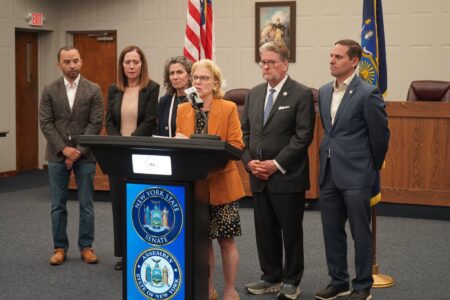
A.11492/S.10464, sponsored by Assemblywoman MaryJane Shimsky, D-Tarrytown, and Sen. Shelley Mayer, D-White Plains, would amend state law to provide criteria that would help determine if an individual is a transient occupant of a hotel or a tenant who would qualify for protection under state law. Shimsky and Mayer said current state law says hotel guests who remain in occupancy for 30 days or longer would be considered tenants for purposes of landlord-tenant law. While current law excludes “transient occupants” from the definition of tenant, that term is not defined in statute, resulting in inconsistent application and uncertainty for courts, hotels and guests around the state.
Several hotels in Chautauqua County have been used to house the homeless. Homeless individuals and families placed in hotels by a county’s Social Services department do not qualify for standard residential landlord-tenant protections because hotels and motels are explicitly exempt from standard protections like the Housing Stability and Tenant Protection Act and the Good Cause Eviction Law. Shimsky and Mayer said they aren't proposing changing those guidelines, but want to provide guidance because they say the law is unclear and could be construed to extend tenant protections to the homeless. If that happened hotels wouldn't be able to evict the homeless without demonstrating good cause.
"This ambiguity has created operational and legal challenges for hotels throughout the state," Mayer and Shimsky said in their legislative justification. "Hotels are intended to provide temporary lodging, yet under current law some guests occupying rooms for extended periods may acquire tenancy protections despite the absence of a lease, traditional residential arrangements or an intent to establish permanent residence. This bill would provide greater clarity and consistency by defining criteria for courts to consider when determining whether someone is a transient occupant."
The bill directs courts to consider the totality of the circumstances, including whether the person maintains a primary residence elsewhere, maintains signs of residence at another location, the location of the person’s employment or principal place of business, the purpose of the hotel stay, and any other indicia demonstrating that the premises are being used for temporary lodging.
"The bill does not exclude all long-term hotel guests from tenant protections, nor does it eliminate judicial discretion. Rather, it establishes a clearer statutory framework to distinguish between individuals using hotels for temporary accommodations and individuals functioning as residential tenants. Providing clearer standards will assist courts in making more consistent determinations and help ensure that hotels are able to operate effectively while preserving appropriate legal protections for those whose use of the premises is residential in nature."
At the same time, state Office of Temporary and Disability Assistance officials are considering a regulation that would require counties to extend services found in homeless shelters to the hotels being used to shelter the homeless. A 60-day public comment period began in late January, but there is no public record that the Part 902 regulation, as it is known, has advanced beyond accepting public comment.
The regulation was proposed after a ProPublica and New York Focus investigation earlier this year found hotels are the state’s most typical response to homelessness in counties outside of New York City. The proposed OTDA regulations would require counties to submit to OTDA plans showing how a county would provide support services, enforce limits on overcrowding and ensure children aren’t sharing beds with adults. Services that typically aren’t provided in hotel settings include serving breakfast and dinner, connections to health services, supervision services and staffing minimums. Some counties are providing services to the homeless in hotels. Supporters of the proposed OTDA regulations say families might not have to stay in hotels as long if they are provided more support.