Rally Remembrance: Clymer unveils historic marker for 1872 Grant for President event
Clymer unveils historic marker for 1872 Grant for President event
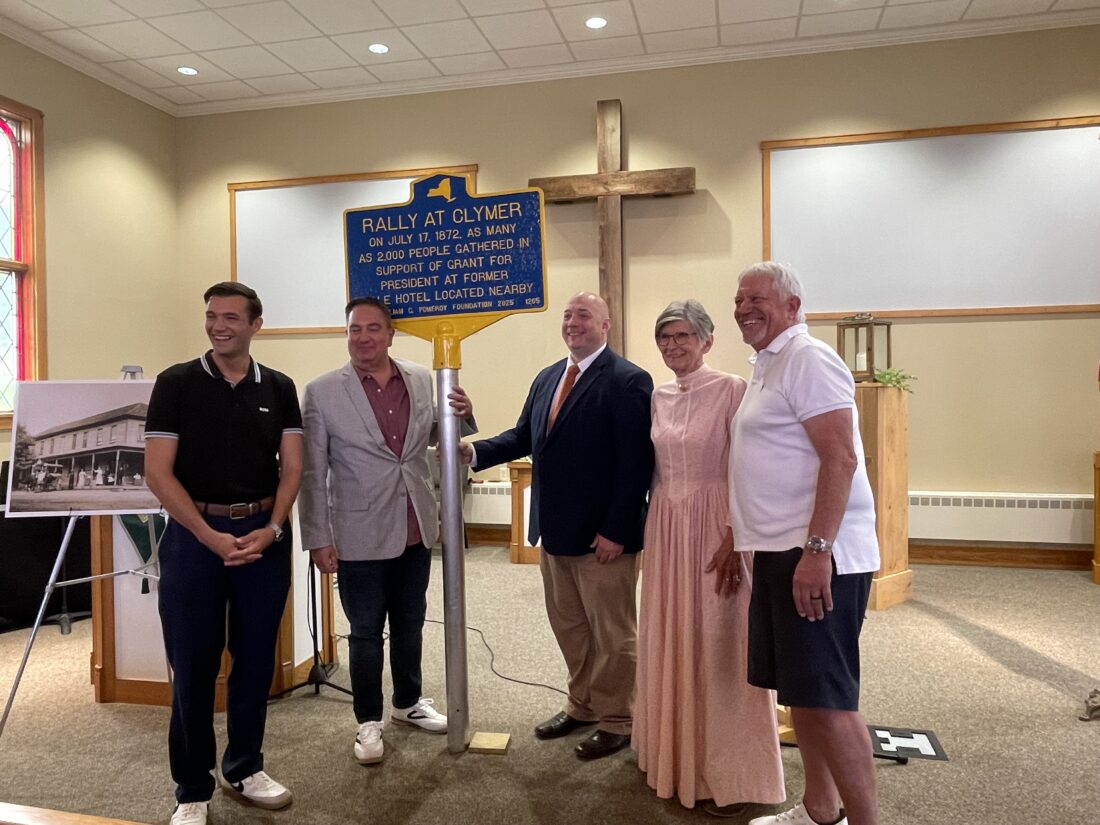
Pictured left to right is the representative for Assemblyman Andrew Molitor and Congressman Nick Langworthy, Senator George Borrello, town councilman Levi Swanson, town historian Cindy Willink and Historical Society president Rod Beckerink with the new historic marker. P-J photo by Sara Holthouse
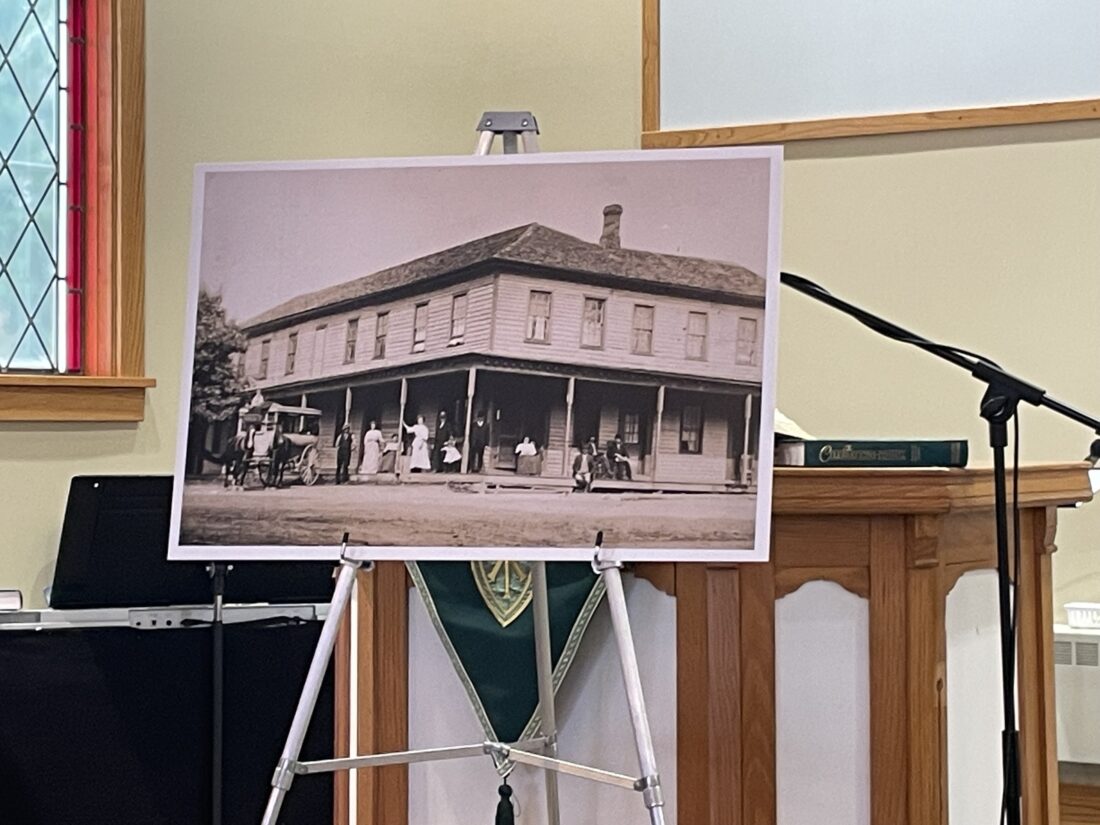
Pictured is the town of Clymer’s former Eagle Hotel, where the 1872 rally for Grant For President was held. P-J photo by Sara Holthouse
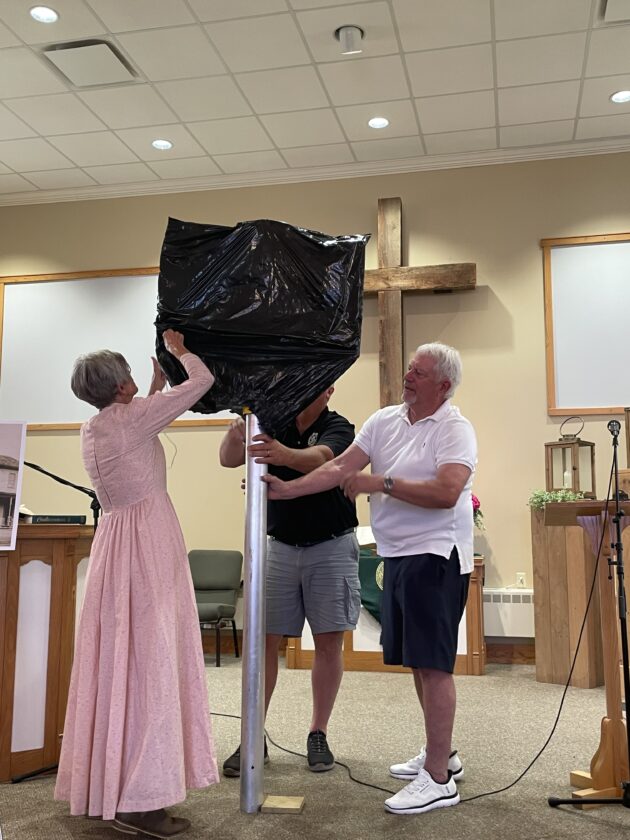
Town Historian Cindy Willink and Historical Society President Rod Beckerink unveil the town of Clymer’s new historic marker with the help of Scott Trisket, Highway Superintendent. P-J photo by Sara Holthouse
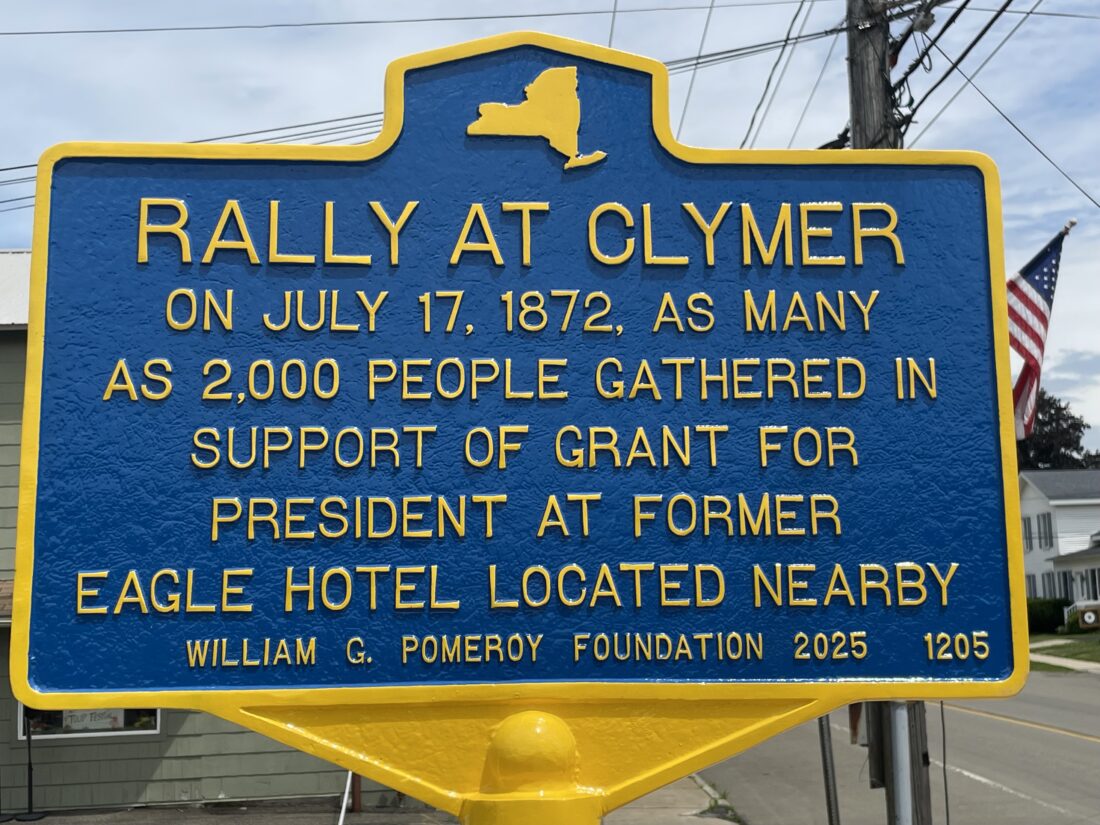
The town of Clymer’s new historic marker, detailing the 1872 rally for Grant For President. P-J photo by Sara Holthouse
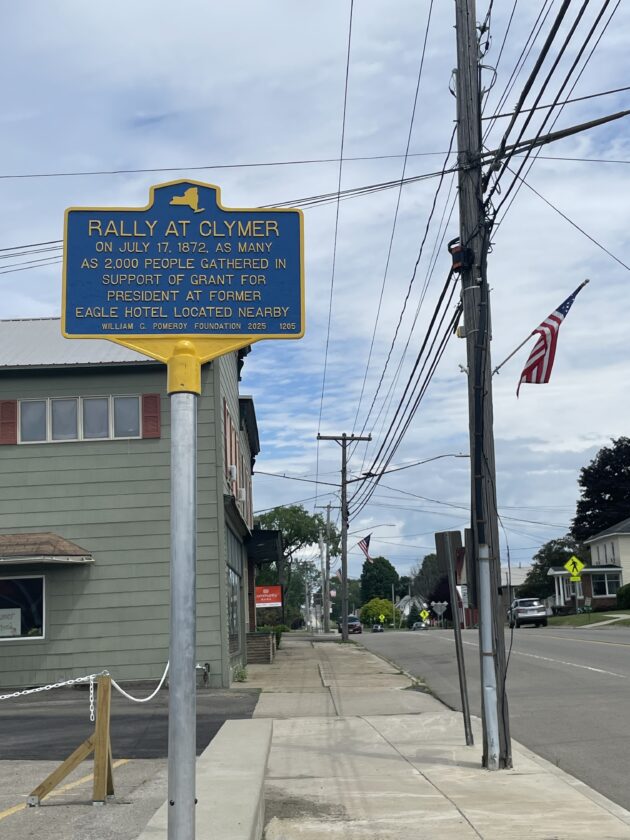
The new historic marker stands on the retaining wall in the parking lot at the center of the town of Clymer. P-J photo by Sara Holthouse
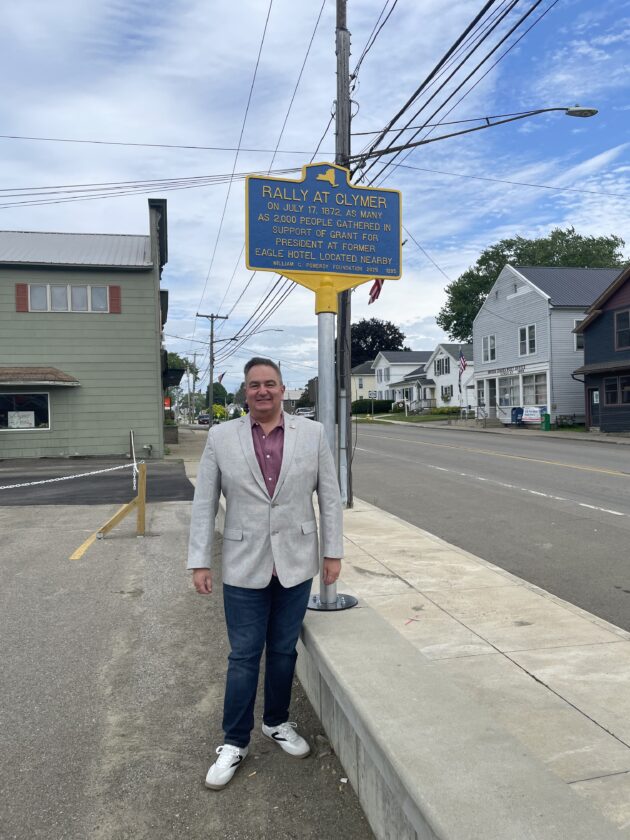
Senator George Borrello stands next to the town of Clymer’s new historic marker in its official place on the retaining wall in the parking lot. P-J photo by Sara Holthouse
Pictured left to right is the representative for Assemblyman Andrew Molitor and Congressman Nick Langworthy, Senator George Borrello, town councilman Levi Swanson, town historian Cindy Willink and Historical Society president Rod Beckerink with the new historic marker. P-J photo by Sara Holthouse
Pictured is the town of Clymer’s former Eagle Hotel, where the 1872 rally for Grant For President was held. P-J photo by Sara Holthouse
Town Historian Cindy Willink and Historical Society President Rod Beckerink unveil the town of Clymer’s new historic marker with the help of Scott Trisket, Highway Superintendent. P-J photo by Sara Holthouse
The town of Clymer’s new historic marker, detailing the 1872 rally for Grant For President. P-J photo by Sara Holthouse
The new historic marker stands on the retaining wall in the parking lot at the center of the town of Clymer. P-J photo by Sara Holthouse
Senator George Borrello stands next to the town of Clymer’s new historic marker in its official place on the retaining wall in the parking lot. P-J photo by Sara Holthouse
Trending
CLYMER -- When people drive through the town of Clymer, they now can see a new historic marker placed on the wall alongside the parking lot at the center of town.
The marker, detailing the 1872 rally where about 2,000 people gathered in support of Grant For President, was unveiled Sunday during a short ceremony.
While the marker is placed at the parking lot, the Sunday afternoon unveiling ceremony took place at the Clymer Methodist Church due to the impending thunderstorm. Rod Beckerink, Clymer Area Historical Society president, welcomed attendees to the event, and town historian Cindy Willink gave the crowd a brief history of Flag Day, as Sunday was also Flag Day. Flag Day commemorates the adoption of the flag of the United States on June 14, 1777.
The history of the day commemorated by the town's new historic marker was then talked about by Beckerink. The rally was held at the town's former Eagle Hotel, which used to stand where the parking lot is now.
"If we were standing over across the street in the parking lot I'd ask you to imagine the hotel that you see in this poster being the center of what we're talking about today, the gathering place of this event that took place back in the summer of 1872," Beckerink said. "The hotel was built around the Civil War and would stand until right before World War I."
Over the years, the hotel was host to New Year's Balls and other festive gatherings, with a ballroom on the second floor. Beckerink said anything that happened in town would most likely have seen the hotel being used, event wise.
COMING TO CLYMER
The summer of 1872 was a presidential election year, with President Ulysses S Grant running for reelection. At that time, Beckerink said, the Republican Party was facing some turmoil and had split over issues such as the Civil War and corruption, with some looking to clean it up. New York Gov. Reuben Fenton of Jamestown was one of the leaders of the split looking to clean up the party, and along with him was Horace Greeley, who Beckerink said was the editor of the New York Tribune in New York City, and who had his own connections to the town of Clymer.
"Greeley would end up being the candidate that Grant would oppose," Beckerink said. "Greeley had his Clymer connections, with his parents living just up on Spirit Hill, just across the border into Pennsylvania, but his address was Clymer. He would visit here many times in the 1830s and 1840s to visit his parents."
Even though Greeley had his connections to the town, the 1872 rally saw around 1,500 to 2,000 people turn out to support Grant's reelection. Beckerink added that one townsperson, Cordelia Hinckley, whose home was kitty-corner to the Eagle Hotel, was also there that day. Willink then read some observations to those in attendance, as Hinckley, imagining what she most likely saw that day, based on the historical society's research. Hinckley's husband, Otis Hinckley, was also chairman of the rally. Willink's Hinckley observations included Hinckley coming with her daughters, the size of the crowd, having both the Panama band and Sherman cornet band, which was known as "the best band in the county".
"There are wagons everywhere," Willink said. "Some people even rented rooms in the hotel so they could have a better view. Look, I think I see Horace Greeley's brother in the second story window. The Honorable Walter Sessions will be speaking in support of Grant For President, and he is also running for New York State Assembly. I can't wait to hear what the Jamestown Journal has to write about this event. It could be an event that goes down in history."
A COMMUNITY STORY
Following Willink, Beckerink acknowledged the work that both Willink and another prominent Historical Society member and former town historian, Sue Rhebergen put into the project to get this new historic marker for the town. Some elected officials in attendance also spoke on the town getting the marker, including Town Councilman Levi Swanson.
"It's moments like this that remind us that history is not just found in books, in big cities, or marble buildings," Swanson said. "History can be found in our own streets, in front of familiar buildings, among ordinary people who showed up because they believed that moment mattered. This marker helps us remember that Clymer has always been more than just a dot on a map. We are a community with a story; a story worth preserving, a story worth passing on."
Swanson acknowledged the town's gratitude to the historical society for helping to bring the marker to life, saying that projects like this only happen because people care enough to bring them to life. Swanson also read the official proclamation for the historical marker from the William G Pomeroy Foundation.
Other elected officials who spoke included Senator George Borrello and a representative of Assemblyman Andrew Molitor and Congressman Nick Langworthy.
"This is really a great day and I'm glad to be here, because so much significant history has taken place here in Chautauqua County," Borrello said. "To think of a community like Clymer being host to this event is really significant, and to hear the fact that you had a hometown boy running against the President of the United States, and you see that clash, that conflict, that also led to gathering people here in this community for that specific purpose."
Following the elected officials remarks, the marker was officially unveiled in the Methodist Church, before being taken back across the street by Clymer's Highway Department to be placed back in its official home on the retaining wall in the parking lot.
'LABOR OF LOVE'
In speaking with the Post-Journal after the event wrapped up, Willink spoke a little on the process and having to do research into the event to prove it happened, including using articles from the Jamestown Journal. She added that the Historical Society was actually awarded the marker a year ago in June and it has been a process to get everything together and placed.
Willink said that the Pomeroy Foundation is very particular about everything that goes into being awarded a historical marker, such as being completely sure all facts are correct. There was also a limit on the number of words that could be put on the marker, around 27 words.
"So when you see a marker, you know that information is right," Willink said.
Beckerink talked a bit more on the history behind the 1872 election, including the split in the Republican party. He said while Grant himself was a popular president, his administration received a lot of criticism because of accusations of corruption and patronage, where political offices or government jobs were sold for money.
"That's what was interesting about this, in spite of that, calls for the liberal Republican party, which really was the candidate, the town and rest of the country still voted overwhelmingly for Grant in the 1872 election," Beckerink said. "I think it was like a two to one margin he won that election. That was really seen in the amount of people that turned out at this rally, 1,500 to 2,000 people at this rally for Grant in the little town of Clymer."
Beckerink noted that this being in 1872 that amount seems like a lot, and had to be almost everyone in town, though he did not know the exact number of the census at that time.
Rhebergen said that getting the marker and being able to put it up is a "dream come true," after all of the work she and Willink and the historical society put into it.
"A lot of hard work and perseverance went into it," Rhebergen said. "After many years of research, checking facts, making sure the facts were straight ... It’s just a labor of love to make a dream come true."