
Businesses eyeing cleaned up Brownfield sites in city
Trending
Federal help is continuing to come in for remediation and redevelopment of the former Crawford Furniture manufacturing site in Jamestown as well as additional sites in the city.
Jamestown is slated to receive $1 million, U.S. Sens. Chuck Schumer and U.S. Senator Kirsten Gillibrand announced Wednesday, in federal support to help assess, clean up, redevelop, and reuse contaminated and abandoned properties. The money is from the Bipartisan Infrastructure & Jobs Law allocated through the Environmental Protection Agency's Brownfields Program.
Grant funds in Jamestown will be used to conduct up to six Phase I and up to six Phase II environmental site assessments and support cleanup and reuse planning and community engagement activities. Four of the sites are mentioned in the city's application for federal funding as sites for existing companies to expand once the sites are environmentally ready.
CRAWFORD SITE
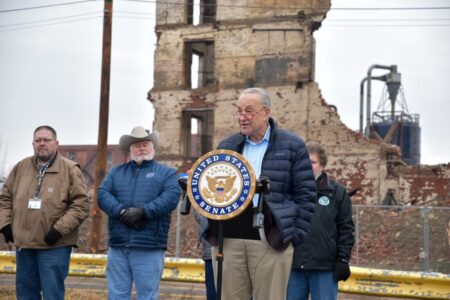
In 2023 Schumer helped lead an effort for the EPA to clean up toxic debris left behind by a 2022 fire at the Crawford Furniture site at 1061 Allen St. Schumer first visited the site in January 2023 and outlined his plan, which called for the EPA to bolster their presence at the site and coordinate with Jamestown to demolish what was left standing of the Crawford buildings, dispose of asbestos and asbestos-containing debris, and decontaminating materials from the site that can be set aside for recycling.
The former Crawford site is the first priority site for the federal money. The EPA completed remediation at the site in September 2024, with the parcel clear of structures though it is still vacant and unimproved. The site is a priority because it is highly visible, is adjacent to an existing furniture manufacturer that has expressed interest in expansion and can therefore convert a former high-risk Superfund property into a job-producing, tax-generating industrial facility.
"From Utica in the Mohawk Valley to Western New York and beyond, New York has had too many toxic eyesores and contaminated sites from our industrial past that drive down property values and put public health at risk. I'm proud to announce that thanks to $14 million in federal investments from the Bipartisan Infrastructure & Jobs Law I led to passage in the Senate, we can accelerate the cleanup and reuse of New York's contaminated eyesores. This support will make our communities healthier and cleaner, all while creating good-paying jobs and new development opportunities that enhance local tax rolls," Schumer said. "The Brownfields program has had tremendous success in transforming sites like these into areas of new growth and will supercharge cleanup and redevelopment efforts at lots in every corner of New York. I am proud to deliver this federal investment to revitalize our communities and will always fight for a brighter and cleaner future for New York's communities."
The other priority sites are 251 Harrison St., 289 Harrison 133 Winsor St. and a pool of city-owned sites at 929 Monroe St., an unaddressed 1 acre plot on Monroe Street, 512 W. 10th St., 1001 Monroe St. and a seven-tenths of an acre site on West 11th Street.
“These parcels are strong candidates for expanded waterfront/green space, trail and riverwalk connections, and neighborhood‑serving commercial or residential uses, subject to confirmation of environmental conditions,” the city’s grant application states. “If funds remain after work at the four primary sites, the city will first advance these secondary parcels, and then any other candidates in the BOA corridor, using a consistent process.”
HARRISON, WINSOR STREET PROPERTIES
251 Harrison St. was once a textile mill from 1867 to 1881 before transitioning into uses by a plating company, chemical company, dry cleaning facility, and multiple metalworking operations. The property once contained a manufacturing complex that underwent phased demolition from 1988 to 1999; it is
now vacant. Historic uses suggest potential impacts from solvents, degreasers, dry cleaning fluids, volatile organic compounds, petroleum products, thinners, metals, cyanide, acids, and bases. Regulatory records indicate that the site was listed as a large‑quantity hazardous waste generator in the early 1990s. NYSDEC inspections of the last recorded tenant, Watson Manufacturing Co., documented serious noncompliance with hazardous waste regulations.
The site is vacant land with likely residual subsurface contamination and is
strategically located near the riverfront and adjacent neighborhoods. The city’s grant application states an adjacent manufacturer has expressed interest in expanding onto the site, possibly as part of a project that includes properties at 289 Harrison St. and 133 Winsor St.
The third priority site is 289 Harrison St., which shares much of the same use history as 251 Harrison St.
The property at 133 Winsor St. had a history as a lumber yard with storage, sawmill operations, printing and glazing, a chemical company, and the manufacture of doors and blinds. On‑site features historically included a transformer room, glue room, paint room, coal room, and lumber storage.
The long industrial history suggests potential impacts from petroleum products, solvents, adhesives, paints, PCBs associated with transformers, and other hazardous substances. A portion of the Chadakoin River, formerly part of Log Pond, once extended into the central and southwestern portions of the site. These areas were filled prior to
1930 with materials of unknown origin, raising concerns about the presence and quality of historic
Fill.
“133 Winsor Street combines long‑term industrial use, likely subsurface impacts (including historic fill), and an important riverfront location,” the city’s grant application states. “Assessment and cleanup here are critical to reducing environmental risk and enabling new industrial, mixed‑use, or river‑oriented redevelopment consistent with community and city plans. Potential to bundle this parcel with 251 and 289 Harrison.”
NEARLY 200 COMMUNITIES GET GRANTS
Brownfields are properties where moderate contamination threatens environmental quality and public health and can interfere with productive re-use of the sites. Since its inception, EPA's brownfields investments have leveraged billions in cleanup and redevelopment funding from a variety of public and private sources and have created tens of thousands of jobs.
The EPA's Brownfields Program announced 190 communities have been selected to receive assistance. Some of this support includes non-competitive supplemental funding to several existing Revolving Loan Fund (RLF) grant recipients who already achieved success in their work to clean up and redevelop brownfield sites. RLF Grants provide funding for recipients to offer loans and subgrants to carry out cleanup activities at brownfield sites.
"This $14 million federal investment from the Bipartisan Infrastructure Law is a major boost for cleaning up contaminated sites across New York that pose serious health and infrastructure risks," said Gillibrand, a member of the Senate Appropriations Interior and Environment Subcommittee. "The Brownfields program is funding more than a dozen projects, including nearly $1 million for the Shinnecock Nation on Long Island to restore a 65-acre former dump site and an 80-acre tidal wetland. This funding will benefit millions of residents and revive hundreds of acres for public use. By investing in our state's future, we are creating good jobs and ensuring a healthier, safer environment for generations to come."