
Burgeoning Business: Ramsay Agriculture Team discusses $120M investment with City Council
Ramsay Agriculture Team discusses $120M investment with City Council
Trending
Ramsay Agriculture's hydroponic operation project that has been in the works in the city for a number of years is continuing to move forward, with plans to invest in a large amount of money and jobs for the city.
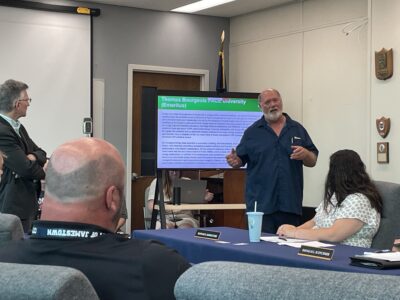
The team at Ramsay Agriculture, led by Ross Ramsay, presented to city council during Monday's work session, on their work and continued plans for the three buildings they possess. Besides Ramsay, team members that were in attendance included; Larry Cosenza, Ramsay Agriculture Science Officer; Tom Bourgeois, Director for Policy Research at the Land Use Law Center and Director of U.S. Department of Energy's New York/New Jersey Combined Heat and Power Technical Assistance Partnership; Sean Stokes, PPP attorney; Liz Kennedy, Edward Jones Financial Representative; Stephen Wooters, Ames Farm representative; Andy Goodell, Ramsay Agriculture corporate attorney; Michael Northrup and Tom Bollman. Other team members include Hank Han from AhBright, Ziyi Zhao, Sarah Cosenza, Doug Spangnola and Stephen Stewart.
The Ramsay Agriculture vertical farming operation is underway with three main buildings in the city involved and owned by Ramsay Agriculture; 40 Winsor Street, which was said to be the project headquarters; 65 River Street, and 1023 East Second Street. It was noted by the team that the plan is to invest $120 million into all three buildings for the project, and that while the science behind the project is not new, it is new to the United States and will help bring a spotlight to the city.
Cosenza and Bourgeois presented the project to the city council, focusing both on some of the behind the scenes work such as partnerships, and other work that has been done that can already be seen in the city, such as the stabilization at 40 Winsor Street.
"This is an opportunity to shine the spotlight on Jamestown," Bourgeois said. "It's really innovative ... I wanted to leave you with the clear notion that we're not talking about anything that is science fiction. This is being done in many places around the world, but this would be a first in the United States."
This science and similar agriculture projects have been successful in the Netherlands, he added, known as controlled environment agriculture. It grows five to seven times more per acre and uses less water and energy as well. The project will provide local power, create local food, and local jobs. Bourgeois emphasized that while it is not new technology, Jamestown will be one of the first to do something along these lines in the United States.
Bourgeois also spoke on the timing, including energy costs and state laws, the use of waste products in the project to help create food and power, helping the power grid, project value streams, the lack of a technology risk for the project as it has already been done and is working, and the enthusiasm from experts and people around the world for similar projects. Cosenza then spoke on financial projections, and the city's partnership with Ramsay Agriculture.
"We can't do it without that," Cosenza said. "We need the community waste to come in, that's what powers the whole operation, making food and energy and services to the community, which are consumed and then they make more community waste."
Bourgeois also noted that another thing that will help feed the generator for the operation is weeds from Chautauqua Lake, helping with that problem as well. Cosenza then spoke on the three locations for Ramsay Agriculture's project, including renderings of what the plan is for them and what they will look like. The Second Street building is set to be a pilot project site to start growing mushrooms. 65 River Street will be used for a larger-scale mushroom growing facility if the pilot project with the Second Street location works. The flagship site at 40 Winsor Street will be used for growing food and converting the waste to energy. That location will also include towers for the hydroponic growing operation.
"The idea is to remove the center of the building, put these towers inside and put like a glass floor ceiling overtop of it, so we can also give tourists a view of what we do and they can walk across the top of it and look down through the glass and see exactly how the operation is going as way to demonstrate what we're trying to do," Cosenza said.
The plan would be to have a farmers market in the building as well, bringing in a grocery store to an area where food might not be as available for the community. After discussing some of the engineering work for the project, the partnership with AhBright for the mushroom project, and some other proposals and the plan for a farmers cooperative, it was noted that the plan right now is to take two years for construction, and should create 150 jobs. It was also noted that regardless of the outcome of the project, it will still be investing $120 million into the area.
Work has been happening on the operation, and the city has been working with Ramsay Agriculture for about the last three years. A substantial amount has already been put into the project with the stabilization of 40 Winsor Street and work at the other buildings, and Ramsay Agriculture has also gone before the Jamestown Local Development Corporation board. The company was approved in August 2025 for a $250,000 loan at four percent interest for 10 years from the Jamestown Local Development Corporation for the stabilization of 40 Winsor Street.
City Development Director Crystal Surdyk noted that from her perspective and working with the company that the project is fascinating and that the business plan has also evolved in that time.
"We're really excited about the project," Surdyk said. "The science is proven ... This is a big, big project that is going to take quite a bit of time. We don't want to rush, though of course we would like to see it done tomorrow, that would be great. But, we get that something like this takes time to bake."
From a technical assistance perspective, while the city does not have unlimited funds to help with the project, Suryk added they are helping look where they can for grants, and they will continue to help the project continue forward as seamlessly as they can.
"Hopefully in a couple of years we'll be looking at 150 new jobs and some significant visible improvement for our community that I don't think otherwise would be able to happen," Surdyk said.
It was noted that the project also fits in with the city's vision and overall economic development plan.