
City DPW to clean city stormwater channels
Trending
The Department of Public Works and the Department of Development have been partnering on a project for a while now to clean out and do maintenance of stormwater channels in the city by Jackson Taylor Park off of Jones and Gifford.
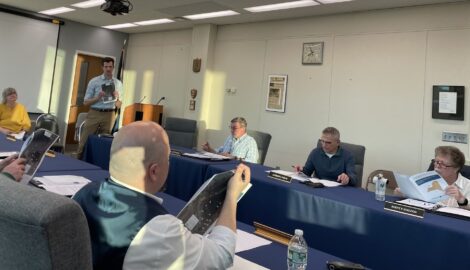
At a recent City Council work session, Director of Public Works, Mark Roetzer, presented the project to the City Council, discussing the reasons behind the project and what all was looking to be done.
"As you can see there's about 1.2 miles of channel that for 50+ years has not been maintained at all," Roetzer said. "During that time sediment and debris has built up in these channels. Currently, we are not able to get back and access these channels to clean them out. It's all in wetland, it's boggy, it's swampy, it's very difficult."
The main goal of this project is to be able to get back to the channels to haul out the debris and sediment and help with stormwater flow, Roetzer said. A big part of the project will be creating access back into the channel areas, and Roetzer said they plan to do that by creating access points along the channels themselves. Following that they will go in with equipment, haul the material out, take it to separate de-watering areas, and let it dry out.
"A lot of this material is contaminated, so it has to be hauled up to the Chautauqua County landfill," Roetzer said. "Like I said before, this project takes place in the wetlands as well, so we'll also have to do wetland mitigation."
With the 1.2 miles of channels, Roetzer said there is an estimated 14,000 cubic yards that will need to be taken out of the channels, equating to about 1,400 to 2,000 truck loads over the course of a few construction seasons that will need to be taken out. While the plan is to create access points or trails along the channels, Roetzer said some places will still be too wet to get trucks and equipment out onto, so some water drudging will have to be done as well.
"We've spoken with some local organizations that have that capability and they might be able to assist us in that," Roetzer said. "One of the big things about this project is, in the future, the continued maintenance of these channels. We don't want to go and clean these channels and then ignore them again for 50 years."
The plan is to do a rotation of every five to seven years, or as needed, to continue to go back in and clean out the channels. Roetzer acknowledged that this is a very large and expensive project, saying that the New York State Department of Transportation has allocated to the city the full estimated cost of the project being $5.5 million, with a 20% local match. The city would be responsible for $1.1 million of the project cost. Next month, a resolution in regards to the project will be brought before council, as an agreement between the state and the city, committing to the match and project. Roetzer said they will have until 2029 to spend the money in the agreement.
Roetzer said the project is easily separated into sections and could be stretched over the three years to minimize the cost on one year's budget. The DPW has also been looking into ways to reduce the cost of the project, along with alternate funding sources to help meet the city's match for the funding. This includes working with local groups for wetland mitigation, Department of Environmental Conservation grants, talking with the county for shared services, and Congressman Nick Langworthy has allocated some fundings towards the project as well, though Roetzer said they do not have a final total on that yet.
Following next month's resolution, Roetzer said they should be able to start the engineering work for the project about four or five weeks after that approval. In the meantime preliminary work and the final design work will be done.
"We've had a consultant for years working on getting New York state DEC permits to be able to work in these areas and do this work," Roetzer said. "So this is something the city has already invested in, to this point."
Mayor Kim Ecklund added that both Langworthy's funding and the other funding is federal, which is why it cannot offset any of the amount that the city has to pay for the project, and why they are looking for the other DEC grants to help offset that. Roetzer said they are still in communications with Langworthy's office about whether or not there is a match on that funding as well, to find out what that amount actually is. The DPW has also been in conversations with the Watershed Conservancy and other local related groups.
About two to four feet of sediment will be taken out with the project, also reducing flooding in those areas as well.
"The ditches along Jones and Gifford, once we're done the ditches will probably always have some water in them, but it will be much lower," Roetzer said. "Every time it rains, it won't flood across Jones and Gifford."
It was acknowledged that water can come up into Jackson Taylor Park as well when it rains. A question was raised about any wildlife issues, and Roetzer said they have been working with the DEC for years to make sure there would not be. The trails that will be made are set to make sure there will be as little of a disturbance as possible, and the public will be able to use the trails both during the project and after as well.
The rules for storage of the sediment as it is being pulled out were briefly discussed as well.
"It has to be piled and de-watered for a certain amount of time before it's lost a certain amount of moisture content, and then it can be loaded onto trucks again and hauled to the landfill," Roetzer said.