
City Explains Cleanup Holdups
Trending
Fulton Street residents have heard city officials say there are legal reasons why some seemingly common sense ways to help clean up the street can't be done.
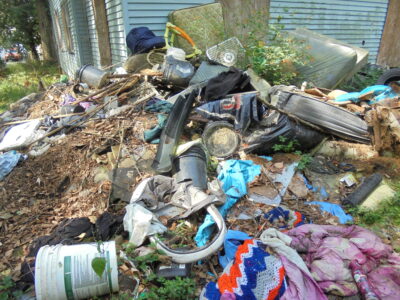
Most recently residents of the neighborhood have been asking the city for help in garbage cleanup on vacant properties, or looking for advice on things they can do on their own. While residents are able to get some of the garbage cleaned up on their own, there are specific rules and regulations that prevent the city from being able to come in and help in certain ways.
"The concerns raised by Fulton Street residents are valid, and the city shares those concerns both on Fulton Street and in neighborhoods across the city," city officials said. "Municipalities are required to operate within state law and federal constitutional protections, including those governing private property rights, due process, and protections against unreasonable searches and seizures."
Specifically when it comes to materials on private property, even garbage, regardless of condition or appearance, legally those items are the property of the owner.
This makes it so the city does not have the authority to enter private property and remove those materials at its discretion.
"Any seizure, removal, or disposal of property from a privately owned parcel requires consent, a valid warrant, or a court order," city officials said. "Action taken outside that legal framework would constitute unlawful entry and an unauthorized taking, exposing the city to civil liability and constitutional claims."
There is a defined enforcement process the city is required to follow before any physical remediation can occur, officials added, and this process includes inspections where access is permitted, documentation of code violations, issuance of formal notices, and, when necessary, court proceedings to obtain judicial authorization requiring compliance. Additionally, officials said property owners remain legally responsible for maintaining their properties in compliance with local codes, and failure to do so may result in fines, and court-ordered remediation.
"The city's authority in these matters is grounded in federal constitutional protections, including due process and private property rights, which establish the legal framework for all enforcement activity," city officials said. "These protections require that any government action involving private property follow established legal procedures, including notice, an opportunity to be heard, and, where required, judicial authorization."
Within this framework, city officials said there are opportunities for reforms at the state level that could help improve efficiency of municipal enforcement. Potential reforms could include streamlining nuisance abatement court procedures, reducing delays in obtaining judicial orders, and improving the consistency and timeliness of enforcement hearings.
"Additional opportunities exist to strengthen statutory nuisance abatement tools, including expanding mechanisms to address repeat or chronic violations and improving options for intervention at properties that are abandoned, neglected, or present ongoing public health and safety risks," officials said. "These changes would allow municipalities to move more efficiently from identification of violations to enforcement action while maintaining full compliance with constitutional protections and due process requirements."
While the city continues to operate within current legal framework, officials say they also remain open to advancing policy or administrative changes that improve the ability of municipalities to address persistent quality-of-life issues in a timely and effective manner, while maintaining full compliance with constitutional requirements.
Right now the specific legal process that the city is required to follow when there comes a need to intervene on private property has multiple steps that take time. Officials said that the enforcement process is "structured, sequential, and governed by law, and it is not immediate."
The process begins with a complaint or identified concern, which is followed by review and inspection by code enforcement officers within the Department of Development when access is permitted to the property. When access is denied, the city has to get a court-issued warrant or other legal authorization before they can enter the property.
"Once conditions are documented, formal notices are issued to the property owner requiring compliance within a set timeframe," city officials said. "The city continues monitoring the property during this period and conducts follow-up inspections where permitted. If compliance is not achieved, the city advances the case into the court system, seeking judicial orders requiring correction of violations. Additional court proceedings may be required depending on the circumstances of the property and owner responsiveness."
WHY IT TAKES SO LONG
The timeline for enforcement can vary depending on property conditions, owner responsiveness and court scheduling. Cases involving absentee owners, complex ownership structures, or estates typically require additional legal steps and extended timeframes. Officials said that the city advances each case as efficiently as the legal process allows. It is only after court authorization is granted that physical remediation can occur on these properties, and that can only happen within the limits defined by the court order.
"Immediate action without prior court approval is limited to narrowly defined emergency conditions involving a clear and imminent threat to life or safety," city officials said. "Throughout this process, Code Enforcement Officers and Department of Development staff remain actively engaged--inspecting properties where legally permitted, documenting violations, building enforcement cases, coordinating with legal counsel, and advancing matters through each required stage. Enforcement activity is continuous, even when it is not immediately visible to the public."
When the city is authorized to perform remediation, they may seek cost recovery through liens or special assessments. According to city officials, recovery is limited by law and by the financial capacity of the property owner. Often it is only partially recovered or not at all.
"When costs are not recovered, they are absorbed within constrained municipal budgets supported by taxpayers, reducing available funding for other essential services," city officials said. "This framework ensures enforcement actions remain legally sound and enforceable."
REPORTING ISSUES IS KEY
The city and Department of Development are actively addressing conditions in the Fulton Street neighborhood through enforcement, interagency coordination, and long-term redevelopment strategies. The quickest way to fix these ongoing problems is through voluntary compliance with direct engagement with property owners, allowing for a timely resolution. When compliance is not achieved, the city must proceed through formal legal enforcement, which requires significant staff time and resources, extends timelines, and can allow conditions to persist during the legal process.
"A comprehensive strategy is in place, utilizing tools such as strategic property acquisition, partnership with the Chautauqua County Land Bank Corporation, and targeted demolition and redevelopment to address long-term vacancy and deterioration," officials said. "Chronic issues are prioritized, with repeat violations tracked and enforcement escalated for properties that remain non-compliant."
Concerns that are brought to the city by residents directly inform enforcement priorities for the city, along with broader neighborhood planning. Once a concern is reported there is a formal process that requires documentation, inspection, and legal action when necessary. Issues are not resolved immediately, and city officials emphasized that they must go through established procedures. When immediate action is not visible to the public it shows that voluntary compliance has not been achieved and the city is advancing enforcement through the legal system. Conditions may remain unchanged throughout the time that legal remedies are pursued.
"Reporting remains a critical component of enforcement, and residents are encouraged to use established city channels so concerns can be properly documented and addressed," city officials said. "This is an active and ongoing effort focused on stabilizing the neighborhood, improving conditions, and ensuring long-term compliance."