
Lake Monitoring: Jefferson Projects Presents 2025 Findings At Symposium
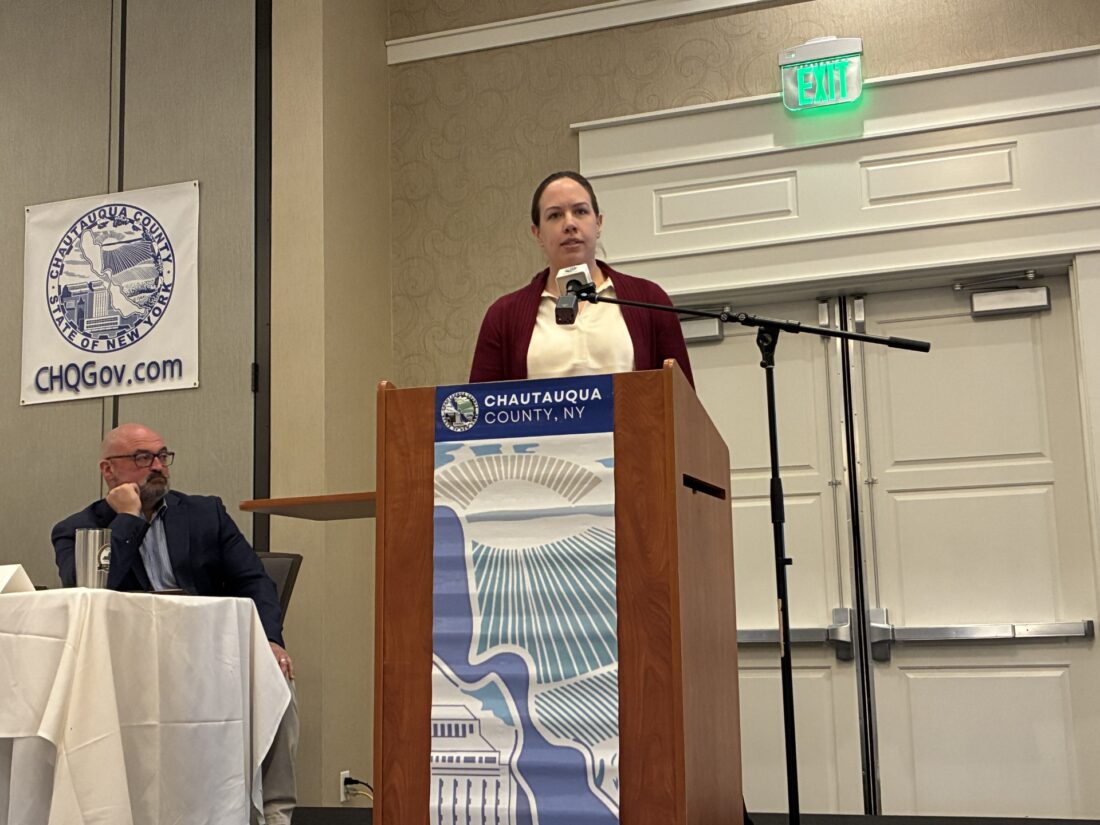
Dr. Allison Hrycik speaking at the 2026 Chautauqua Lake Symposium about the Jefferson Project’s research. P-J photos by Owen Reed
-
- Dr. Allison Hrycik speaking at the 2026 Chautauqua Lake Symposium about the Jefferson Project’s research. P-J photos by Owen Reed
-
- A slide of Hrycik’s that shows the various tributaries that the group collected data from in 2025.
Dr. Allison Hyrcik, a research scientist with the Jefferson Project, discussed the research organization’s preliminary thoughts on last summer’s weed issues – among other things – during a presentation Saturday during the Chautauqua Lake Symposium presented by Chautauqua County.
Hrycik first mentioned a couple of potential factors that the group does not collect information on, that being biocontrols and macrophyte management. Krycik stated that, while no data was collected on these, changes may have still been contributing factors to the conditions. The organization was able to look at the nutrient level and the water temperature though. Water nutrient levels have very little change from previous years, according to Hrycik. However, the water temperature differences seem to have been a potentially large factor.
“What we did see though was that the surface water where those macrocytes are actually growing was a lot warmer in 2025 compared to the previous four years that we have data for. It also warmed up a bit faster last year and that was probably because we had lower rainfall. We had that really dry spring and summer and the rain water tends to be a lot colder but also mixes things up,” said Hrycik. “So that surface water was a little bit warmer last year, we think that could have contributed.”
The Jefferson Project, a research effort headed by the Rensselaer Polytechnic Institute and IBM Research, was brought to Chautauqua Lake in 2020 to have a more hands-on approach to gathering data for better management strategies. With another year gone, Hrycik reviewed information gathered from 2025, and discussed potential paths forward to make the lake cleaner for everybody.
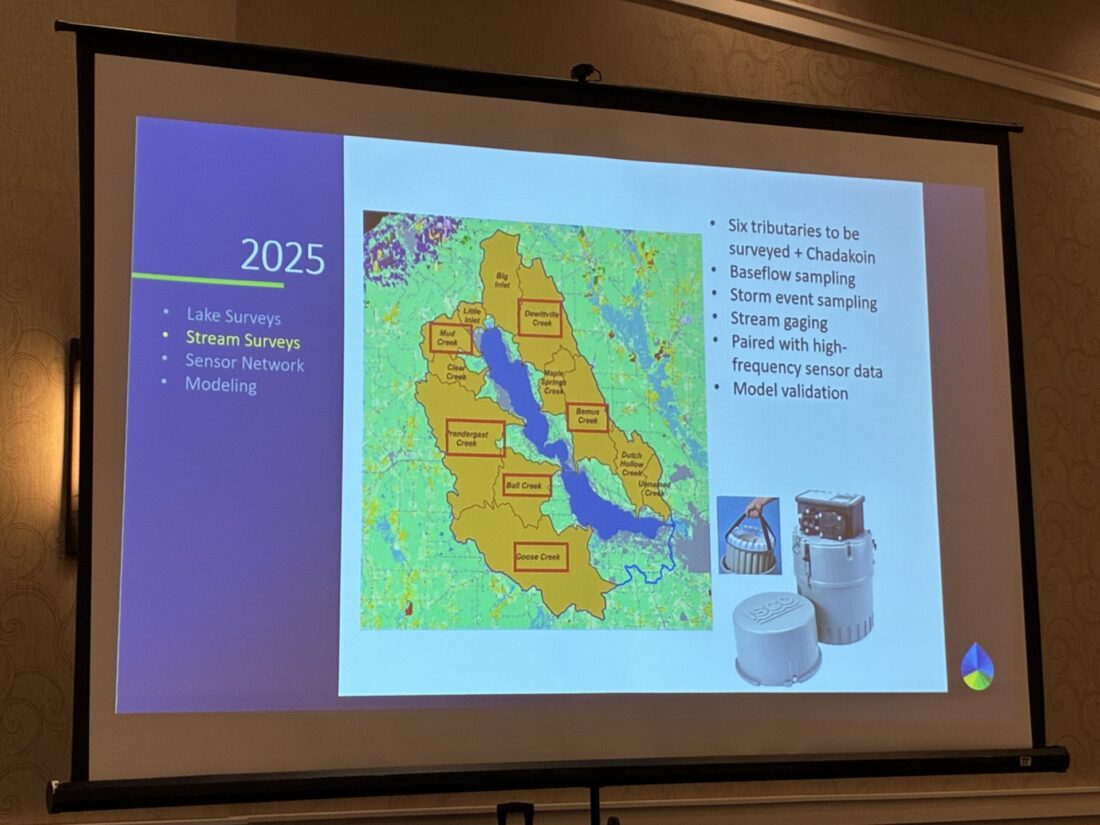
A slide of Hrycik’s that shows the various tributaries that the group collected data from in 2025.
Throughout 2025 the Jefferson Project conducted lake surveys at all depths in the lake every two weeks. These surveys would take place at about 14 locations and measured levels of nutrients, algae, toxins, genetics, and light extinction. The group also monitored six tributaries, with baseflow sampling at each location. These locations included Mud Creek, Dewittville Creek, Prendergast Creek, Ball Creek, Goose Creek, and Bemus Creek. The groups also used vertical profilers all round the lake, something many keen observers may have noticed. Additionally, the organization has implemented numerous weather stations and two land based stations that further monitor and collect data.
“Then modeling is what brings everything together. So we have people working on weather models, watershed models which is new this year and also hydrodynamics which just means the water flow and water currents in the lake itself,” said Hrycik. “And so these models are used to build a more complete picture and kind of integrate our data to get a better idea of what’s going on.”
A large focus continued to be looking at nutrient deposits in the lake, as well as the cycling systems of these nutrients through the lake, according to Hrycik. Hrycik stated one new focus in 2025 was looking at how macrophytes affect the nutrient levels in the lake. Though the data is still being analyzed, the group will be looking to see how much Nitrogen and Phosphorus are removed from the water system when these macrophytes are harvested.
The group also looked at toxins that had been present in the lake throughout the year. The main toxin that was seen is a liver toxin called microcystins. These rates are typically quite low, though Hrycik noted that there were four instances in the fall that the levels exceeded the safe threshold. Additionally, the group recorded a different liver toxin called cylindrospermopsin. Hrycik stated that this is the first time that the organization has recorded this toxin inside of the lake, though all measurements recorded very low levels.
Currently, the group is working to finalize a public report of all of the research and findings that occurred throughout 2025. Hrycik stated that all information will also be published on the Environmental Protection Agency’s Water Quality Portal.
Top stories
IDA Director Seeks Refresco Answers
The director of the Chautauqua County Industrial Development Agency wants to have a conversation with a juice ...
Lake Monitoring: Jefferson Projects Presents 2025 Findings At Symposium
After Court Win, Mayville To Demolish Sea Lion Drive Property
St. Susan Center Decision Won’t Affect Women, Children’s Shelter
Gerry Man Charged With Cruelty In Death Of Python
GERRY --- A town resident is facing animal cruelty charges after Chautauqua County sheriff's deputies found a dead ...
City Looks For Public Input On Safe Streets
The city’s Safe Streets For All initiative is continuing to move forward, and part of moving forward is looking ...