Gasoline Prices Surge To $3.399
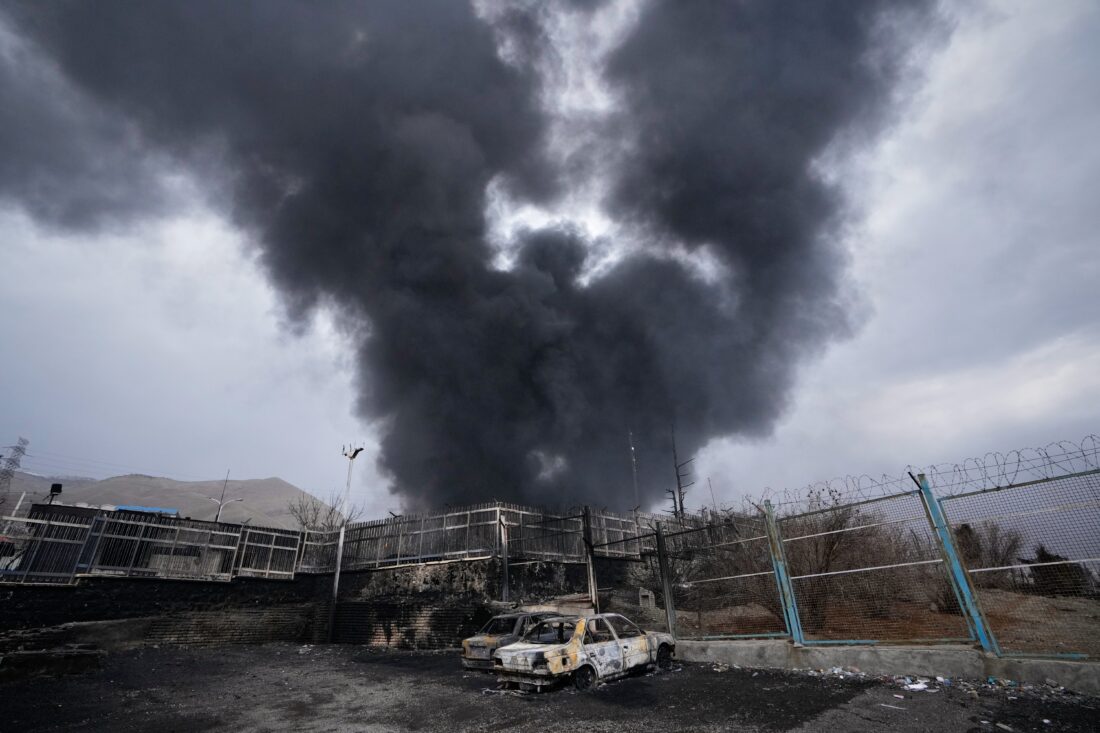
A thick plume of smoke rises from an oil storage facility hit by a U.S.-Israeli strike late Saturday in Tehran, Iran, Sunday, March 8, 2026. (AP Photo/Vahid Salemi)
The average price for a gallon of gas in Jamestown is 16 cents higher this week at $3.399, according to AAA East Central’s Gas Price Report.
The national average for a gallon of regular gasoline jumped 48 cents over the past week to $3.47 – the highest since summer of 2024. The conflict in the Middle East is causing crude oil prices to rise to over $100 per barrel for the first time since summer of 2022 after Russia invaded Ukraine. The price of crude oil accounts for 50 to 60% of the cost of a gallon of gasoline, so when the price of crude oil rises, gasoline prices do the same.
Springtime also typically sees higher gas prices as gasoline demand rises and summer-blend gasoline production begins. Current gas prices are on track to match spring break prices of 2024. Today’s national average is 57 cents higher than a month ago and 39 cents higher than a year ago.
According to new data from the Energy Information Administration (EIA), gasoline demand decreased last week from 8.73 million barrels per day to 8.29 million. Total domestic gasoline supply decreased from 254.8 million barrels to 253.1 million. Gasoline production increased last week, averaging 9.3 million barrels per day.
As of Monday morning, West Texas Intermediate is trading at more than $100 a barrel. The EIA reports crude oil inventories increased by 3.5 million barrels from the previous week. At 439.3 million barrels, U.S. crude oil inventories are about 3% below the five-year average for this time of year.
The national average per kilowatt hour of electricity at a public EV charging station stayed the same at 39 cents.
The nation’s top 10 most expensive gasoline markets are California ($4.81), Washington ($4.44), Hawaii ($4.43), Oregon ($4.04), Nevada ($3.87), Alaska ($3.72), Arizona ($3.58), Illinois ($3.36), Pennsylvania ($3.35), and Michigan ($3.27).
The nation’s top 10 least expensive gasoline markets are Oklahoma ($2.79), Mississippi ($2.81), Kansas ($2.83), Tennessee ($2.84), Texas ($2.87), Arkansas ($2.90), Louisiana ($2.90), Wyoming ($2.90), North Dakota ($2.91), and Missouri ($2.92).
According to the Associated Press, the price for a barrel of Brent crude, the international standard, surged to as high $119.50 per barrel early in the day but later was trading above $101 per barrel, up 9%.
West Texas Intermediate, the light, sweet crude oil produced in the United States, also soared above $119.48 per barrel before falling back closer to $100.
Oil prices have surged as the war, now in its second week, ensnares countries and infrastructure critical to the production and movement of oil and gas. And on Monday, Iran named the hard-line Ayatollah Mojtaba Khamenei to succeed his late father as supreme leader, signaling a new sign of defiance by Iran’s embattled leadership amid heavy U.S. and Israeli bombardment.
The war’s toll on civilian targets grew as Bahrain accused Iran of striking a desalination plant vital to drinking water supplies. Bahrain’s national oil company declared force majeure for its shipments after an Iranian attack set its refinery complex ablaze. The legal declaration releases the company of contractual obligations because of extraordinary circumstances.
The war has disrupted oil supply chains in the Persian Gulf. Roughly 15 million barrels of crude oil — about 20% of the world’s oil — typically are shipped every day through the Strait of Hormuz, according to independent research firm Rystad Energy. The threat of Iranian missile and drone attacks has all but stopped tankers carrying oil and gas from Saudi Arabia, Kuwait, Iraq, Qatar, Bahrain, the United Arab Emirates and Iran from traveling through the strait, which is bordered in the north by Iran.
Iraq, Kuwait and the UAE have cut oil production as storage tanks fill due to the reduced ability to export crude. Iran, Israel and the United States also have attacked oil and gas facilities since the war started, worsening supply concerns.
In response to soaring prices, there have been discussions of dipping into emergency oil stockpiles. But on Monday, the Group of Seven major industrialized powers said it had decided against using their strategic reserves, at least for now.
“We’re not there yet,” French Finance Minister Roland Lescure said after chairing a meeting of his G7 counterparts. Still, he told reporters in Brussels that the group was “ready to take necessary and coordinated steps in order to stabilize markets, such as strategic stockpiling.”
On Saturday, President Donald Trump also downplayed the idea of turning to America’s Strategic Petroleum Reserve, maintaining U.S. supplies were ample and prices would soon fall.
Yet the surge in costs for oil and natural gas is still pushing fuel prices higher, cascading through other industries and jolting Asian economies that are especially vulnerable due to the region’s heavy reliance on imports from the Middle East.
Iran exports roughly 1.6 million barrels of oil a day, mostly to China, which has called for an immediate end to the fighting. Beijing may need to look elsewhere for supply if Iran’s exports are disrupted, another factor that could increase energy prices.
“All parties have their responsibility to ensure stable and smooth energy supplies,” Chinese Foreign Ministry spokesman Guo Jiakun said in a briefing Monday. “China will take necessary measures to safeguard its own energy security.”
Top stories
Gasoline Prices Surge To $3.399

Panama Emphasizes Support For School Merger

Borrello Proposing New Winter Thruway Limits
JCC To Present ‘Biloxi Blues’
He really didn’t have a background in theater, but Noah Benjamin enjoys getting to tell a story to people, to a ...

Second Person Charged In Relation To 2025 Shooting