
Randolph Celebrating 200th Anniversary March 7
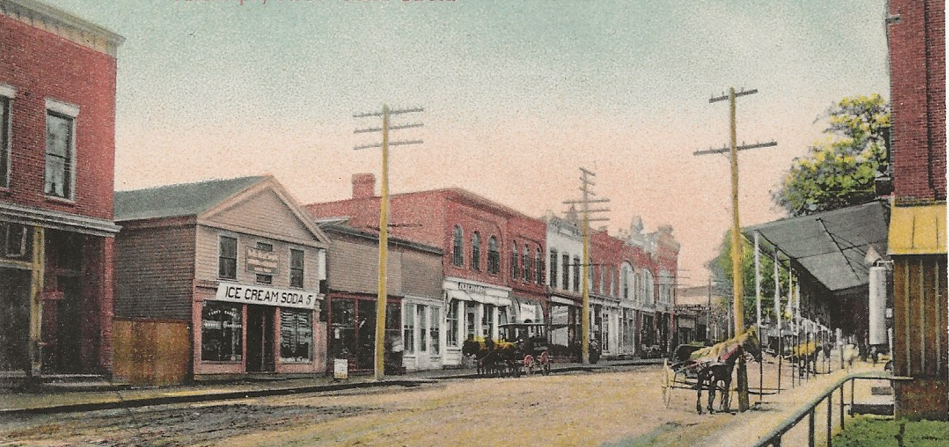
Pictured is a historic view of Main Street in the town of Randolph.
-
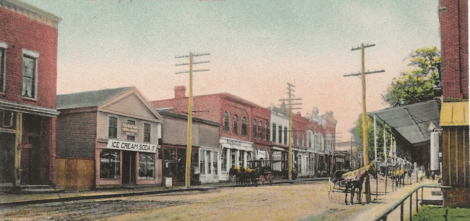
- Pictured is a historic view of Main Street in the town of Randolph.
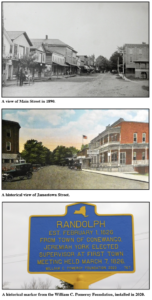
The celebration will officially begin on the day of the anniversary at 1 p.m. The event will be located in the Town Court Room in the Town Municipal Building, which is located at 72 Main Street. This will be at the same time as the first ever town board meeting on March 7, 1826. Various town officials, and other various elected leaders from the area, will gather, and the Bicentennial Kickoff Proclamation & Celebration will begin. For those that are interested in a deeper dive of the town’s history, an event will be hosted at 10 a.m. titled Discover Your Roots: Genealogy 101. The event will be hosted by Town Historian Nancy Olejniczak, and will focus on teaching attendees how to trace local roots to uncover old ancestors. Additionally, there will be a wide-range of vendors for residents to browse. These vendors will be hosted by the Randolph Area Community Development Corporation, with vendors available from 10 a.m. to 4 p.m. in the Randolph Fire Hall and Municipal Building Community Room.
The creation of the town resulted from the New York State Legislature stepping in to divide the town of Conewango on Feb. 1, 1826, which in turn created the town of Randolph. While officially formed, Randolph still looked quite different at the time as it would include the entirety of what is now the town of South Valley. The Legislative Act stated that the first town meeting was to be held at the home of then resident Benjamin Clark on the first Tuesday in March.
At this first meeting the Town Moderator was chosen as Justice of the Peace Thomas Harvey, the Town Supervisor was chosen as Jerimiah York, and Andrew D. Smith was chosen as the Town Clerk. Various other roles were decided that day, some still existent and some long gone. These other positions included assessors, highway commissioners, poor masters, commissioners and inspectors of common schools, a tax collector, and path masters. In addition, this meeting saw officials vote to raise $100 for the roads and double that of what the state was to contribute for education. While similar in structure, these meetings occurred just once each year. The meetings main purpose was to develop roads, oversee education, and care for residents in need.
Plans to settle the Randolph area had begun over three decades prior, before the town of Conewango had even been officially incorporated. Beginning in 1792, the Holland Land Company would purchase over 3 million acres of New York land to survey and create municipal boundaries for. This early attempt to form these governmental structures were some of the earliest, even predating Cattaraugus County’s formation in 1808.
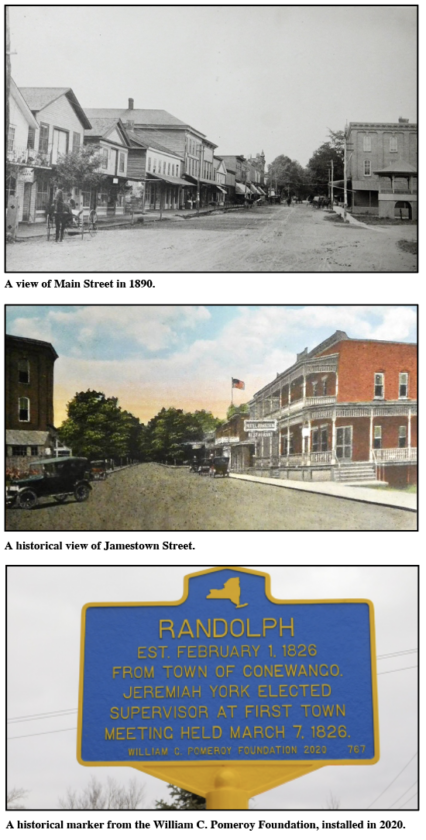
On Oct. 30, 1821, about five years before Randolph would be incorporated, Edmund Fuller and four others would purchase some of this land in what is now Randolph. Fuller was the first of the five men to make a permanent settlement, creating a log cabin on lot 31 within the town. While Fuller would sell his land and move west in 1822, others would quickly pick up where he left off. By 1826, there were between 30 and 40 families that lived in what would soon be the town of Randolph. Thomas Harvey, former Town Moderator, moved into the former Fuller residence and took over the position of Town Supervisor. By 1830, the first Census would be taken in the town. Results stated that the town had grown to about 135 households with about 776 people overall. This growth would continue, with the 1840 Census showing that the town’s population had grown to 1282, eventually sparking the need to split away the bottom portion of the town into the town of South Valley in 1847.
With such a neat and complex history, the town officials want to ensure recognition for those that have perpetuated the legacy of the local area. Many roads and streets within the town still hold the name of these early settlers as a form of recognition for their efforts including Archer, Bowen, Bush, Caswell, Crowley, Sample, and Torrance. Officials hope that people will take advantage of the opportunity to grow a closer connection with the history of the town, and to explore the various things that the town has to offer today.
Top stories

Protecting The Waters: DEC Releases Algae Bloom Roadmap
Ellicott Police Respond To Homeless, Trespass Complaints
FALCONER - Although progress has been made, safety and compliance problems concerning the homeless population are ...

Artemis II’s moonbound astronauts capture Earth’s brilliant blue beauty as they leave it behind

Mission Shaper: Jamestown Native Works On NASA’s Artemis II, Receives Special Invite To Launch

Trial For Hector Rosas Expected This Year
City Man Faces Second Child Porn Charge
John Peterson, 42, of Jamestown was arrested and charged by criminal complaint with distribution and possession of ...