
Jefferson Project Finds No Easy Solutions For Weeds
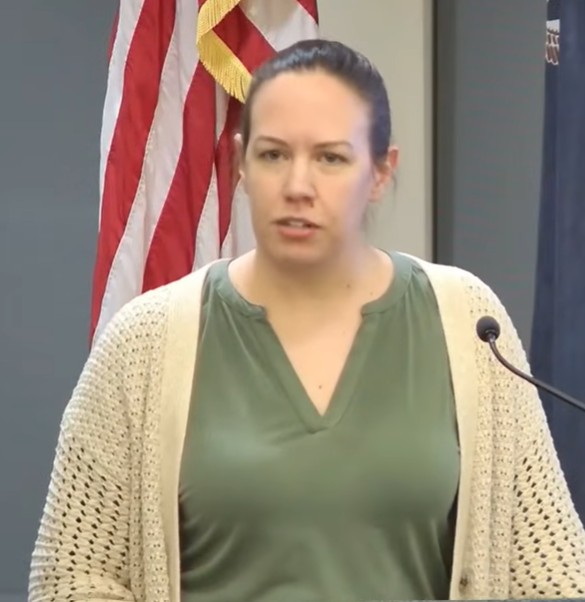
Dr. Allison Hyrcik with the Jefferson Project spoke recently at a Chautauqua County Legislature meeting, regarding their research on Chautauqua Lake.
MAYVILLE – For the past five years, researchers with the Jefferson Project have been studying Chautauqua Lake to understand human impacts on fresh waters and how to mitigate those impacts, in particular with weeds and harmful algal blooms.
Dr. Allison Hyrcik with the Jefferson Project recently gave a presentation at the Chautauqua County Legislature, where she noted the progress they’ve made as well as the challenges they have finding a solution.
The Jefferson Project began as a collaboration between Rensselaer Polytechnic Institute and IBM Research in 2013 on Lake George.
In 2020, the Jefferson Project expanded to Chautauqua Lake, through funding at that time from Chautauqua Institution. Chautauqua County has also helped fund the research.
In 2025, New York state provided funding from the Department of Environmental Conservation.
The Jefferson Project uses sensor platforms. In 2025, those sensor platforms were used from April through November. Hyrcik noted they have sensor platforms under the ice and will be using data from them in the spring.
They also have tributary monitoring stations and are working on building two more weather stations.
“Our end goal is to develop a holistic understanding of water quality in the lake, accounting for both spatial and seasonal variation. Our big emphasis is trying to understand Harmful Algal Blooms and how to mitigate nutrients in the lake to guide management,” Hyrcik said.
Hyrcik noted Chautauqua Lake has a lot of nutrients in it, which lead to algal blooms as well as lake weeds.
Some of the goals of the Jefferson Project for 2026 include:
– Develop a high resolution nutrient budget;
– Identify areas of high nutrient loading throughout the watershed;
– Tributary station improvements;
– Weather station deployments;
– High resolution modeling;
– Conduct HABs forecasting.
Hyrcik noted a lot of the water quality issues in Chautauqua Lake are from too many nutrients and too much phosphorus.
“There are rarely quick fixes here and that’s because of a whole host of issues,” she said. “There are issues of land ownership because it’s not just an in-lake problem; it’s a whole watershed problem.”
Hyrcik said they don’t want to “over-promise” but rather optimize strategies. “It’s important to be very careful about the management actions we might take in the future,” she said.
Two obvious lake management items include watershed management and controlling invasive species, which Hyrcik noted there are lake groups that are already doing these practices.
Hyrcik discussed the Jefferson Project’s lake and stream surveys done in 2025, as well as the sensor network and modeling.
In 2025, they started streaming live data, which can be found at chq.jeffersonproject.live.
They’ve been focusing on understanding external nutrients coming in from the watershed as well as internal nutrients that are being recycled in the lake.
“Something new for us this year is that we started trying to understand how macrophytes are affecting the nutrient budget,” Hyrcik said. “This will tell us how much nitrogen and phosphorus are removed when harvesting occurs of the macrophytes.”
2025 SEVERE WEED PROBLEM
Hyrcik acknowledged how the weeds were very bad in the southern basin near Burtis Bay. When this happened they were able to test for nutrients and water temperature.
“Nutrients were very similar this year to previous years. There was nothing crazy with nutrients that would explain why the weeds were so bad this year. Nutrients are very high. It’s definitely a problem but they weren’t particularly high this year compared to other years,” Hyrcik said. “What was different is that water temperature was a lot warmer, especially surface water. And this is the area that the weeds are growing in.”
Hyrcik blamed the warmer water on the drought last summer.
“Rain water is a lot cooler and also mixes things up,” she said.
They also believe that algal blooms have been moving from the south basin to the north basin.
For 2026, they’re developing some pilot nutrient mitigation projects, which will need DEC approval.
Hyrcik also acknowledged the work being done by the U.S. Army Corps of Engineers.
During the question-and-answer period, Legislator Bob Bankoski, D-Dunkirk, asked Hyrcik in simple terms what should the county do to help prevent a large weed problem in 2026.
Hyrcik replied, “It’s a great question, but the thing is we’ve taken a couple hundred years to get to this point. We can’t fix it in five years.”
She continued, “In my opinion, controlling the nutrients coming in from outside the system is most important. This internal recycling is extremely hard to resolve.”
John Shedd with Chautauqua Institution noted that when the Jefferson Project was first brought to Chautauqua Lake, they were instructed to focus on data. “That team tried not to give recommendations on what to do about these problems because there’s a tendency for politics to play a part,” he said.
According to Shedd, the original plan was for lake organizations to take the data and develop a lake maintenance plan.
Shedd noted this year, the contract with the Jefferson Project has been modified. “This is the first year we wrote into the contract to try to provide a prescription for a pilot project to see if they could identify enough from the last five years of information, a project that they could recommend us to build,” he said.
Shedd shared that Chautauqua Institution is impatient as any organization wanting an answer for the weed problems, but recognizes it won’t be a simple one. “We want answers quickly but quick for us in this environment is going to be a generation of trying to solve the lake problems,” he said.
Top stories

Frewsburg Terminates Student Affairs Coordinator

Success Story: Kidney Transplant Recipient’s Family Reflects On Life Years Later
Public Works Talks Speed Limit Adjustments, Safer Streets
Jefferson Project Finds No Easy Solutions For Weeds
Police Chief Charter Change Discussed
Borrello’s Medicaid Audit Proposal Defeated
Legislation that has been introduced for the past seven years has been approved by the state Senate - but not ...