
Clymer Hosts School Merger Forum
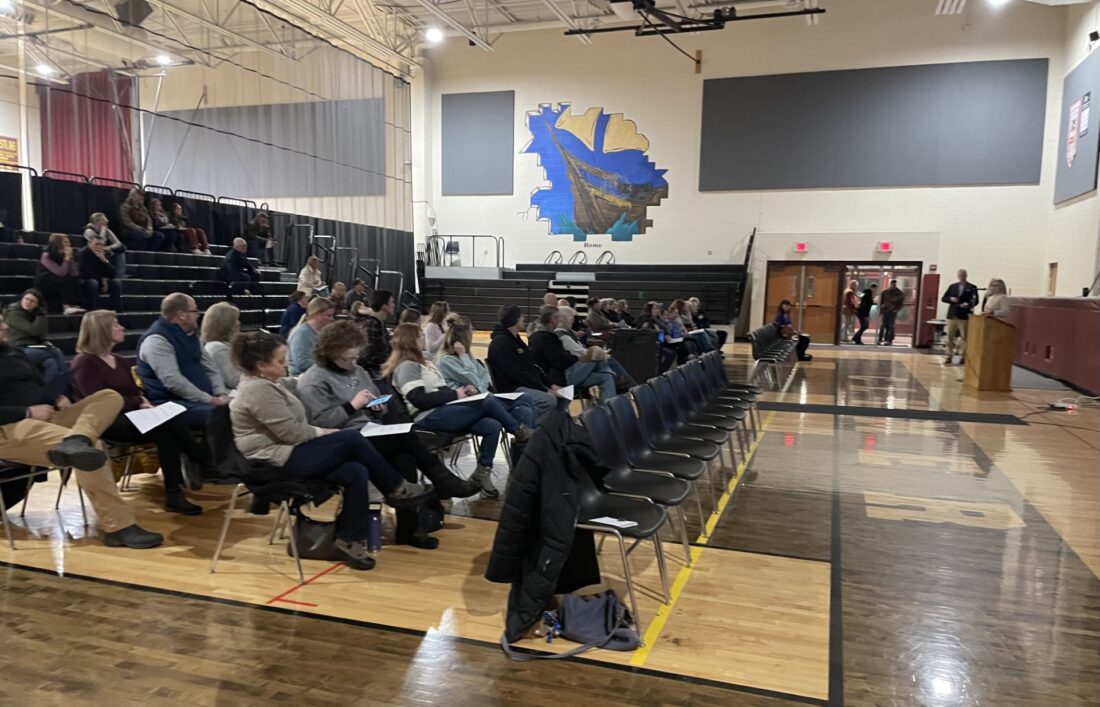
The first of three community forums for the CSP Merger Feasibility Study was held Monday night at Clymer Central School. P-J photo by Sara Holthouse
CLYMER — The Clymer, Sherman, Panama Central Schools merger feasibility study has reached the community input phase, beginning with a community survey that went out earlier this month and continuing with the first of three community forums that was held at Clymer Central School on Monday.
There will be three community forums, one for each district’s community, with the Sherman and Panama forums coming at the beginning of March. Clymer’s community forum began with Dan White and Lynda Quick, members of the consulting firm doing the study, presenting to those in attendance some of the reasons for the feasibility study and what is involved.
White noted that a feasibility study is required by New York state when two or more school districts are considering merging, and is meant to be unbiased and done by an outside firm, and the study makes no decisions for the schools or school boards.
“The study will be provided to the three boards of education for their review and to determine what next steps they are willing to take,” White said. “Our role as White and Partners, and White and Partners is made up of a few retired superintendents, is to present the facts and a set of recommendations to the boards of education.”
STUDY TIMELINE
Quick addressed the scope of work that is involved in the study, along with the process and timeline for the study. The study itself goes from January to June 15, when a final draft of the study is expected to be presented to the board. The study is currently in a section of the timeline labeled as January to April where data is being collected through things such as surveys, community forums, and focus group meetings, and then that data is being processed. A draft of the study is required to be shared with the State Education Department by May 1. The final study will be presented to the boards in a joint meeting in mid-June.
Quick also discussed with the attendees the leadership meetings such as the steering committee that are already being held, and what the steering committee does. She also talked a bit on deliverables, or the reports that will be issued from the study.
“There are two types of reports that we’re going to be issuing,” Quick said. “We’re going to be issuing a feasibility study report with analysis and recommendations for a merged school district of the three schools, and we’re also simultaneously going to be providing individual reports to the three school districts.”
WHAT WOULD COME NEXT
As for what follows the feasibility study, Quick said in June and July the individual boards will resolve to continue the process or not, and if they decide to move forward they will go into the July to October time frame where public meetings and information sessions will be held to talk about the merger and implications of it. A potential straw vote will be held in October 2026, which is a petition of support from each district to gauge official support to continue to move forward. If the straw vote results are positive the commissioner of education for New York State will then put forward a formal official vote, currently projected for December 2026. If both votes are positive, a merger will occur with the earliest possible date being July 1, 2027.
“All mergers are effective July 1 of the year following the vote,” Quick said. “That’s a requirement by law and it coincides with the fiscal calendar of the school districts.”
WHAT WE KNOW NOW
Quick then addressed study input and information that has been received over the recent months, including results from the community survey, done for both adults and students. There were three specific questions presented to those in attendance at the forum — what potential benefits are there to a merger, potential challenges, and any other input people might have — along with some specific data points, including some of the reasoning behind having this conversation now.
Specific data points include enrollment trends, which White and Partners had a chart of broken down over the last 30 years, beginning in 1995 and going to the 2025 school year. Overall the combined districts have lost 52% of their enrollment over the past 30 years. This data includes non-resident students. A combined district is projected to have between 960 and 980 students over the next five years.
Fiscal realities and trends were also discussed, and while White and Partners noted that at the moment all three schools are fiscally sound, there are some struggles that will be faced moving forward, especially with factors such as state aid — which is projected to be less in the coming years –, and which all three districts were said to rely heavily on, along with the school districts’ tax levies, which are all three districts’ two major revenue sources. The general costs of living are also projected to continue to increase in the next few years, and are expected to be greater than the money coming in from foundation aid and taxes.
Quick then discussed projected five year revenues for the schools, some of the fiscal challenges they face, and limited options the schools will have. Projected state aid that will come if the schools decide to merge will last for the next 14 years and will be an additional $68 to $70 million dollars, which was also noted to be a lot more than it was when Clymer and Panama originally discussed merging back in 2017. There will also be incentive reorganization building aid that the schools will be able to receive.
MIXED RESPONSE
Looking then to the results of the community survey, results came in with 798 responses overall from all three districts. 280 of the survey participants strongly agreed that a merger is a good idea today, 161 agreed, 178 did not know, 76 disagreed and 109 strongly disagreed. White and Partners also showed a breakdown of the priorities shown from the survey, where the number one priority was shown to be educational opportunities, along with some of the other items that ranked highly. Clymer’s individual survey responses were shown as well, which again showed results heavily weighted towards strongly agreeing that a merger is a good idea at this time.
Quick then moved on to feedback and questions, some of which they have already received from focus groups and staff. The Amish community will be reached out for conversations on the merger as well.
Potential benefits that attendees brought up include more opportunity for students, and increasing program availability. Questions were brought up on how board members will be elected to the school board, and the use and configurations of buildings. Quick said for board seats after a merger is decided it will be decided if the combined district wants five, seven or nine members and then a board election will be held. There will not be a way to dictate going into the merger having three members from each district, but there can be an agreement that that is how the school wants it to be. Quick said generally, the combined board will be made up of those already on the individual boards who express interest, because of their knowledge, experience and understanding of the time commitment.
As for the buildings, it was noted that White and Partners will not be the ones to decide that but will give recommendations to the boards, and that they will not give recommendations for uses beyond educational purposes, but can give suggestions as to things that can be pursued. It is likely that White and Partners could recommend ways to do a study on that as well.
The community forum wrapped up by asking attendees to fill out forms given to them at the beginning of the forum, and any other questions that people think of can be emailed to CSPstudy@e2ccb.org. More information on the merger study process can be found on each districts’ website.
Top stories
Maple Grove AP Class Makes Trip To D.C.

Honing Her Routine: Erinn Sluga Readies For State Competition
Resident Says Fulton Street Improving Despite Change, More Help Is Still Needed
County Helping Fight HABs in Findley Lake
MAYVILLE – Chautauqua County is helping address Harmful Algal Blooms in Findley Lake. During the county ...

Protecting The Waters: DEC Releases Algae Bloom Roadmap
Ellicott Police Respond To Homeless, Trespass Complaints
FALCONER - Although progress has been made, safety and compliance problems concerning the homeless population are ...