
Aerospace A Bright Spot For SKF
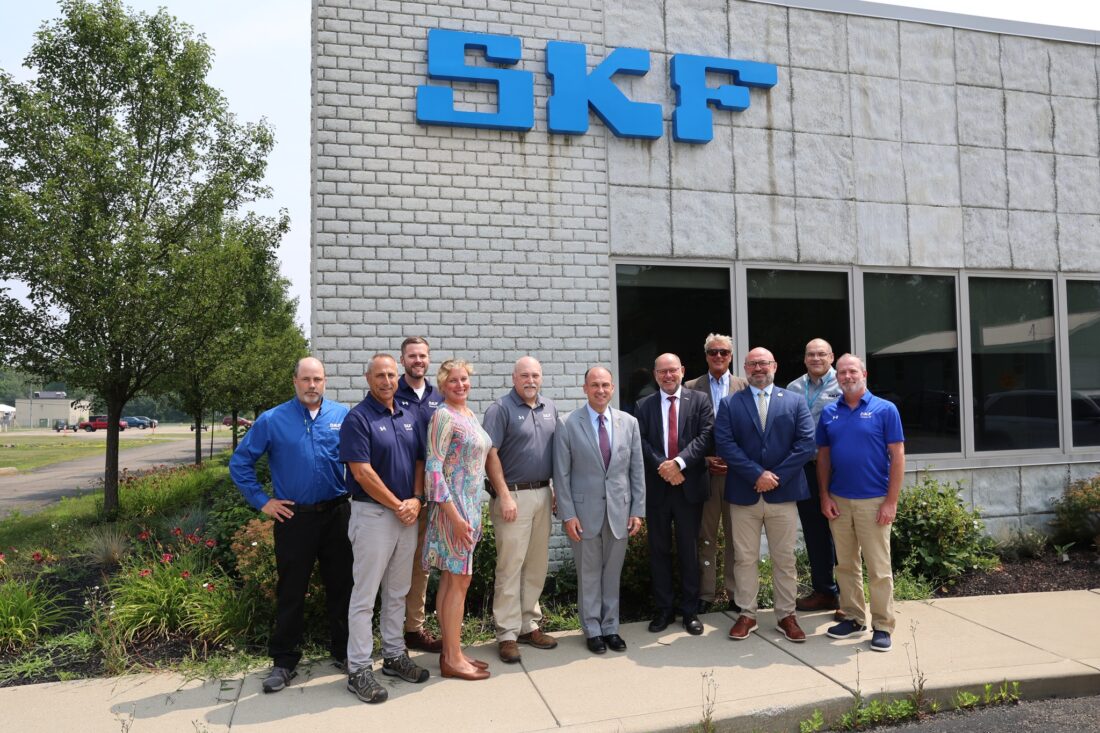
Rep. Nick Langworthy, Swedish Ambassador Urban Ahlin, County Executive PJ Wendel, county officials and SKF employees in Falconer are pictured during a stop on Ahlin’s tour of the area in August. Photo courtesy Congressman Nick Langworthy’s Facebook page
In a year in which SKF’s organic sales were flat and profits were down, the company’s Aerospace Division remained strong.
SKF’s Falconer plant is part of the Aerospace Division. SKF’s Industrial business reported net sales of 15.938 billion Swedish krona. Organic growth was 2.3%, driven by price/mix. All regions contributed with positive organic growth except for India and Southeast Asia where organic growth were relatively unchanged compared to last year. From a customer industry perspective, industrial distribution contributed positively and aerospace continued to deliver strong organic growth while railway and heavy industries declined.
“Turning to Americas, also flattish growth in general,” said Rickard Gustafson, SKF president and CEO. “Here as well, we have positive organic growth in our Industrial business, to a large extent driven by tariff-related price increases to compensate for tariffs. But if we break out some Industrial verticals that actually sees good development is aerospace. It’s also high-speed machinery and automation.”
Overall, SKF reported net sales of 22.0 billion Swedish krona in the fourth quarter of 2025. For the full year, SKF achieved net sales of 91.6 billion Swedish krona with an adjusted operating margin of 12.7%. Organic growth was flat in the fourth quarter, an improvement from the 3.1% decrease in the fourth quarter of 2024. Currency impacts of 2.617 million Swedish krona impacted SKF’s bottom line, though the company saved 383,000 Swedish krona with cost cutting initiatives as the company became more efficient.
“Our cost management generated a strong contribution to the profit and a 1.7 percentage point improvement to the margin,” Gustafson said during a conference call with investor analysts. “And there are some main drivers of that. The first one to talk about is the rightsizing activities that are now starting to give a positive contribution year-over-year of some SEK 190 million. This impact falls positively through our results as the dissynergies of automotive separation will come from the start of next year, where Automotive will be operating more independent within the SKF Group. The main dissynergies will be derived from IT and their management structures and consequently offset the impact of the rightsizing activities. By that, I still reconfirm the positive impact of the rightsizing activities of some SEK 2 billion and the relatively linear effect until the end of 2027.”
SKF’s industrial business, which accounts for 73% of group net sales and 96% of adjusted operating profit, delivered organic growth of 2.3% in the fourth quarter of 2025, with operating margins increase from 14.6% to 15.6% from the fourth quarter of 2024. The automotive business saw organic growth decrease by 5.8% in the fourth quarter. The automotive business is being separated and is expected to be listed separately by the fourth quarter of 2026.
“Strategically, we are excited about the future,” Gustafson said. “There will be a lot of activities in 2026 to finalize the separation that is planned now, as you heard, for the fourth quarter of 2026 and that we have found a way to strengthen the starting point even further for both the Industrial and Automotive business that we are very excited about. But then we’ll not just focus on the separation in 2026. The organization is fully charged to work on delivering on those strategic pillars that I mentioned that will be the foundation to unlock the full potential of both our Industrial and Automotive business. So these two things will be the main focus in 2026 to finalize the separation and gear up for profitable growth in both our businesses.”
Top stories

Life Lessons: St. Luke’s Youth Embarking On Pilgrimage
Aerospace A Bright Spot For SKF

Lawsuit Challenges Dewittville Condo Project
Frewsburg Board Eyes Prelim Budget
Comptroller Finds Issues In Ashville Fire District Audit
Hiring Ramps Up At Electrovaya
Hiring continues at Electrovaya’s plant in Ellicott as the company continues buildout of the plant as the company ...