Road Salt Limits Proposed In Assembly
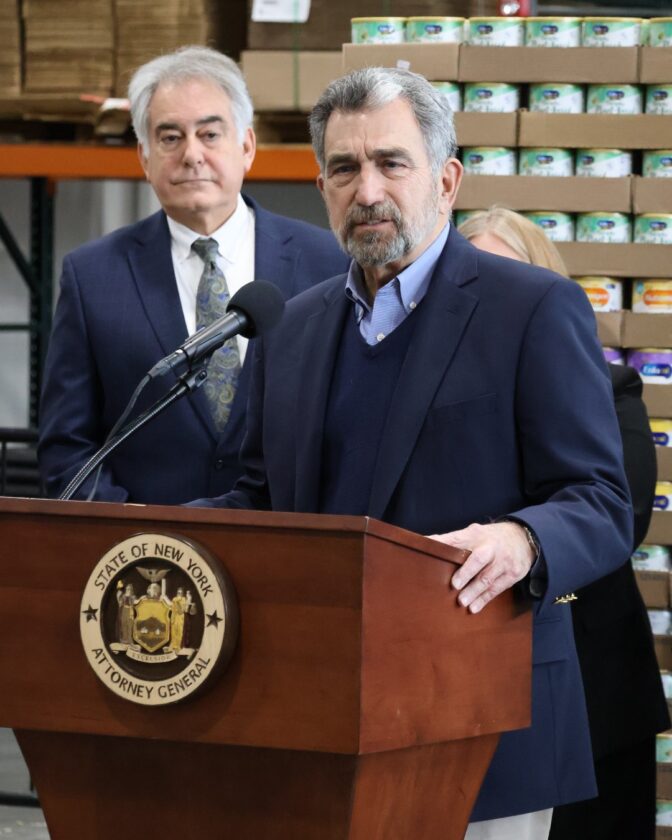
Assemblyman Bill Magnarelli, D-Syracuse, is pictured during a November news conference in his Assembly district.
Local governments could see new limits on the amount of road salt they can use each winter under legislation introduced recently in the state Assembly.
Assemblyman William Magnarelli, D-Syracuse, recently introduced a bill (A.9561) to limit the amount of road salt spread by the state and municipalities to a rate of no more than 300 pounds per lane mile on average during each snow and ice management season. For parking lots and sidewalks, the limit would be set at 4.7 pounds per 1,000 square feet. Magnarelli also proposes all salt spreading equipment be metered and calibrated, with the state Transportation Department required to provide annual data on its website regarding road salt use.
Magnarelli said in his legislative justification that his legislation has roots in 2020 legislation that created the Adirondack Road Salt Reduction Task Force. That task force released a report in 2023 and called for the development of several new ways to clear roads in the winter in the Adirondack region, including managing “cold spots” through selective vegetation management as an alternative to excessive road salt, another to investigate chloride-free deicing alternatives, and another to create weather warning signage telling motorists to reduce their speed in areas where road salt application is reduced.
The report also proposes “chloride-free zones” be established in areas near Mirror Lake in Lake Placid and around Lake Clear to test using alternatives in low traffic areas and research the change in environmental impact. It also suggested testing out seasonal speed reduction zones with signs warning motorists, but did not list areas where those speed reduction zones could be implemented.
Magnarelli also cited a 2025 New York City Department of Environmental Protection report showing rising salt pollution levels in reservoirs and watersheds that provide drinking water to New York City and surrounding municipalities.
“It found that if left unchecked, critical reservoirs could be rendered unusable by the end of the century,” Magnarelli wrote in his legislative justification.
The reports prompted a roundtable of the Assembly’s Transportation, Environmental Conservation and Health committees to discuss changes to the use of road salt, with one possible solution coming via Magnarelli’s legislation.
“One recommendation from that meeting was to set a limit on the rate at which road salt can be spread to limit pollution but still allow for safe maintenance,” Magnarelli wrote. “This bill sets that limit at 300 pounds per lane mile over the average of a season, which is above the current spreading rate used by NYSDOT and serves as a baseline to provide guidance to other highway departments.”
Magnarelli also proposed legislation (A.9564) that would require all municipalities and localities store their road salt in a protected shed within 10 ten years. The bill, Magnarelli wrote, is Adirondack report and ensuing legislative committee meetings
“One recommendation from that meeting was to ensure road salt was being properly stored to eliminate run off,” Magnarelli wrote in his legislative justification. “Unfortunately, several municipalities still store their salt out in the open. This legislation seeks to remedy this by giving all state agencies and municipalities 10 years to properly store their road salt. The timeframe would give these entities ample time to comply.”
Top stories
Hiring Ramps Up At Electrovaya
Hiring continues at Electrovaya’s plant in Ellicott as the company continues buildout of the plant as the company ...

Comptroller Finds Issues In Ashville Fire District Audit

All Stars: Local Business Aiding Olympics Team USA
As some people push to make profound autism its own diagnosis, this family is raising twins with it
Former Sherman Feed Store Sold