Not Over Yet: Five Stories That Will Make More Headlines In 2026
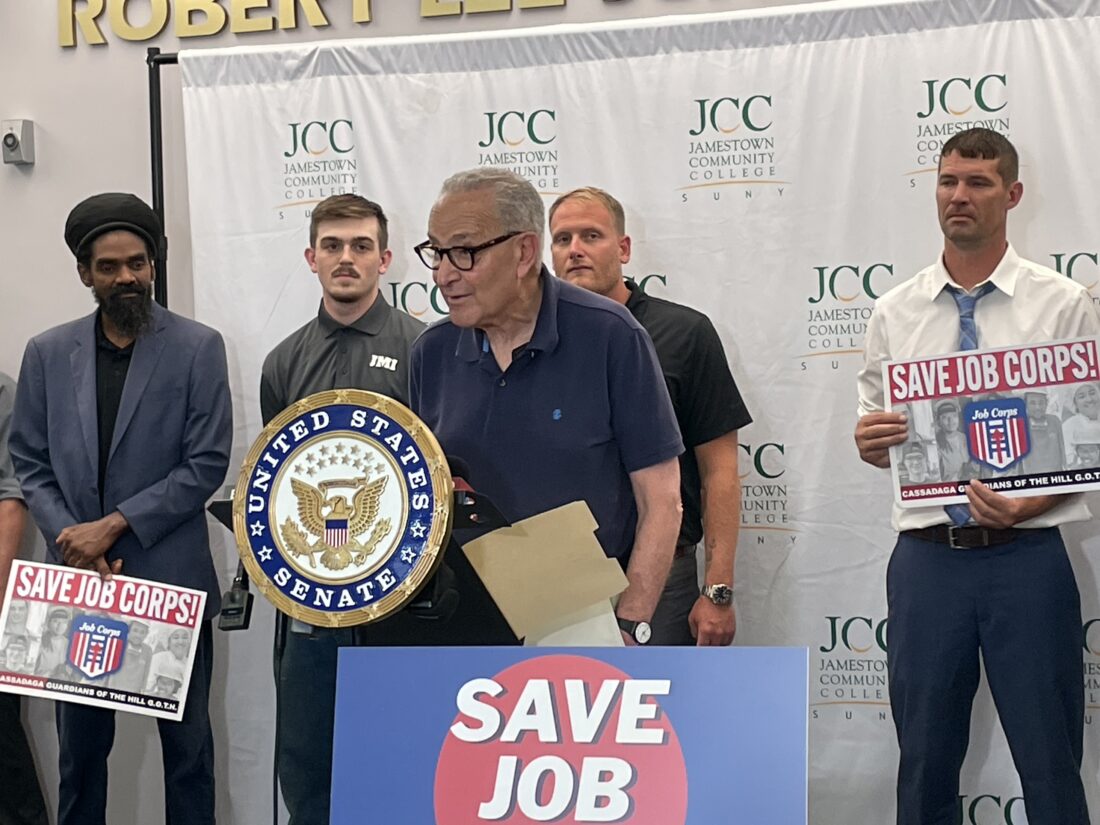
U.S. Sen. Charles Schumer is pictured at Jamestown Community College, where he expressed support for Job Corps to continue. P-J photo by Gregory Bacon
-

- U.S. Sen. Charles Schumer is pictured at Jamestown Community College, where he expressed support for Job Corps to continue. P-J photo by Gregory Bacon
-
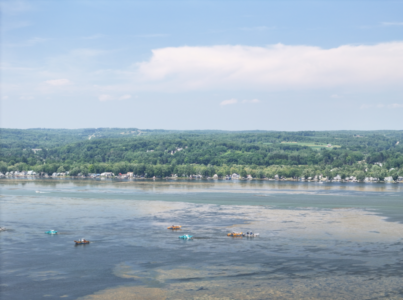
- Boats are pictured on Chautauqua Lake near a weed mass earlier this summer. Photo courtesy Chautauqua Lake Partnership newsletter
-
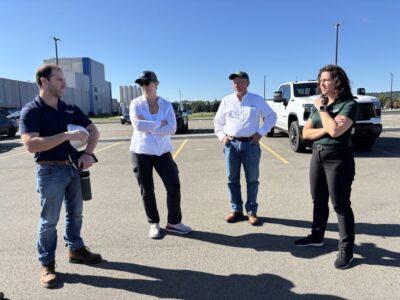
- Amanda Lefton, state DEC commissioner, is pictured near Great Lakes Cheese in Franklinville in December. Photo courtesy state DEC Facebook page
The condition of Chautauqua Lake has been one of those issues for the past few years, and 2026 will be no different. Readers agree. One of the most read stories published in The Post-Journal this year focused on conditions in the south basin of the lake.
Jamie Kilgore, who owns a home by the southern basin, noted that the condition of the lake has deteriorated rapidly this summer, expressed frustration in not only the condition but the apparent lack of concern about it from some groups that focus on and take care of the lake, except for the Chautauqua Lake Association, which she noted has been trying to help.
“I’m worried that this is a potential new normal for the southern basin,” Kilgore said. “The lake is always a concern to us, but this condition is at an all time high this year. It’s a literal field of weeds; we had birds literally standing on the lake.”
While the condition of Chautauqua Lake’s southern basin is something Kilgore said they always watch, it is also something that has been exacerbated this summer. Additionally, she said she feels her concerns about the increasing amount of weeds is being largely ignored by other lake organizations besides the CLA.
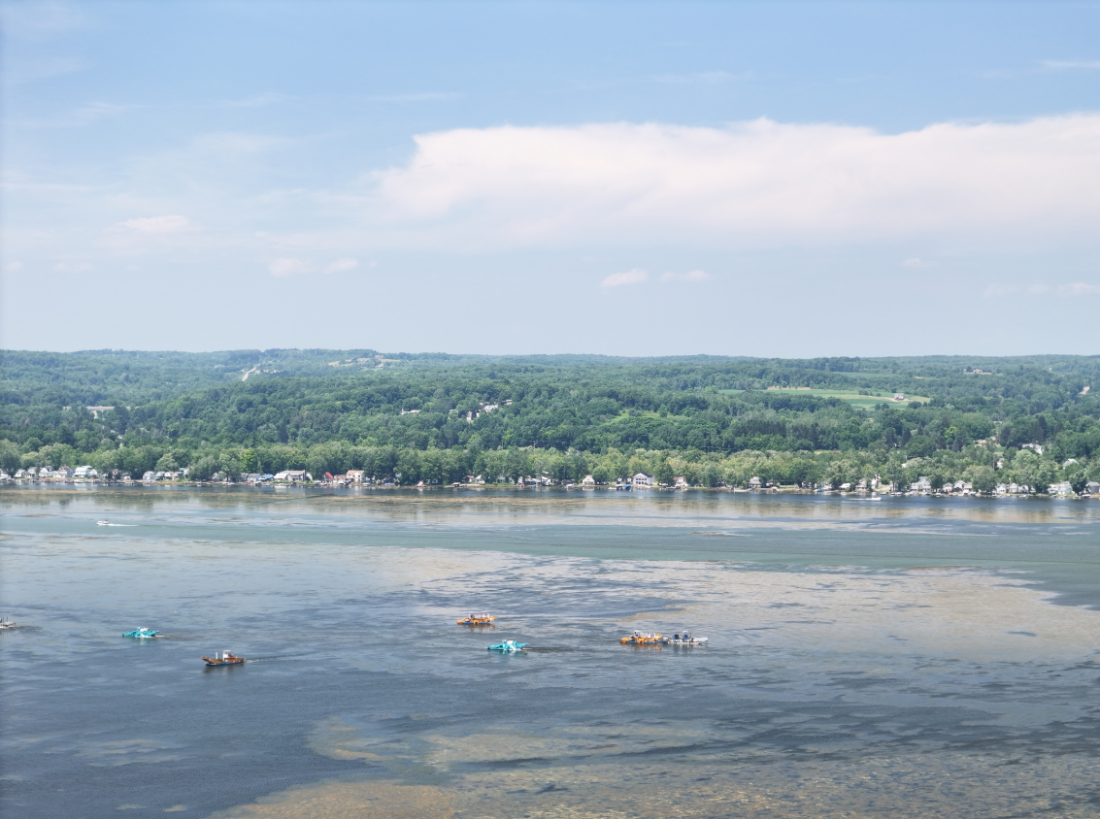
Boats are pictured on Chautauqua Lake near a weed mass earlier this summer. Photo courtesy Chautauqua Lake Partnership newsletter
Kilgore said that the reason they purchased a home by the lake is that it can be amazing and relaxing, but described this summer as stressful while watching the southern basin’s condition deteriorate. She added they are by the lake all summer besides one week, and when they returned from that week away the lake was already in its deteriorating condition.
“It’s stressful to watch this decline as a homeowner,” Kilgore said. “It can’t continue as it is. It’s horrible. And this is not to diminish the work being done by the CLA, who are doing their best, but it’s not enough.”
There will be some changes as the calendar turns to 2026. Local elected officials will have a greater say in the Chautauqua Lake Watershed and Management Alliance board has changed to include more representation from town and village boards and the agencies that are performing lake maintenance work.
And, early in 2026, legal challenges to the state’s Freshwater Wetlands Act changes will be heard in state Supreme Court in Albany. Oral arguments in local efforts to overturn the state’s Freshwater Wetlands Act changes will be heard Friday, Jan. 23, in the state Supreme Court in Albany.
Justice Richard Platkin announced the case scheduling in an order issued Dec. 19. If any of the parties want to postpone oral arguments they need to confer with other attorneys involved and propose at least two mutually agreeable dates and times, at least one of which is a Friday morning.
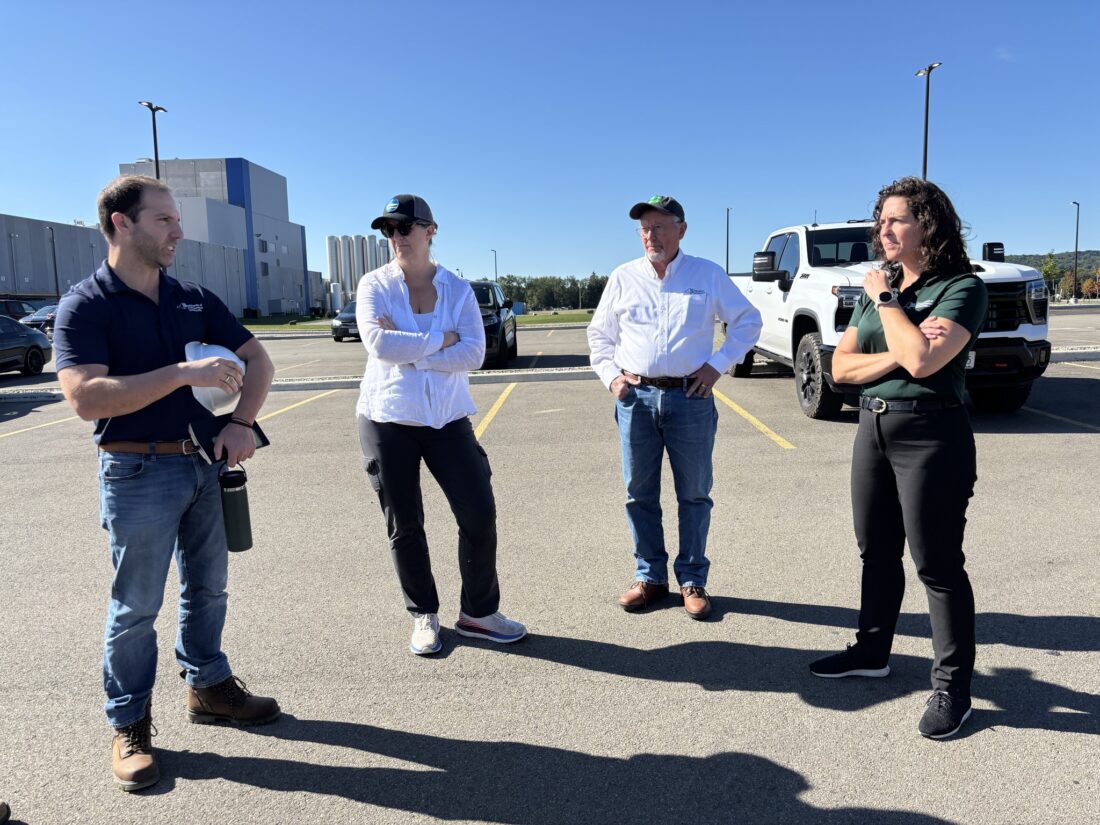
Amanda Lefton, state DEC commissioner, is pictured near Great Lakes Cheese in Franklinville in December. Photo courtesy state DEC Facebook page
Four cases – all filed within a few weeks of each other in the spring – are being heard at the same time. The first to file was the Chautauqua Lake Property Owners Association, followed in short order by the Chautauqua Lake Partnership, Village of Kiryas Joel and the Business Council of New York state. Each of the legal challenges also has co-signers involved as well, while state lawmakers including Assemblyman Andrew Molitor, state Sen. George Borrello, former Assemblyman Andrew Goodell and environmental groups have filed amicus curie briefs that raise issues not included in the original lawsuits or briefs filed by the state Attorney General’s office.
DEAD FISH IN ISCHUA CREEK
A September column by Forrest Fisher drew attention to anglers’ concerns about a concerning fish die-off in Ischua Creek in Franklinville.
Around Aug. 26, the state DEC responded to reports of a massive fish kill in Ischua Creek near Franklinville. Field teams discovered large numbers of dead fish, amphibians, reptiles and other aquatic species downstream. The DEC investigation found that effluent discharges from the Great Lakes Cheese facility in Franklinville were likely responsible. Organic waste from dairy processing had been released into the creek, leading to low dissolved oxygen, high nutrient levels, elevated temperature and excessive dissolved solids — this can be a toxic mix for aquatic life. Residents near the facility, including one recounting multiple dead fish, confirmed the visible effluent and odor in the creek.
On Aug. 29, Great Lakes Cheese voluntarily paused discharging wastewater into Ischua Creek. DEC has ordered the facility to implement a suite of operational improvements and enhanced monitoring to prevent effluent from exceeding safe limits and improve the quality of operations, which are key to treating dairy waste. DEC indicated that they will continue data collection and impact assessments to understand the ecological effects better.
The New York State Department of Health and Cattaraugus County Health Department are conducting sampling of private wells in the area as a precaution. However, there’s currently no indication of contaminated drinking water. Local water systems have been notified and are undergoing precautionary monitoring.
A public advisory is in effect: refrain from fishing, boating, swimming, or having contact with Ischua Creek downstream of Franklinville until further notice. Residents are also advised to keep pets and livestock away and to report unusual wildlife observations.
Oversight and monitoring will continue as DEC will closely supervise the facility modifications and operational improvements, and monitor the health of aquatic wildlife, especially with expected rain events that could alter water flow and dilution. This ongoing commitment to monitoring and oversight should provide reassurance to the public. Public concerns are being amplified by state officials like DEC Commissioner Amanda Lefton and State Senator Great Lakes Cheese was ordered a short time later by the DEC to pay nearly half a million dollars in fines and to take corrective action on the harmful discharge the company expelled into Ischua Creek.
DEC Commissioner Amanda Lefton said Great Lakes Cheese will be issued a fine totaling $475,000. Of the fine total, $250,000 must be paid directly to the DEC, $75,000 is pending suspension based on completing terms and conditions, and $150,000 must be put towards an environmental benefits project. The facility will also be ordered to complete an extensive list of corrective actions, according to Lefton. Required actions include extensive in-stream monitoring, modifications to the wastewater treatment plant, implementing plans to more quickly detect problems within the plant, preventing excessive future levels of hydrogen sulfide, hiring DEC-approved third parties to ensure compliance, timelines to report sampling data, and system evaluations to ensure compliance with the company’s air state facility permit.
“We appreciate the Department of Environmental Conservation’s transparency in handling this matter and Great Lakes Cheese’s cooperation in addressing the violations and strengthening its operations. Accountability, transparency, and a genuine commitment to improvement are essential to ensuring this type of incident does not happen again,” said state Sen. George Borrello.
CHAUTAUQUA INSTITUTION LEADERSHIP
Readers followed with interest the finances at Chautauqua Institution — information that typically doesn’t filter outside the gates of the institution but which at the same time impacts most of those who live in the southern portion of Chautauqua County.
The institution has started to book non-seasonal concerts to take advantage of opportunities to bring people inside the institution before and after the summer season, including a fall performance by Bonnie Raitt.
“Overall attendance is still down from 2019 numbers, and a big part of that this year was that our friends in Canada did not come across in the same numbers to visit Chautauqua, or likely to visit New York or the United States,” said Deborah Moore, Chautauqua Institution senior vice president and chief programming officer.
The struggles of lessened Canadian tourism is not one which the institution is facing alone. Information from the International Visitor Arrivals Program, run by the International Trade Administration, shows that slightly over seven million Canadian visitors came to the United States between January and May. This is roughly a 17% decrease from the rates for the same months during 2024. According to the ITA report the United States saw roughly 20.4 million visits from Canadians in 2024, making it the number one foreign source of tourism to the United States for that year. This only further shows the importance of protecting Canadian tourism, as it holds an incredible amount of importance to contributing to the U.S. economy as a whole as well as local economies.
At the same time, Michael Hill, former institution president, resigned to take a position at Macon College, while Kyle Keogh stepped into the position on an interim basis and spoke with candor about the institution’s financial challenges, hosting regular conversations with institution residents and posting community conversations and updates on the institution’s website. Keogh and the institution’s board began a process earlier this year that led to the elimination of 30 positions, closure of the institution’s office in Washington, D.C., and changes to many areas of the program inside the gates.
Institution board members have made $5.7 million in changes to the budget, approving a 2026 operating budget in November that “This again is a reset moment to get us back. It’s a financial reset, not a relevance reset,” Keogh said. “We think Chautauqua is more relevant than it’s ever been in the past. We are multi -generational and we look at the world from multiple views. We integrate across the arts, education, recreation, religion, and we think that’s actually tremendously valuable now and for the next 20 years. So this is a financial change, not a programming change. And we are confident that we can deliver a great program next summer and beyond, and even be more relevant than we are today.”
JOB CORPS ON CHOPPING BLOCK
Employees at the Cassadaga Job Corps were told in late May their program is being put on pause as the Trump administration looked to permanently end the program. The U.S. Department of Labor planned to pause Job Corps Center operations at contractor-operated Job Corps centers nationwide, which included the Cassadaga Job Corps on Glasgow Road that is one of 99 non-federally operated Job Corps centers.
“The decision follows an internal review of the program’s outcome and structure and will be carried out in accordance with available funding, the statutory framework established under the Workforce Innovation and Opportunity Act, and congressional notification requirements,” the Labor Department said in a news release.
Federal officials said the program operated at a $140 million deficit in 2024, requiring the Biden administration to implement a pause in center operations to complete the program year. The deficit was projected to reach $213 million in 2025.
The Cassadaga Center had around 180-190 students on the campus and about 100 positions.
A court injunction was sought – and granted – to keep Job Corps in operation.
The Job Corps is a federal job training and education program designed to serve low-income youth between the ages of 16 and 24 who face barriers to education and employment, founded by the Economic Opportunity Act of 1964.
The Cassadaga Job Corps opened in August, 1978. It offers training in carpentry, electrical, painting, plumbing, certified nursing assistant, advanced training licensed practical nurse and security officer/guard certification.
PUSH FOR YEAR-ROUND ATV ACCESS TO SNOWMOBILE TRAILS
Snowmobile season is just around the corner – weather permitting. In January 2025, however, a Chautauqua County legislator’s idea to open some snowmobile trails year-round for all-terrain vehicles. During the discussion of a state grant in a committee meeting, Legislator Dan Pavlock, R-Ellington, noted that the utilization of the trails is weather dependent. In the last few years there have been very few times that snowmobilers could use the county trail system. “It seems once hunting season is over and the trails open, the snow melts,” he said.
After regular firearm season, New York state has late bow and muzzleloader hunting seasons for deer Dec. 9-17 and Dec. 26-Jan. 1.
There apparently were a couple of days that some select trails were open in Chautauqua County shortly before Christmas, but they were closed by Dec. 26 once the “holiday hunt” took effect.
Pavlock asked about the idea of having trails open year round for vehicles.
“I know it’s an uphill battle and there’s a lot of naysayers, but where do we stand on a more all-season type trail,” he asked.
Lauren Sharp with the county Department of Planning said there are trails in the county that are open year round, but mainly for hiking, biking or horseback riding.
She noted that the Rails to Trails and trails in the Department of Environmental Conservation forests are open to the public.
“As far as other motorized vehicles – side-by-side, four-wheelers, things like that – typically the DEC doesn’t want them on their property and Rails to Trails is more of a hiking/walking trail,” she said.
Sharp also said that much of the snowmobile trails are owned by private landowners who do not want access on their property year round.
She noted the county has put together a countywide trail map that lists which trails are for hiking, snowshoeing, horseback riding and biking. Snowmobilers have their own map with the state Snowmobile Association that lists trails exclusively for snowmobiling.
Pavlock thanked Sharp for her comments, but said that he still believes there would be value in trails open for motorized vehicles year round.
“If it was done in 20 years, I’d take it. I would say it would be work well done,” he said.
Top stories

County Clerk: No Evidence Of Local Plate Fraud

‘Horrific And Heart-Wrenching’: City Man Pleads Guilty In Death Of 16-Month Old

Another plug for plant: Area leaders push NRG natural gas repowering
New Hires Paying Dividends For LBPD
Former WGH employee charged in missing medication
A year-long investigation into missing medication at Warren General Hospital has resulted in charges filed by the ...