Local Woman Talks Experience Getting Seeing Eye Dog, Looks To Educate Area
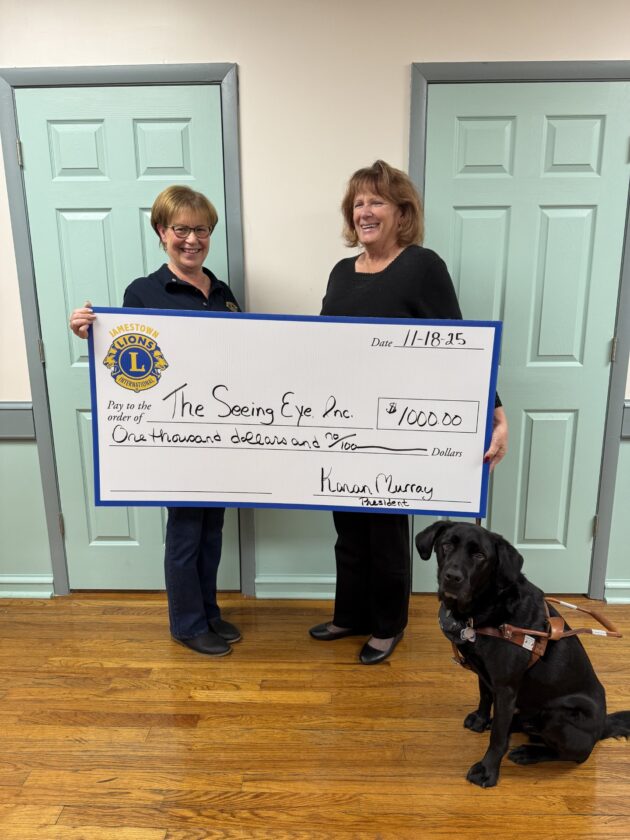
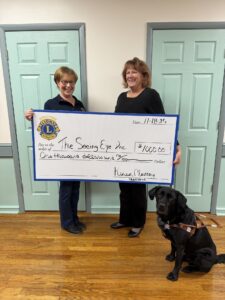
Pictured are Karan Murray from the Jamestown Lions Club and Tracey Fiorenzo with her seeing eye dog, Iggy. Submitted photo
When local woman, Tracey Fiorenzo, lost her eyesight in 2017, it was not long before the possibility of getting a seeing eye dog to help her in her everyday life was suggested.
Fiorenzo moved back to the Jamestown area after losing her sight and was advised by both Chautauqua Blind Association Vision Rehabilitation Services — which serves Chautauqua and Cattaraugus counties — and her doctor that a seeing-eye dog would be beneficial. However, the process would take some time.
“To obtain a seeing-eye dog, my doctor first needed to declare that I was legally blind,” Fiorenzo said. “I also had to complete Orientation and Mobility lessons with CBA Vision Rehab to become proficient in using a long red and white cane for independence. CBA helped me fill out the appropriate forms and verified my ability to navigate the community independently with the cane, as I can no longer see ink on paper. After that, I had to wait for about two to three years.”
Fiorenzo obtained her seeing-eye dog, Iggy, from an organization called The Seeing Eye, located in New Jersey. Before receiving the dog, she completed a comprehensive three-week mobility training course at the guide dog school. She also received numerous hours of support from the staff at CBA. The Jamestown Lions Club covered the cost of her luggage and assisted in making the entire process possible.
Once Fiorenzo and Iggy were paired together, additional work was necessary to help them travel efficiently within the community. Ongoing guidance and instruction from CBA continued after they were matched. Fiorenzo emphasized the significance of integrating Iggy into her daily life, sharing an incident that occurred while crossing the corner of Third Street and Main Street.
“I gave him the command to lead me to the pole with the audible crossing signal,” Fiorenzo said. “I then hit the button to cross, and it made the noise to say it was safe to cross. But then, while we were crossing, the dog stopped because a vehicle had run the light. If he hadn’t stopped, I would’ve been hit.”
Iggy has been trained to perform various tasks, including walking up stairs, using escalators and elevators, and locating amenities like elevators within a building. Fiorenzo described him as “remarkable” and emphasized that the choice to get a seeing eye dog is ultimately a personal decision. She added that while having a guide dog involves significant responsibility, it also offers increased independence.
When the dog is out wearing his vest, it indicates that he is in training and working, and Fiorenzo said it is important to understand the laws regarding guide dogs and their rights in public spaces. Fiorenzo highlighted the need to educate others about what Iggy can do and the places where he is allowed to go.
The Jamestown Lions Club, which helped Fiorenzo in acquiring Iggy, also focuses on supporting the blind and visually impaired. Karan Murray with the Lions Club mentioned that federal laws state that Iggy has the right to accompany Fiorenzo everywhere, even in apartments that typically do not allow dogs, as well as in businesses and restaurants.
Additionally, she said the law states that guide dogs are allowed wherever the public is allowed, including but not limited to restaurants, hotels, grocery and department stores, theaters, parks, hospitals and medical offices, buses, trains, taxis, rideshare vehicles, etc. It is illegal to deny access to them due to allergies, religion, or fear of dogs. It is also illegal to require identification or certification and to require that the dog be wearing a vest or harness, and it is illegal to charge additional pet policy fees. There are also specific rules regarding service animals, such as not petting them while they are working.
“I think people in this area might not always understand that as it is relatively new for here and our end of the county,” Murray said.
She added that there was only one other seeing eye dog in the local area that she could think of. Murray and the Jamestown Lions Club, along with CBA, have a focus on assisting the blind and visually impaired and educating everyone regarding federal laws. The Jamestown Lions Club had a recent fundraiser held for the school, to let others benefit from this education.
Similarly, Fiorenzo said education of what her dog can do is important, as there are many people out there who, out of generosity, want to help her and intervene in ways such as yelling across the street that it is safe to cross, but her dog knows when to cross and what to do.
“Iggy knows what to do,” Fiorenzo said. “He knows to look before crossing the street. He knows to notify me when there are stairs. We’re not ungrateful to people who are just trying to help, but we also want to make sure we educate the public.”
Fiorenzo said guide dogs are trained to be calm and well-behaved, and should always be leashed and under control. They are trained to guide people with blindness or low vision safely around obstacles, through crowds, and across streets.
To learn more about The Seeing Eye or CBA Vision Rehabilitation Services, visit seeingeye.org and cbavision.org. More information on the Jamestown Lions Club is available on their Facebook, Lions Club Jamestown, or by contacting them at lionsclubjtny@gmail.com.
Top stories
County waiting on feds regarding commercial air service
Honoring History: Area Resident Upset Over U.S. Removal Of Netherlands World War II Plaques

Chagnon Vows To ‘Protect Taxpayers,’ Amid State, Federal Cuts
Local Woman Talks Experience Getting Seeing Eye Dog, Looks To Educate Area
Chautauqua Town OKs $70M Project At Former Golf Course