June Eyed For Finished CSP Merger Study

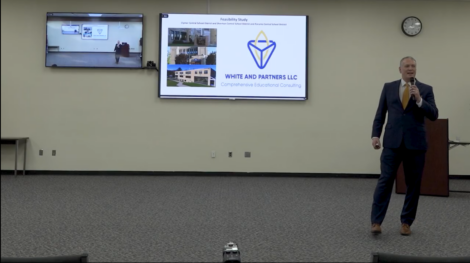
Dan White of White and Partners presents to those in attendance at the CSP Merger Feasibility Study Kick-Off meeting Thursday night. Screenshot courtesy of Clymer Central School’s website
ASHVILLE — The merger feasibility study being done for Clymer, Sherman and Panama Central School Districts is officially underway, with the kick-off meeting for the public being held Thursday night.
At Thursday’s meeting, following an introduction from David O’Rourke, BOCES superintendent, the consulting firm that was hired to do the study for the three schools, White and Partners, presented their plan to those from the public that were in attendance.
Dan White from White and Partners began by introducing their firm, saying that they are a group of retired school administrators. The team had the chance to walk through all three school facilities earlier the day of the meeting, and acknowledged the faculty, staff and administration of all three districts for their hospitality in that. White also acknowledged the work of the three school boards, including those in attendance at the public meeting.
“Our intent this evening is to really do three things,” White said. “We want to talk to you about what’s going to happen with the scope, the process and the methodology we’re going to use to conduct this study. We are intending to do this in a way that is independent, objective and comprehensive with analysis and actionable recommendations.”
White noted that the company does not walk into the study with a predisposition as to what should happen, and that the feedback from the community, the information they look at and the analysis that is performed will lead them to that. Additionally, he said they will be providing recommendations for the three school boards to consider, and do not tell the boards what to do.
White went back to introducing the team briefly, saying that they have experience and expertise, with a focus on being transparent throughout the whole study process and conducting it with integrity and care.
“We’re parents, we’re educators,” White said. “We care about kids. We care about schools. We care about communities. We want them to be successful. That’s our framework as we move through this.”
White then introduced the individual team members and talked a bit about their backgrounds, which for him includes experience as a District Superintendent, a superintendent, high school principal and school counselor. White is a project leader for the study, alongside Linda Quick, who is originally from Cattaraugus County, spending a big part of her career at Cattaraugus-Allegany BOCES, also spending part of her career as a school superintendent after leaving her district superintendent position at her BOCES.
Educational Consultant for the team, Sharon Huff, is a retired superintendent from Cattaraugus Little Valley, and is a former high school principal and teacher. Financial Consultant, Scott Covell, is a retired assistant superintendent for business, starting his career in Oswego County and moving through a few different schools in that area. The final team member, Project Consultant, Thomas Burns, is a retired district superintendent from Saint Lawrence Louis BOCES in the North County, and White said his job is data analysis, having been through similar processes multiple times.
Following introductions, White went into the timeline of the study, beginning with Thursday’s kick-off meeting. The plan is for the study to be conducted from January to the middle of June.
“The middle of June is a report, as you can see, June 15 or on or about a final report, public report, to all three boards of education, a report that will be made public to the community as well,” White said.
The data analysis and input gathering process of the study is going to take place between January and the end of March. In April the team will be working on doing their analysis, with the requirement of getting a draft report to the state education department by May 1. White provided meeting attendees with a condensed version of the expected timeline, including surveys, community forums, focus groups, data reviews, interview requests, leadership committees and steering committees throughout the time between the end of January and up to April.
Quick then discussed the team’s approach to doing the study, which is focused on collaboration.
“We believe that these conversations are only successful when we get your input, your involvement and your collaboration with us,” Quick said.
This collaborative approach includes the kick-off meeting, data review and calendar, leadership meetings, steering committee meetings, and stakeholder and community engagement, all of which are important pieces of the puzzle to have a successful study, Quick said, to have a final report that community members will appreciate, understand and accept as being well thought out and reasonable.
Quick briefly spoke on each of these puzzle pieces, some of which have already started such as the kick-off meeting and data analysis. Bi-weekly meetings are set with each school’s leadership teams, made up of the superintendents, and each board’s president and vice president. These are meant to keep the boards informed and to receive feedback and information on the process, and those have started as well and will be happening every two weeks.
Quick then discussed the schools’ seeking to form a steering committee this month with the help of multiple members of the community; students, staff, parents, administrators and community members. The committee will meet monthly January through May and the intent is to help get a gauge on what is happening, review and make suggestions on the process, and seeing and helping to understand the raw data.
“But, they’re also a liaison back to their various groups, because they’re going to be sitting at the table, seeing the data, understanding what the process is as it is unfolding, and so we want them to really be a help to our eyes and ears in the community,” Quick said.
As far as stakeholder and community engagement go, Quick said an important piece of the puzzle is getting community feedback and providing the ability for community members to ask questions and engage in the process. These types of meetings will be coming, including in a survey that will be going live on January 28 for all community members, and will be on the districts’ websites. The survey is to help the consultants get the feelings and perceptions in the communities around the merger process, and will be open until about mid-February.
In-person meetings for all three communities are being scheduled, starting at the end of February and going through the second week of March. Focus groups will be formed from specific chosen people and groups, and the consultants will go out to each of the communities, with an open community forum at the end of the day for anyone who wants to come.
There is also an email available for stakeholders to send in and ask questions, CSPstudy@e2ccb.org, and there will be a Frequently Asked Questions document that will be updated regularly.
The final analysis that the consultants will be doing is broken down into seven sections; enrollment projections, instructional program, student opportunities, and support services, facilities and food services, student transportation, staffing, financial and economic analysis, and community/school culture.
Quick went over each of the seven sections with attendees, beginning with enrollment, which she said has dropped both across the state and in the three districts, something she said is at the heart of most of the work being done in this process, and something that is already in the process of being looked at. Staffing and looking at how each district is organized is already being looked at and analyzed as well, and how combining the districts could work, including aspects such as hiring. Instructional and extracurricular programs will be looked at across the three districts, along with other supportive services such as mental health and counseling and technology platforms. Looking at facilities and food services has begun with the tours that happened earlier in the day, and the existing facilities will be analyzed along with transportation facilities. Finances will also be looked at, getting a feeling of what each district looks like today and how having a consolidated district may help in that regard.
The final aspect being looked at is the community and school culture, which was noted to be unique to each of the three school districts. Additionally, all of the different groups and surveys are to gather information on the school communities and how the study will work within them. Meetings will be held with town and village officials as well, along with local employers.
The kick-off meeting ended with a return to the overall study timeline. Quick touched on each aspect of the condensed timeline, saying steering committees should be formed by the end of the week and will start meeting at the end of January. Other meetings have already begun, with other informational gathering aspects planned to start soon. White then discussed the end of the study report, reemphasizing the importance that community feedback will have on the overall process.
“You’re here this evening,” White said. “You obviously have interest. We want your input. We want your feedback. There are opportunities to do this, significant opportunities.”
White reminded attendees of the planned survey, community forums, Frequently Asked Questions document, and keeping informed through district websites and by coming to meetings, along with the importance of communication from each district to the communities.
More information on the overall merger process, including the video and slideshow from Thursday’s meeting is available on all three districts’ websites.