A Silent Voice: Homicide Victim Remains Unidentified After 42 Years
ELLERY – It’s been more than three years since cold case investigators released a new sketch of a woman found dead in Ellery on Dec. 6, 1983.
Since then little has changed in the case of Ellery Jane Doe – though Tom Tarpley told The Post-Journal recently that the Chautauqua County Sheriff’s Office is still investigating the case while hoping a tip from the public eventually helps solve the the mystery of Ellery Jane Doe.
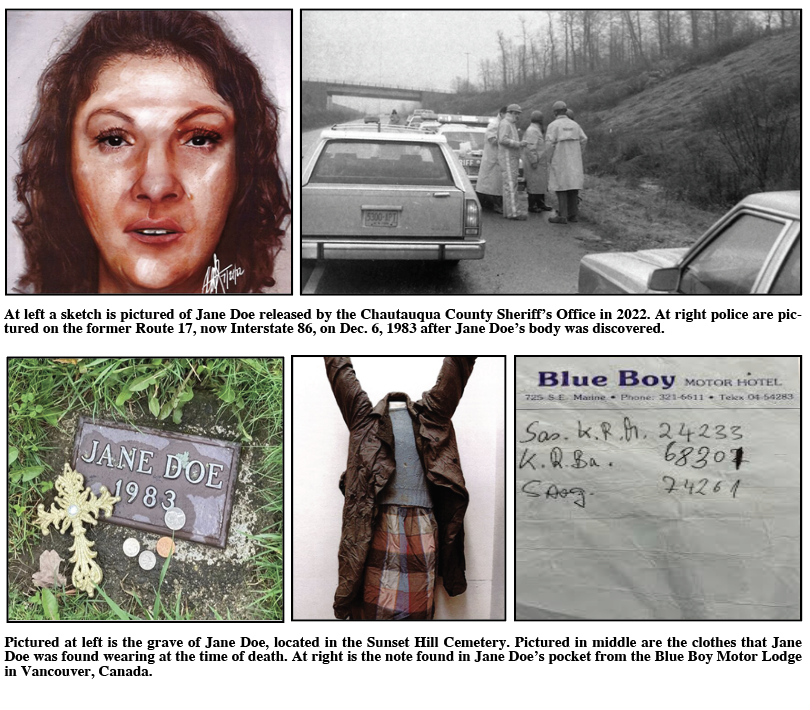
“The Chautauqua County Sheriff’s Office continues to actively investigate the December 6, 1983 homicide of a female who was found shot to death along Route 17/Interstate 86 in the Town of Ellery. When the victim could not be identified she was named ‘Ellery Jane Doe.’,” said Sheriff’s Office Investigator Tom Tarpley. “We ask the public to once again look at the forensic artist sketch completed of “Ellery Jane Doe” along with photographs of the clothing she was wearing when her body was found, and a picture of the crime scene.”
THE STORY
On Dec. 6, 1983 members of the Niagara Mohawk Power Corporation would set out to begin the usually scheduled early-morning work along the former Route 17, now Interstate 86. The workers would stop about 1.5 miles eastward beyond the Chautauqua Lake Bridge. Snowfall had previously covered the area for about two days, but on this morning a rainfall had mostly eliminated any snow that would remain. With the ground clear, workers noticed something strange in the ditch along the left side of the road at about 8:30 a.m., and approached to investigate. Without realizing it, the workers had just stumbled upon one of the greatest mysteries within Chautauqua County, which 42 years later remains as shrouded in mystery as the day it was discovered.
Upon approaching, the worker’s fears were confirmed, they had just located a deceased body that appeared to have been disposed of along the side of the expressway. The body was lying face up, described as “partially clad”, and appeared to have possibly been the victim of a sexual assault as well. The woman appeared to be in her late 30s according to reports, with estimates putting her age between 30 and 37 years old at the time of death. The woman had two moles, one on her left cheek and a 15 mm raised one behind her left ear, along with a wart located above her left eyebrow. There was a T-shaped scar on the victim’s neck, and her blood type was A+. According to reports, the woman was about 5’4″, and weighed about 128 pounds. The woman was found without any jewelry, identification, or even shoes. The only thing the woman seemed to carry on her was a mysterious note with three unidentified series of numbers and letters. Countless efforts to identify the woman have turned up nothing. No Interpol reports have shown matching descriptions for missing persons, DNA attempts have not yielded any conclusive results yet, no success was had in attempting to identify her through fingerprints, and nothing has come back as a match on her biometric data that numerous international missing person groups have. With so many paths leading to dead ends, the case only continues to get colder and colder with time.
The woman was almost immediately identified as a victim of a homicide. Investigators noted that it appeared she had been shot four times; once in the back, twice in the chest, and once in the mouth. While investigators have stated that the shot inside the victim’s mouth may allude to an execution-style killing, this explanation posed more questions. For example, if the victim had been killed by an initial execution-style shot to the mouth, then why would the killer have continued to fire three more rounds into her? Furthermore, how could the killer have fired shots into both her chest and back once she had been deceased without strangely flipping the victims over? This could suggest that the victim’s shot to the mouth may have been one of the final shots to the victim, and that the initial shot may have been the lone bullet wound on the victim’s backside.
While no definitive location has been listed for where the woman could have initially come from, many are in agreement that she likely came from somewhere outside of the United States. The clothing found on the woman’s body would be the first clue to suggest this. The victim wore a green, red, and brown checkered trench coat, which was reversible to an olive drab wool. She also wore a homemade plaid wool skirt, and a blue-grey crewneck. Additionally, the victims wore a white V-neck camisole, something that was only available in Capri, Italy at the time. All of the clothing that the victim was wearing was considered to be of value, suggesting that the woman likely came from an upper-middle class background. This further complicates the investigation by making one wonder why the woman had made her way so far.
Other evidence available suggests that the woman is of European descent. At the time of death, investigators noticed that the victims had some expensive dental bridgework that had been done, which had used gold. This not only further suggests that the woman came from some wealth, but also narrows down her possible location of origin. Counties such as West Germany, Switzerland, and Italy were amongst the countries that more commonly offered this gold dental work. Investigators would also find that the woman had an IUD, which had been foreign made in Finland, Belgium, or Holland. Investigators also stated that the type of IUD was available in Canada at the time, yet not available in the United States. While available in Canada at the time, the Canadian Encyclopedia noted that IUD usage was at a mere three percent amongst Canadian women in 1984. Based on the legal types of IUDs in the 1980s, and based on the estimated manufacturing countries, it is likely that the victim may have had a copper IUD. There were some copper IUDs available in Canada at the time, and while also available in the United States heavy restrictions limited many copper types. Importantly though, copper IUDs were available at the time in many of the suspected European countries of origin, including the suspected countries of West Germany and Italy.
Despite large amounts of evidence suggesting European heritage, investigators believe that the woman may have arrived in the United States from Canada. A note in the woman’s pocket was found to be from the Blue Boy Motor Hotel, formerly located in Vancouver, Canada. The note contains three lines of text, reading “Sas.k.R.h. 24233, K.R.Ba. 68301, Sarg. 74261”. There have been no successful attempts to decode what the note means, though it is believed to be transportation or contact information of some kind. Additionally, no employees of the Blue Boy Motor Hotel ever recalled seeing the woman at the hotel, according to public reports.
Why would a woman that appears to be from a family of wealth find herself traveling through Ellery? Furthermore, what circumstances would have pushed a person from wealth to immigrate from Europe in the first place. Based on the information that has been provided it seems appropriate to say that the woman may have been from West Germany or Italy. If either of these countries were her location of origin, an explanation might be available as to why she immigrated. At the time, West Germany was at the frontline of Cold War tensions. While not inherently unstable at the time, West German also did exhibit many restrictive social norms for women. The United States may have looked appealing to women that were seeking a life change or trying to grow their independence. Italy seems to have an even stronger explanation for an upper-middle class woman wanting to leave at the time. Italy was experiencing the Years of Lead from the late 1960s to the late 1980s. The Years of Lead saw a period of incredible political instability plague Italy, with terroristic attacks breaking out from both left-wing and right-wing extremist groups. The idea that the woman may have been from wealth supports the idea that she may have been fleeing closely targeted violence, or just simply seeking greater stability. The woman’s entrance through Canada first also fits both of these migration narratives. United States immigration was seeing more restrictions put in place at the time. Many European immigrants would first go to Canada. This is because Canada had far fewer entrance restrictions for immigrants, and once in North America it was much easier for these immigrants to continue the process of entering the United States.
“In the ensuing 42 years since her body was found by a utility crew working in the area, ‘Ellery Jane Doe’ remains unidentified. Advanced forensic analysis of Ellery Jane Doe’s DNA, dental work, and fingerprints here in the United States, Canada, and around the globe has not led yet to her identification, or to the identification of any of her family members,” said Tarpley. “Following a recent media release by the Chautauqua County Sheriff’s Office noting the 42nd year anniversary of Ellery Jane Doe’s murder, the Sheriff’s Office received new leads which are being investigated.”
Despite the four decades that have passed since finding the victim, the woman’s identity still remains unknown. The woman is currently buried at Sunset Hill Cemetery, with her gravestone simply marked Jane Doe. Anybody with information is encouraged to contact 716-753-4231, or email unsolvedchautauqua@sheriff.us.
Top stories

Chautauqua’s Got Talent Opens 16th Season At Spire Theater
Legislator Wants Elected Officials’ Salaries Disclosed
MAYVILLE — In 2024, the Chautauqua County Legislature, without any Democratic support, approved significant pay ...

UPMC Chautauqua Hosts Trainings For Rare Birth Emergencies

Scott Forster Appointed Police Chief At Voting Session

City Woman Faces 17 Charges Of Child Welfare