Plenty Of Tales To Know About Turkeys
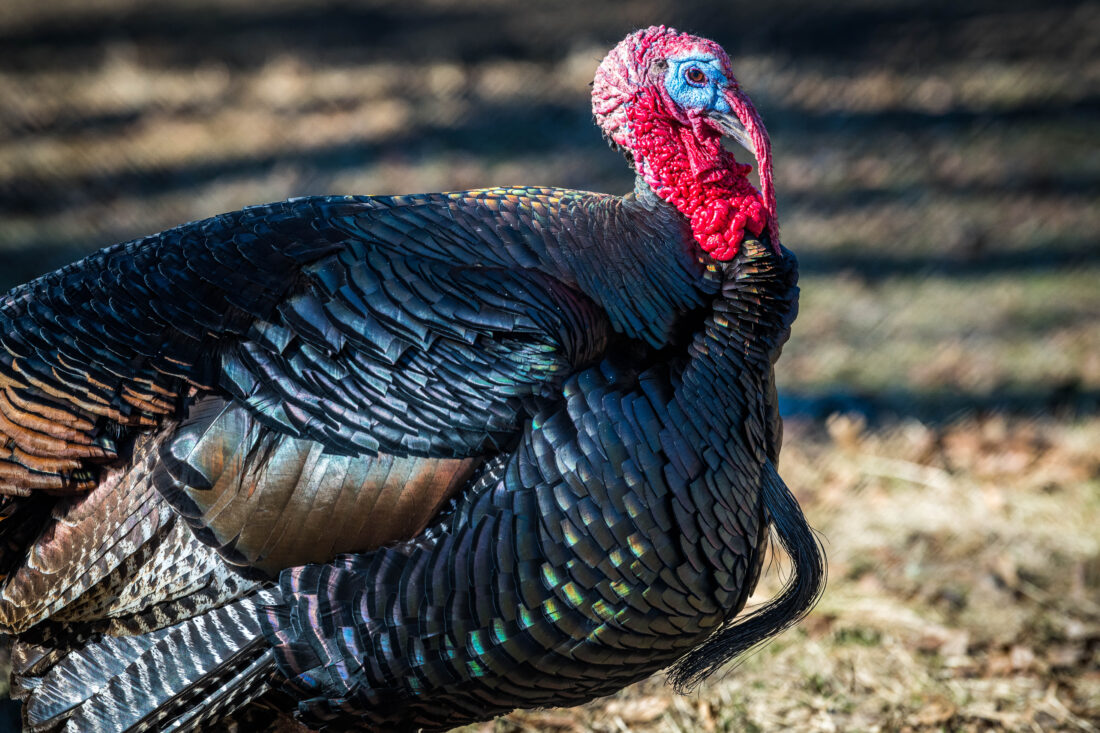
A mature tom showing off his colorful head, dangling snood, and long beard. Photo by Don Sniegowski
Gathering around the holiday table might include turkey as part of your shared meal with family and friends. Whether it’s grocery-bought or hunted from the land, Wild Turkeys are much more than a delicious centerpiece at the dinner table.
Wild Turkeys are known for their large stocky build, wide chest bones, and long feathers. At first glance, males and females appear to look similar – large dark-colored birds with small heads often spotted grazing in a field. Turkeys have small heads compared to the size of their body, but they have excellent eyesight which helps them forage for small insects and detect predators in their habitat. They are seen with breathtaking iridescent plumage (if the sunlight hits it just right). These feathers are located on their chest and side. Most commonly seen during breeding season in the springtime, a male’s wing feathers are puffed out and dragged on the ground in an enticing display for the females.
Male turkeys grow a beard over their lifetime, but it is not a full beard like Santa Claus has. A Wild Turkey’s beard is made up of a cluster of longer, thicker hairs that sprout together from their chest. In an older tom bird, these beards grant great amusement as they comically stick out. Younger jake birds have smaller beards, starting to grow when they are just a few months old. Turkey beards are sometimes found on female hens as well, but are much smaller and hard to see. Although the purpose of a beard is somewhat unknown, many speculate it’s an indicator of health and dominance. The longer the beard, the more hens a tom will attract.
As part of the turkey’s unique appearance, their heads act as nature’s mood ring. Changing colors ranging from white, blue, and red give other turkeys and humans a sneak peek into their mood and health. In addition to their interesting way of displaying emotions, a long stretch of red flesh drapes over a tom’s beak, called a snood. This dangling snood helps signal courtship to hens and when it shrivels up, this sends a message that danger is nearby.
The iconic ‘gobble gobble’ may have crossed your mind when thinking of turkeys. This loud rumbling sound is one of many ways that turkeys talk to one another. Yelping and chirping are some other common sounds from these birds, as a soft clicking sound when they feel safe and content, or a repeated scratching sound that hunters use to attract adult tom birds.
Seeing turkeys wander in a field are tell-tale signs of a well-balanced ecosystem. When turkey eggs hatch, the hen will guide her young away from the nest, teaching them how to peck for seeds, berries, and insects. Ticks, among other insects we consider bothersome, are a turkey’s go-to snack. As they pluck insects from blades of grass with the help of their excellent eyesight, this helps decrease the chances of other animals getting tick-borne illnesses. A single turkey can consume around 200 ticks a day.
Hatched at the start of summer, these poults, or baby turkeys, are raised from a camouflaged nest hidden under brush. Most often, groups of hens will be spotted together with their newly hatched poults and stick together. Safety in numbers are important for vulnerable groups with youngsters. By having a steady population of turkeys, it is a sign that there is enough food for all groups of the food chain. I have found that depending on where you are in the state of New York, Wild Turkeys behave in very different ways. Growing up in Staten Island, a highly populated and very small island, it is home to an outrageous number of Wild Turkeys. With nowhere for them to go and no regulated hunting season, these turkeys have become confident and curious. Walking up to people’s homes or standing in front of vehicles, this greatly contrasts the shy and cautious nature of Wild Turkeys in Western New York.
Another bird common to this area that shares the name “turkey,” is the Turkey Vulture. The head of a Turkey Vulture looks similar to the Wild Turkey, both with their red coloring. Vultures keep their heads feather-free in order to effectively rip apart carcasses without getting residue on their heads. Their behavior is much different than the Wild Turkey, first starting with their appetite. These birds are known for their scavenging behavior, feeding on remains such as roadkill.
Turkey Vultures are considered the ‘cleaners of the natural world’, helping break down and recycle carcasses. These scavenging birds help kickstart the decomposition process, especially on the side of the road where animals are most often found deceased. Where there is a Turkey Vulture soaring low to the ground, picking up the scent of death nearby, you are likely to find a carcass. Vultures fly much differently than Wild Turkeys. Using their long wings to their advantage, Turkey Vultures have a clumsy flight pattern, dipping and turning their wings to catch wind as they soar in an upward ‘V’ shape. On the other hand, Wild Turkeys seldomly fly, and when they do, it is commonly to their roosting spot in high branches to rest for the night.
The next time you encounter a Turkey Vulture soaring above, I encourage you to send a quiet ‘thank you’ its way for keeping our roads clean and safe. Wild Turkeys also deserve their own thanks as well, for many dinners provided from their meat and much needed insect patrol.
Top stories

Second Person Charged In Relation To 2025 Shooting

Person Charged After Shooting, Chase
Town discusses Dewittville water district extension project
Officials are hoping to start construction on a new water district extension in the Dewittville area by next year. ...
Person Charged After Shooting, Chase
Humane Society Begins Capital Campaign
The Chautauqua County Humane Society is accepting contributions for its new capital campaign. The overhaul of ...