Local Freshwater Pesticide Bans Vetoed
Gov. Kathy Hochul has once again vetoed legislation opposed by Chautauqua County’s state representatives that would allow local governments to ban freshwater pesticide use.
State lawmakers once again passed legislation (A.6930/S.5983) that would have given local governments which have implemented a freshwater wetlands protection law or ordinance to adopt a local law or ordinance prohibiting the application of pesticides to wetlands, provided that such laws allow for the use of pesticides for the control of invasive species, pests of significant public health importance, or noxious weeds; or for the protection of critical native plant species.
Local laws would have been limited to wetlands hydrologically connected to a source of public water supply. The bill passed the state Assembly 97-46 largely along party lines with Assemblyman Andrew Molitor, R-Westfield, voting against. Senate approval came via a 40-9 vote with Sen. George Borrello, R-Sunset Bay, voting against it. There was no debate on the floor of either chamber this year.
Burdick said during flood debate in June that, following Hochul’s veto, the bill had been changed to limit the application to wetlands which are hydrologically-connected to any public water supply, to make it clear that the bill would not prohibit or limit the use or application of pesticides used in farm operations as defined in Section 301 of the Agriculture and Markets Law. Burdick said the law also would not prohibit pesticide applications for the control of invasive species, pests, noxious weeds or for the protection of native plant species.
“The DEC review process is basically nonexistent, to be very candid about it,” Burdick said during floor debate on the bill in June. “It’s filling out a form that you’ve got your permit, your certification number as an applicator, and that’s about it. And then if it checks out they’ll look at a database to make sure that, you know, that license is current and so forth, and that the pesticide that’s listed is one that’s been approved. That’s it. And so that’s my concern, is that I think we had a void here. That we have a gap here. And it’s to provide the opportunity, again, at the local option if a locality wants to go further. And if I would hazard a guess there are probably not too many municipalities in your own district that have adopted local wetland laws. But if they did, then they still have the option whether or not they wanna take this further step.”
Assemblyman Matthew Simpson, R-Queensbury, questioned sponsor Christopher Burdick, D-Mt. Kisco, before saying he feared the bill would create confusion between DEC rules and local pesticide bans.
I agree with those that we received opposition letters of,” Simpson said in his floor remarks. “This will create a patchwork of regulations and interpretations. And, you know, when I talked about the planning boards, you know, that’s a political body that – and I’m sure there are qualified people in some municipalities. But as I said, those resources are controlled by that legislative body, and not every community is gonna have the resources that, you know, others do to apply this. But they may very well feel the pressure of controlling and having stronger regulations than DEC because that’s just the way politics is. One side wants more regulation, one wants less. So for those reasons I’m gonna continue to oppose this bill and I would urge my colleagues to consider that as well.”
Top stories

Kennedy Man’s Parents Organizing Benefit

JHS Student Faces Weapons Charges
Heritage CEO: Closure Helps Save Other Buildings
Following the announcement earlier this week that Heritage Ministries’ Gerry facility, Heritage Village, will be ...

From ‘Paige’ To Stage: Former P-J Reporter Pens Play About Prolific Pitcher
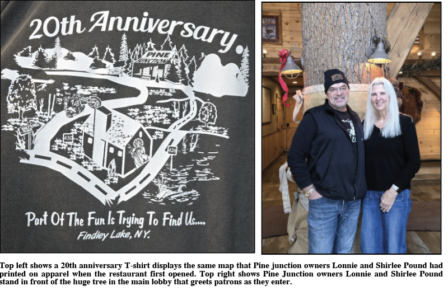
Hidden Treasure: No Hiding Pine Junction’s 20 Years Of Popularity