
Lakewood Won’t Support Lake Plan
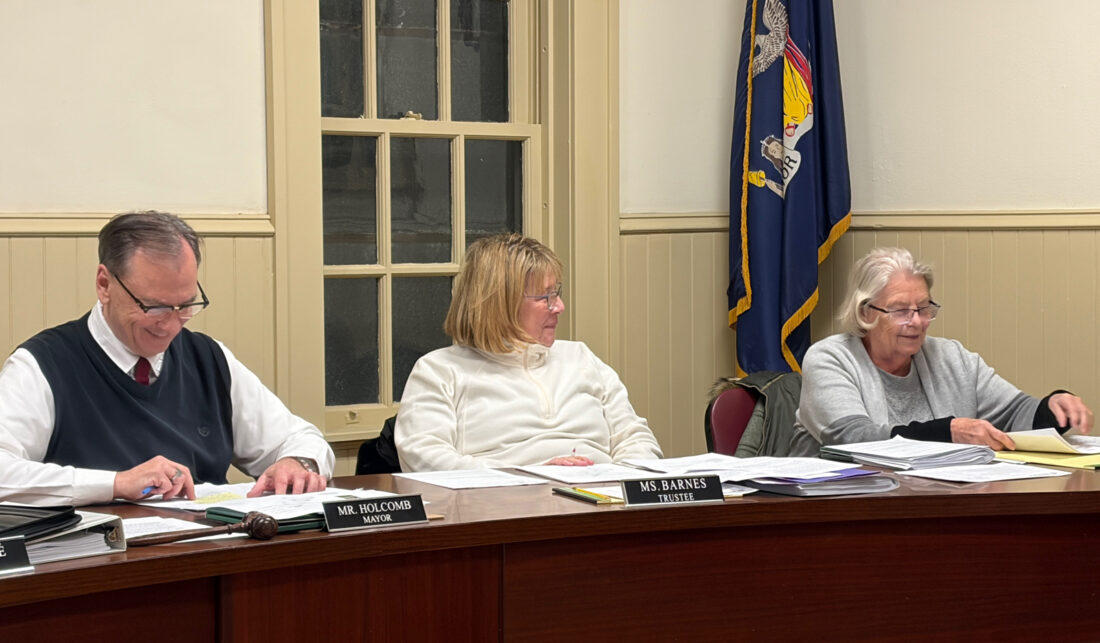
From left, Lakewood Mayor Randy Holcomb, Trustee Ellen Barnes, and Trustee Nancy Jones reflect on Jones’ tenure as a trustee. It was Jones’ last meeting as she retired from being a trustee. P-J photo by Michael Zabrodsky
LAKEWOOD – A proposed Chautauqua Lake Management plan is “dead in the water.”
After much discussion, and by a vote of 3-2, trustees voted Monday not to support a resolution concerning the five-year Chautauqua Lake Management plan that was proposed and developed by Dr. Robert Richardson of North Carolina State University. In January trustees voted 3-2 to not support or adopt a long-term plan for the submersed aquatic vegetation in Chautauqua Lake.
“I think I speak for a lot of people when I say we’re looking for positive results from our actions in the lake, and I think we can all agree that none of us want a repeat of last summer’s conditions,” said Trustee Ellen Barnes.
She added that the lake management plan would address the excessive aquatic plant growth, would be adjusted annually, and would be managed on an annual cycle by a central lake manager.
“This plan was developed for Chautauqua Lake, specifically by nationally recognized experts in the field of aquatic plant science, with over five years of studying our lake alone,” Barnes added.
Trustee John Shedd said that there is research that needs to be done to verify what is causing the algal blooms and the excessive macrophyte growth. The New York State Department of Environmental Conservation, he added, is doing a study on the internal load on the bottom of the lake. The U.S. Army Corps of Engineers is also studying what is happening in the lake in conjunction with the Jefferson Project, which is also doing analyses and findings for lake activities, Shedd noted.
“In fact, there’s an interim report coming out January 28 from the Jefferson project at the county legislature meeting where that project will be, identifying what their current findings are,” Shedd added.
The Jefferson Project, which has been headed up by Chautauqua Institution, should have its study completed by 2026. The Jefferson Project has mainly been focused on harmful algal blooms (HABs).
“And I don’t see the merit behind endorsing any kind of resolution, supporting it (The NCSU Plan).
Trustee Nancy Jones said it is time that the NCSU plan is a step in the right direction.
“If we just keep kicking the can down the road, where are we going to end up with a swamp,” Jones said. “You can buy good farmland out there in a few years if we don’t start doing something instead of just saying, ‘well, it’s not a bad plan or whatever. It’s a step to try and get something done. … And this, this will at least get us started. It’s just a step forward.”
Jones added that she doesn’t think there will be a consensus among various lake groups to use one plan. She said different groups give different views.
“I’m so discouraged about it,” Jones noted. “You may not like everything in the plan. We’re not going to get a consensus where everybody says, ‘Well, it’s a great plan, but I don’t want anybody to harvest or it’s a great plan, but please don’t use any herbicides.’ It’s going to have to be something that we’re all going to have to give a little bit about.”
Barnes added that there is not a current plan for the lake.
“OK, there’s been no plans implemented in this lake at all. It’s this group going out and doing what they get the money for, and that group going out doing what they get the money for,” Barnes said.
At their November 24 meeting, trustees tabled a resolution of sending a letter to DEC Region Nine Director Julie Barrett O’Neill, and Pierre Chagnon, president of the Chautauqua Lake and Watershed Management Alliance, Mayor Randy Holcomb on behalf of the trustees and village residents is in support of the plan.
Also by a 3-2 vote, the letter will not be sent.
In other business, trustees thanked Jones for her time on the board as she will retire from being a trustee.
“Nancy, thank you,” said Mayor Randy Holcomb. “We appreciate it very much – what you’ve done for us for four years.”
Top stories

Lakewood Won’t Support Lake Plan

‘Belongs To Everybody’: St. Luke’s, JRC Rededicate AIDS Memorial Park
Public Hearing For Dewittville Project Is Wednesday
Another public hearing will take place this week regarding a proposed $70 million development project at the former ...

Sparring Continues Over Power Grid

Man Charged With Animal Abuse, Neglect
Alleged crossbow murderer arraigned in county court
A Jamestown man has officially been indicted in a murder earlier this year in the city. Chautauqua County ...