
Century Farm Has Connection To Robert H. Jackson
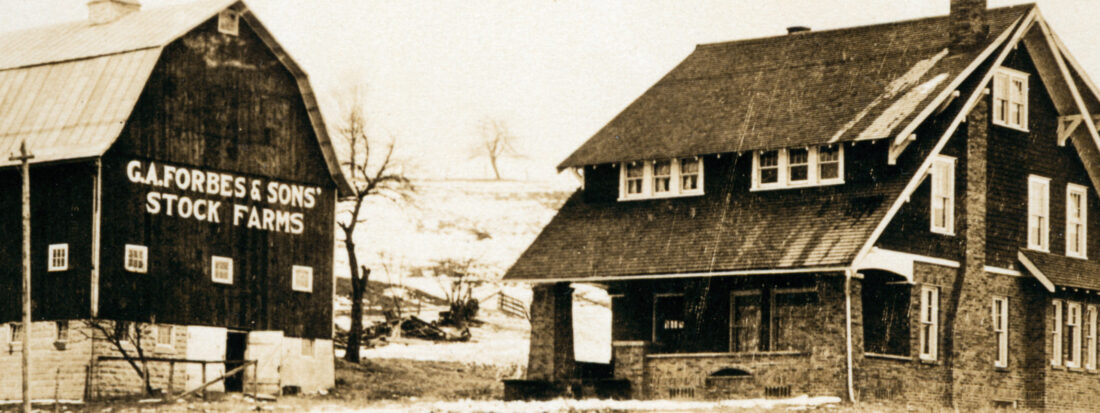
Shown is G.A. Forbes and Sons during the time of the 1925 legal case with Robert H Jackson. Submitted photo
Editor’s Note: This article continues the series on historical places in Chautauqua County, focusing on Forbes Farms, which existed in Jamestown until recently.
The Forbes Family Dairy Farm was first established in 1920 at the end of Willard Street Extension.
Grant Forbes was the original owner, and he would also become a key figure in the establishment of Robert H Jackson’s career.
In 1923, there was a typhoid outbreak in Jamestown, which the public health officer at the time connected back to the raw milk being sold by G.A. Forbes and Sons Dairy. The dairy took up 100 acres next to Cassadaga Creek, and the source of the typhoid was found to come from the particular milk delivery routes the farm had.
The farm’s license was canceled and they were told they could not sell milk for three years. The Forbes family took it to Chautauqua County court. “My great grandfather hired Robert H Jackson to defend him when he sued the city of Jamestown,” said Bill Forbes, a Forbes family member who grew up on the farm. “They ended up winning a large settlement from it.”
The case would end up as two separate trials in 1924 and 1925, where Jackson would argue for the family that the typhoid came from pollution in Cassadaga Creek. Jackson would win at both trails, winning the Forbes family a settlement of $13,000. It is also believed that these lawsuits led to the city of Jamestown planning a proper sewage system for the city, instead of what leaked out into Cassadaga Creek.
The full details of the case can be found on the Robert H Jackson Center’s website, under Robert H Jackson and the Forbes Family Dairy.
Bill Forbes’s father took over the farm and his parents owned the property. Forbes grew up on the farm, where they milked 80 cows, until he left with his wife in 1976. The Forbes family was known for having some of the best Holstein cows in Western New York, setting multiple product records. Some of their bulls were also sold into the Artificial Insemination business.
“We had three Holstein bulls in the 60s and we sold two to American Breeders Service and one to Eastern AI in Ithaca,” Forbes said. “We took very good care of them and at six months old they were sold and my dad was paid $1000 for them.”
Forbes added that those types of things happen less these days, saying that a statistic shows only 18% of bulls taken for breeding purposes come from farms outside of the company these days.
Forbes Farm also had seven different types of soil on their parcel of land, including well-graded gravel and flooded soil.
Forbes said keeping the farm alive for so long meant a lot.
“It’s a legacy because my dad lived his whole life on the farm,” Forbes said. “It’s a tradition of ownership, and taking care of and maintaining it is important.”
Forbes’s dad died in 2001.
These days, Forbes said the property looks “completely different.” An Amish family bought 40 acres of it at an auction about 15 years ago, and Stephen Cass bought the rest for deer hunting purposes. Forbes said the Amish family now has seven buildings there, including a general store. He added that the original house burned down a few years ago and that the barn has not been used in a long time.
This is one of many things Forbes said has changed over the years.
“It’s a good way to raise your family, but as the years go by it’s harder to show a crop,” Forbes said. “There are two farms that still produce milk in that area. When I was a kid there were 18 farms there. It’s the way the industry is. There have been many changes over the years.”
Top stories
Councilman Raises Issues With App-Based Parking Meters Downtown
Profits, Revenue Up As Electrovaya Continues Buildout Of Local Plant
Electrovaya, one of the newest additions to Jamestown’s manufacturing base, is projecting a roughly 30% increase ...

Search Is On For Missing City Man

Bemus Point-Stow Ferry Receives Engine Upgrade Via Cummins
Electric Bus Mandate May Be Delayed
Dems Propose End To Legislative Raises
Two Democratic county officials want to see the clerk’s pay cut in the future as well as see legislators’ ...