
Clymer Holds Public Hearing On Second Solar Project
Trending
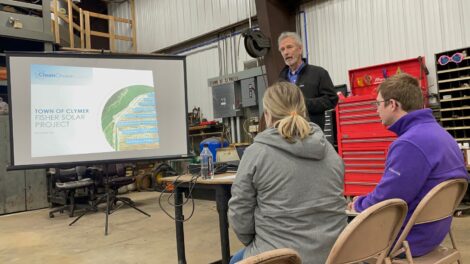
CLYMER -- A second solar project in the town of Clymer is being proposed on Clymer Hill Road.
The 5-megawatt project by Clean Choice Energy would cover 30 acres with the ability to power 1,000 homes. Clean Choice Energy is not asking for any setback variants and construction, if approved, is expected for 2024. The project will last for a duration of 30 years before decommission.
Project Manager Grif Jones, who attended a public hearing from the Clymer Town Board, said that the site selection process relies on a few aspects.
"Obviously we don't just wander down the road and say, 'There's a nice looking field, let's put solar on that,'" Jones said. "First and foremost, interconnection availability. The National Grid power line runs right through the property."
Jones added that community character is also an important factor, saying that solar projects are typically found in rural areas, mainly because of low noise and low surface structure. Other factors in choosing the site include zoning laws, visibility, and environmental impacts.
Jones said that the company has taken the time to visit the neighboring properties within 500 feet of where the solar project will be to talk to those residents about their plans. Jones also addressed other factors that members of the neighborhood might be concerned about, including no discernible noise, no decrease in traffic, a secure fence, low profile panels, panels will be screened, and panels will not let off any type of glare.
"If you think about solar panels, we do not make money if they are reflecting sunlight," Jones said. "From the Department of Energy, panels absorb 98% of light and reflect about 2%."
Jones's presentation included more key points such as revenue, no new sewer or water will be needed, the land will be able to be used for agriculture again at the end of the project, what the panels are made of, that property values should not have an impact, and compliance with the solar law. Jones also discussed PILOT and community agreements, and fire concerns.
Questions from the group included what happens if the project does not produce the expected five megawatts of power? Jones said once the project is turned on it will produce the amount expected, adding that yields do tend to drop in the winter and if it's a cloudy year, but yields do not drop as much as someone might expect. He added that even if it is producing a little bit less it is still there and still making money so it will keep going.
"Yields do drop a little bit in winter time, but they don't drop as much as you think," Jones said. "The fact that it's cloudy, I mean you go to the beach on a cloudy day, do you forget sunscreen? It's still sunny. It might not be as sunny as a full sun day, but still sunny."
Jones added that solar panels run more efficiently in the cold.
Other topics discussed centered around the three year reevaluation of the bond between the company and the town, if the electric bill would decrease, how becoming a community solar project works, house values, and environmental impacts.
There was a question about clearing trees and disrupting habitat for bats and birds on the site, and the DEC screening process was discussed, including that if cutting down trees it needs to not be during nesting season. Jones said there is no bat habitat on site. There have also been studies as to how solar panels affect bats and birds, and whether or not they might mistake them for water. Specific studies regarding bat and bird deaths because of solar panels have been done, and the studies show the effect is minimal.
More questions were asked about disrupting their environments, with the answers being that the babies will move on to other trees nearby. Projects are allowed to clear minimal trees, but not on a broad scale, needing to follow a specific amount.
Town Supervisor Brian Willink said the public hearing on the project will remain open for the December meeting.