Transparency Law For Businesses Takes Effect
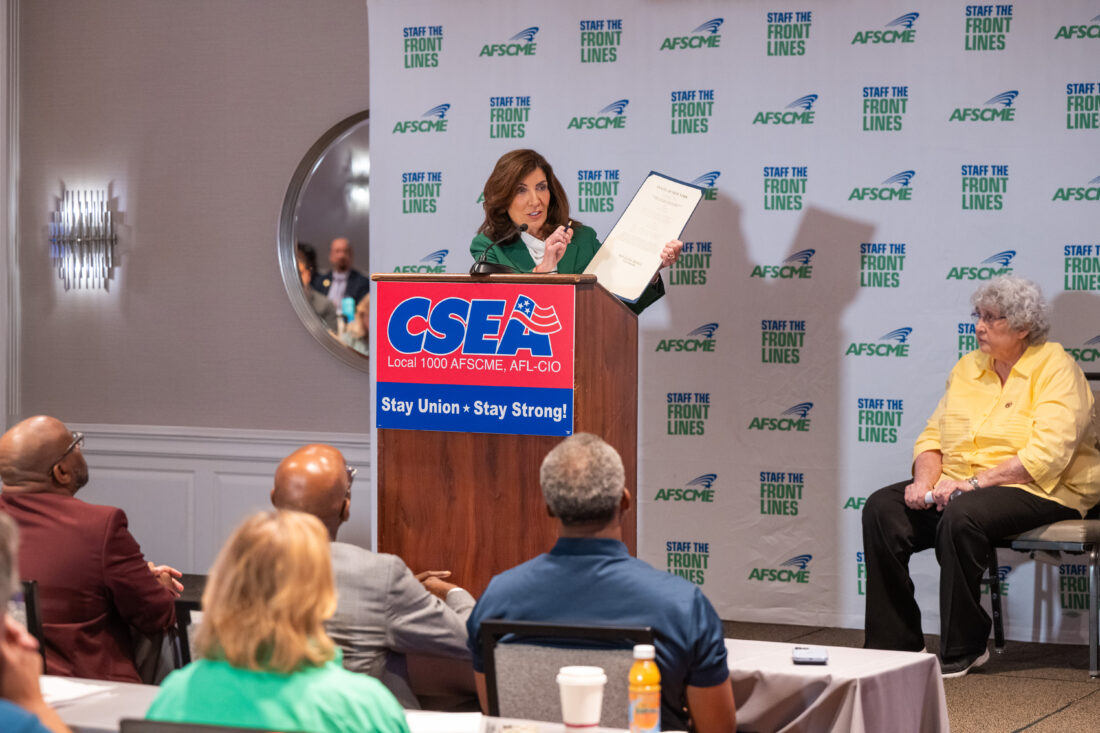
Gov. Kathy Hochul is pictured with legislation expanding civil service opportunities. Legislation Hochul signed in 2022 requiring employers to provide pay ranges in all advertisements for new hiring or promotions went into effect this week.
Businesses advertising new jobs or promotions will need to make sure they include a salary range or risk running afoul of the state’s pay transparency laws that took effect Sunday.
Gov. Kathy Hochul signed S.9427-A/A.10477, which passed largely along party lines during the 2022 legislative session, in December with the law taking effect Sept. 17. The legislation requires businesses across New York state with four or more employees to include compensation ranges in all advertisements for job, promotion, and transfer opportunities.
“With the implementation of our pay transparency law, New York is once again at the cutting edge of promoting fairness and equity in the workplace,” Hochul said this week. “Wage disparities have deepened inequality in our state for far too long and put countless workers – particularly women and people of color – at a disadvantage. I was proud to sign this legislation to help level the playing field across our state, and I will continue to work with the legislature on solutions to support, protect, and empower workers until we finally close the wage gap in New York.” The law requires all job, promotion or transfer opportunities physically performed, at least in part, in the state of New York to include a range of pay when advertised. This applies to any opportunities that are performed outside the state, including remote or telecommuting opportunities, that report to a supervisor, office or other work site in New York state.
Pay ranges must consist of the minimum and maximum annual salary or hourly compensation believed in good faith to be accurate at the time of posting. Employers must also clearly state if a position is commission-based. This law marks a significant step towards leveling the playing field, ensuring that employees have access to vital compensation information, and empowering them to make informed decisions about their careers.
The law does not require employers to create a posting for every available job, promotion or transfer opportunity and also does not does not require employers to use a specific medium for advertisements. The pay transparency law applies to newspaper ads, printed flyers, social media posts, website postings, anything sent to an electronic mailing list and emails sent to a pool of more than one applicant. Postings to third-party job sites are also required to include pay information.
Assemblyman Andrew Goodell, R-Jamestown, voted against A.10477 on the Assembly floor for several reason because it could, in his opinion, be onerous for small businesses.
“First, especially with small businesses, the actual compensation is a matter that’s negotiated between the employer and the employee, and typically reflects the extent of experience that the employee has,” Goodell said. “So in a small business, the actual nature of your job and how much you’re paid and how much you do often depends on your background and experience. And so you may have an opening, for example, I was a managing partner for many years of a law firm. I might have an opening for a paralegal. Some paralegals were great at answering the phone and copying documents, others could do a complete real estate closing. And so the range is meaningless when you have that amount of range.”
A similar pay transparency ordinance has been in effect in New York City since 2022. Other states that have passed similar laws include California and Colorado.
Compliance will be a challenge, said Frank Kerbein, director of human resources at the New York Business Council, which has criticized the law for putting an additional administrative burden on employers.
“We have small employers who don’t even know about the law,” Kerbein told the Associated Press in 2022 while predicting there would be “a lot of unintentional noncompliance.”
Top stories

Sea Lion Scrapped: Lack Of Funding Ends Planned Move To Virginia

Area Family Holding Crushing Cancer CELL-ebration April 25
County Planning Board Rejects Ripley Gravel Mine Proposal
A proposed gravel pit in Ripley is not getting support on the county level. The Chautauqua County Planning Board ...

Hosting solar can be a lifeline for farmers. But overcoming local opposition is tough
Nine Businesses Fined For Water Violations
MAYVILLE – There were nine businesses that were recently fined for violating various water regulations. During ...