
Old Lake Arguments Die Hard
Trending
Arguments about how to best manage Chautauqua Lake have been a long-lasting and contentious disagreement amongst the herbicide and non-herbicide camps for some time now.
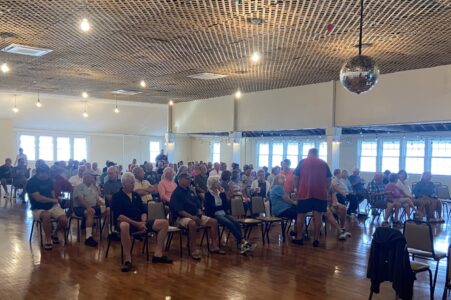
Chautauqua Lake Partnership officials recently made the case to more than 250 supporters recently why they feel herbicides should continue to be used on Chautauqua Lake, citing a recent study by North Carolina State University officials who spent time on Chautauqua Lake studying invasive weeds found in the lake. That study found, in part, the following:
¯ Growth from non-native species (Eurasian milfoil and curly leaf pondweed) can impair the recreational, ecological and economical use of Chautauqua Lake.
¯ Eurasian watermilfoil is the most widespread submersed plan species in our lake, with a 58% occurrence across the entire lake.
¯ The abundance of eurasian watermilfoil should be considered with future management decisions.
This study indicates, that while some in governmental leadership have praised the current conditions of Chautauqua Lake, it may not be out of the weeds completely -- at least not quite yet.
"Herbicides do not increase biomass (define) in the lake- they actually decrease biomasses," presented by Mike LaTone, Chautauqua Lake Partnership treasurer and local Jamestown business owner. "Herbicides do not kill native plants in the lake (according to a Princeton-hydro report conducted in 2019), they actually increase native-life plant growth." Moreover, "Herbicides do not kill or harm fish. However, weeds can and have killed them,"
Also, LaTone advocated for the beneficial impact on the local economy spraying the lake could have.
"Tourism is not negatively affected by herbicides -- it actually improves them by making the lake cleaner and returning it to a more natural setting (prior to the introduction of invasive plant life). Moreover, according to the CLP, a primary herbicide used in May 2023 to treat part of the Lake, Aquathol k, is less toxic than some very common household products such as hot sauce, bleach, cinnamon, table salt and coffee."
In stark contrast to the CLP's advocacy for herbicidal treatment of the lake. The Chautauqua Lake Association prefers to take a more holistic approach when it comes to proper lake management.
"We use harvesting to control weeds and plant growth," Douglas Conroe, the CLA's executive director said. "When harvested, plant life cycles tend to remain intact, and proper filtration and nutrient recycling happens vs a man-made herbicidal induced cycle, which releases nitrates into the water and can have devastating affects for plant and aquatic life."
Moreover, while the CLA does not fully support the use of herbicides, they're not 100% against their usage either.
"There's no one problem or any singular answer to the lake issues," said Conroe. "This is a complex issue with many facets which affect our lake. I'm not saying herbicides should never be used. There's a time and place for them to be used, and when we use them, it should be an exception to the rule, not the rule or the first go-to."
However, the CLP has a strongly different opinion on harvesting and the potential damage that it does to the lake's ecosystem.
"Mechanical harvesting -- is manpower intensive and requires a rather large payroll for employees, vehicle maintenance and insurance. All plants are harvested and there's no selectivity involved (natural or habitat normal). Harvested (accidental) fish are killed and not returned to the lake. Uncollected fragments from milfoil plants decay and clutter up the lake," CLP officials said.
Furthermore, Chautauqua County governmental officials also spoke on this matter. In a direct press release to The Post-Journal, County Executive PJ Wendel said he continues to work to unite lake stakeholders.
"Chautauqua Lake is among our county's most valuable natural resources and needs to be well maintained and protected. Over the decades there have been many groups, regulatory agencies and scientists involved in the lake management process, some with differing opinions and strategies that have sparked public disagreement and conflict. I believe in order to best maintain our lake we have to work together utilizing all tools on our tool belt. I'm proud to say Chautauqua County is working to unite all stakeholder groups involved with our lake. With a unity of effort of all stakeholders we will continue to evolve our lake management policies and maintain this beautiful gem for generations to come. Just like in nature, I feel our strategy is ever evolving and Chautauqua County is currently seeking additional funding sources to further environmental efforts. If you missed our recent Chautauqua Lake public meeting, visit chqgov.com/CHQLake to view the county's presentation and submit your comments to CHQLake@chqgov.com. Community feedback is a vital part of our planning process," Wendel said.