Bed Tax Bill Would Require Increase In Lake Spending
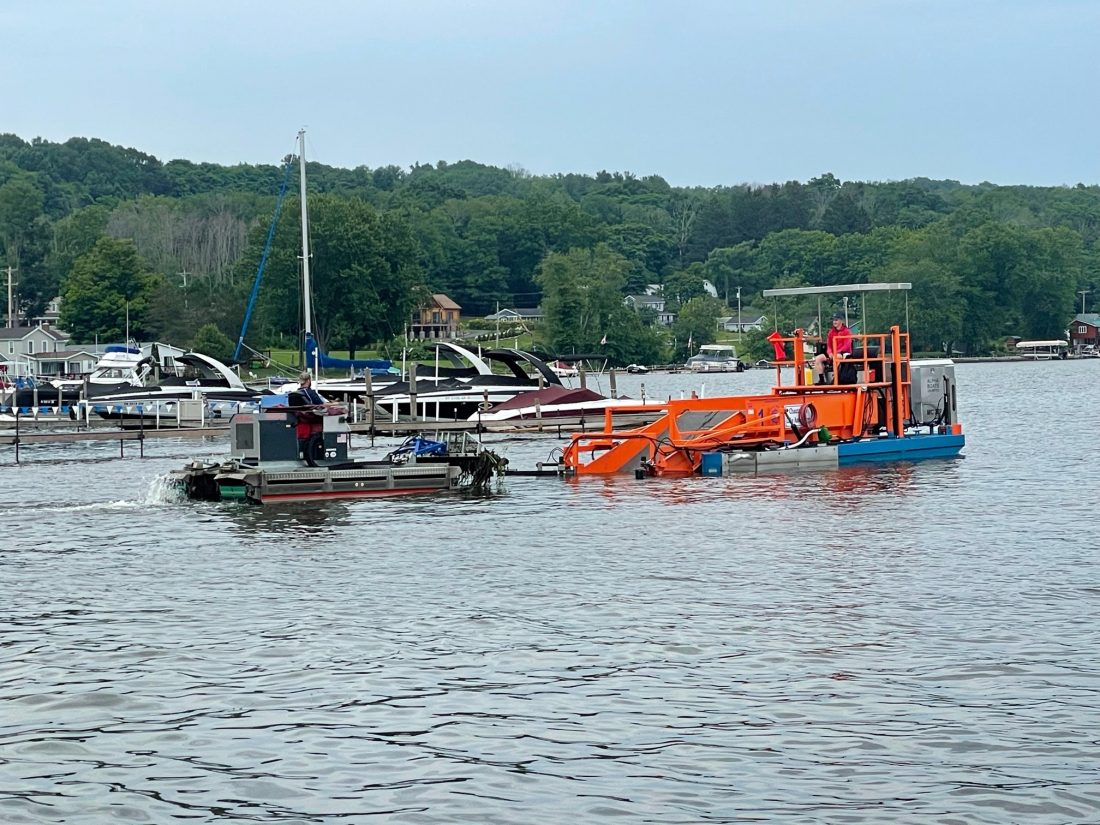
Pictured is a Mobitrac, left, operated by the town of Chautauqua and “skimmer” vessel, right, operated by the Chautauqua Lake Association working in coordination for near-shore cleanup on Chautauqua Lake in 2021. Photo submitted by the Chautauqua Lake & Watershed Management Alliance
Chautauqua County’s bed tax will focus more on Chautauqua Lake once it is reauthorized by the state Legislature.
Legislation introduced by Assemblyman Andrew Goodell, R-Jamestown, and Sen. George Borrello, R-Sunset Bay, both extend the bed tax for another three years through Nov. 30, 2026, and require more of the bed tax be spent on Chautauqua Lake maintenance.
Under the new bed tax formula, at least one-half of the money in the tourism and convention fund must be allocated to the Chautauqua County Visitor’s Bureau, with the rest used for trade shows, special events, parks, recreational facilities and tourism attractions. The biggest change is that one-half of the money in the Lake Management and Enhancement Fund be used for control, treatment or removal of invasive and nuisance weeds, reduction of harmful algal blooms or shoreline cleanup. Remaining money can be used for fishing, boating or recreational activities, reduction of watershed erosion, sedimentation and nutrient loading or similar activities.
According to the bill’s legislative justification, the bill is designed to make sure half of the lake management and enhancement funds are used for activities performed by the Chautauqua Lake Association, Chautauqua Lake Partnership, Cassadaga Lakes Association, Findley Lake Watershed Foundation, Bear Lake Association, and for Mobitrac and shoreline cleanup. The money is not supposed to be used for third-party staff expenses for project evaluation, supervision or related management or administrative expenses, such as the county watershed coordinator or the Chautauqua Lake & Watershed Management Alliance.
“That will result in a substantial shift, or should result in a substantial shift to in-lake management,” Goodell said. “A significant portion in the past has gone for watershed erosion projects. But the state provides for funding available through our Environmental Conservation Fund and right now we have about $4.2 million of state grants for watershed management. So my point was the tourism industry needs a healthy lake now and at least half should go for in-lake maintenance now, and we have a much much larger pot of money available for watershed management so we should focus our efforts on bringing that money in, as we have the millions that are available for that.”
Bills like this are typically taken up in the last few days of the state legislative session in June, but the Chautauqua County Legislature also has to approve the new language before it can be taken up by the state Legislature. A resolution approved by the County Legislature in March contained a request to extend the bed tax, but it wasn’t until Goodell and Borrello wrote their new draft legislative language that county officials saw specifics.
“I support these changes because they are supported by the county executive and the chairman of the county Legislature. I am always supportive of local control, particularly when it comes to things like this. Chautauqua County’s occupancy tax is very unique because it directly supports tourism and the health of our lakes and waterways,” Borrello said. “These changes will ensure that we keep that focus.”
CHANGES COMING
The push to increase spending on Chautauqua Lake maintenance comes after a four-year process to create a Chautauqua Lake taxation district ended earlier this year amid widespread opposition. County legislators then voted down a proposal to increase the bed tax and dedicate the additional money to maintenance of all county lakes.
The 2% bed tax for lakes and waterways typically generates about $820,000 a year, and Goodell said in his opinion too little of that, roughly 18%, has been spent on lake maintenance activities. Roughly $150,000 is spent for in-lake management, $150,000 is budgeted for the Chautauqua Lake Watershed and Management Alliance, $106,000 is spent on the salary of David McCoy, county watershed coordinator, and then roughly $200,000 is spent on watershed maintenance.
“Obviously if it passed, the 2% is allocated for weed control, harmful algal blooms and shoreline cleanup, bringing that up from 18% there will have to be some adjustments,” Goodell said. “Those adjustments may occur on the management side, how much is allocated for management. It may be adjusted how much is available for watershed projects or the county may want to supplement, or the foundations, may want to supplement some of those other projects.”
The county’s use of the bed tax currently includes about $233,000 for watershed projects. One change to make is to shift county resources away from watersheds and encourage watershed organizations to look for state grants instead. The state budget typically includes $300 million each year for the state Environmental Protection Fund, and there are roughly $4.2 million in state-funded watershed projects ongoing at any one time.
HEAVY INVESTMENT
The bed tax isn’t the only money being spent on Chautauqua Lake. Area foundations spent roughly $683,000 on the lakes in 2022, according to Goodell, with another $815,000 available through the bed tax. The state budget includes $150,000 for the Chautauqua Lake Association and $90,000 for the Chautauqua Lake Partnership. Each of those agencies raise their own money from area residents as well. All told, roughly $2 million was spent in Chautauqua Lake last year.
Goodell noted the state is also investing money in the Chautauqua County Soil and Water Conservation District for watershed projects, more than a million dollars a year for the Prendergast Point fish hatchery and pays to maintain 14 boat launches and three state parks. Plus, the state has invested heavily in sewers around Chautauqua Lake that will decrease the amount of phosphorus and waste that leaches from private septic systems into the lake and watershed.
“The state’s investment in Chautauqua County for our lakes is several million a year,” Goodell said.
ADMINISTRATION AND OVERSIGHT
The proposed legislation also makes clear a 10% cap on administrative positions paid for with bed tax money. There had been questions whether the original 10% administrative spending cap applied only to the actual collection of the bed tax or if it also applied to the money the legislature approved in the bed tax for use by other agencies. Goodell and Borrello make clear that bed tax money is not intended to be used for third-party staff expenses, project evaluation, supervision or related management or administrative expenses, such as the county watershed coordinator or the Chautauqua Lake & Watershed Management Alliance.
Goodell and Borrello also give the county greater freedom to impose conditions on bed tax projects as they are approved by the county. Those conditions, according to the bill, can include performance requirements, maintenance of effort requirements, matching contributions, limitations on recipient organizations’ fund balances, timely reporting of time and material costs, use of GPS tracking data, equipment utilization information and similar information and cooperation and coordination with the county and other organizations.
“There’s also some concern that the contractual arrangements with the bed tax funding needed to be more outcome-oriented and that it would be appropriate to have more tighter contractual provisions,” Goodell said. “You saw in the revised bed tax language that it specifically authorizes the county, as part of the allocations at the county’s discretion, to impose various restrictions in the contract. … The county doesn’t, nor should the public, want to use bed tax funds so some organizations can make a profit. The bed tax funds are envisioned as being a mechanism to fill budget gaps as opposed to creating a situation where an organization might profit from the bed tax.”
Top stories

Body recovered from lake appears to be missing Lakewood man

Fairmount Avenue Rite Aid sold to O’Reilly Auto
Electrovaya Eyes Move Into Energy Storage
Everyone knew Electrovaya made lithium ion batteries when the company’s expansion into the Jamestown area was ...

Mark Wilson discusses wife’s 1988 kidnapping and murder

‘Rare Moment’: Three Local Veterans, Families, Attend Latest Buffalo Niagara Honor Flight