Birds, Bees Protection Act Passes Assembly
-
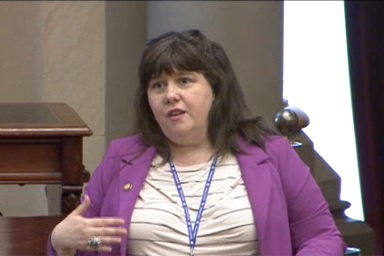
- Assemblywoman Emily Gallagher, D-Brooklyn, speaks on behalf of the Birds and Bees Protection Act on the Assembly floor this week.
-
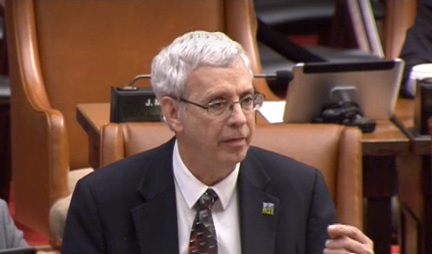
- Assemblyman Andrew Goodell, R-Jamestown, speaks aganst the Birds and Bees Protection Act on the Assembly floor this week.
Assemblywoman Emily Gallagher, D-Brooklyn, speaks on behalf of the Birds and Bees Protection Act on the Assembly floor this week.
The state Assembly is sending a message to the state’s farmers — get ready to move away from the use of neonicotinoid insecticides.
It’s uncertain if legislation to ban the commonly used insecticide will actually become law this year because, with the days in the state’s legislative session dwindling, a companion bill has yet to be introduced in the state Senate. But, it’s likely only a matter of time before the legislation gains traction — and that could be a problem for farmers.
Assembly members earlier this week passed A.7429 by a 103-41 vote with Assemblymen Andrew Goodell, R-Jamestown, and Joe Giglio, R-Gowanda, joining many other Assembly members from farm-oriented districts in opposition. Otherwise known as the Birds and the Bees Protection Act, the legislation prohibits the use of certain active ingredients in pesticides that can harm pollinators, including pesticides with the active ingredients clothianidin, imidacloprid, thiamethoxam, dinotefuran, or acetamiprid. According to a graphic created by The Guardian, such pesticides are used on farms in Chautauqua and Cattaraugus counties.
“There is an overwhelming amount of information that suggests we should be proceeding in the direction of this very well written measure,” said Assemblyman Steve Englebright, D-Setauket and sponsor of the legislation, during his comments on the floor. “There is a compilation of hundreds of individuals who have studied this. The Cornell study itself is 1,100 professional ecologists and medical researchers. I think it is prudent when we see the biomass. We don’t like to have insects bothering us, I get that, but when the biomass of insects decrease, the ecology of the entire state is at risk. That’s what we’re looking at and that’s what this measure aims to address.”
NATIONAL DEBATE
Assemblyman Andrew Goodell, R-Jamestown, speaks aganst the Birds and Bees Protection Act on the Assembly floor this week.
Goodell argued that while the issue is being studied, the state Department of Environmental Conservation and the federal Environmental Protection Agency haven’t called for a ban on neonicotinoid insecticides. In January 2020, the EPA released proposed interim decisions for acetamiprid, clothianidin, dinotefuran, imidacloprid, and thiamethoxam. The chemicals are a group of insecticides used on a wide variety of crops, turf, ornamentals, pets for flea treatment, and other residential and commercial indoor and outdoor uses. In the proposed interim decisions, EPA is proposing:
¯ management measures to help keep pesticides on the intended target and reduce the amount used on crops associated with potential ecological risks;
¯ requiring the use of additional personal protective equipment to address potential occupational risks;
¯ restrictions on when pesticides can be applied to blooming crops in order to limit exposure to bees;
¯ language on the label that advises homeowners not to use neonicotinoid products; and
¯ canceling spray uses of imidacloprid on residential turf due to health concerns.
Additionally, the agency is working with industry on developing and implementing stewardship and best management practices.
In 2017, the EPA also implemented a policy to protect bees from agricultural pesticide spray and dust applications while the bees are under contract to provide pollination services while recommending states develop pollinator protection plans and best management practices.
“This bill calls on us to pass legislation that bans the use of a pesticide that is highly regulated, highly studied and not banned by any other regulators that’s critical to the success of the agricultural industry” Goodell said. “Our DEC consists of scientists whose mission is to ensure that these products are safe and effective and applied properly. The U.S. EPA, whether under Republican or currently under a Democrat administration, has the same mission. And they’re filled with scientists who are focused on these issues. So today, we’ve heard the EPA doesn’t ban this and their scientists haven’t banned it. And we’ve heard today the DEC and our own scientists are not recommending a ban and then we’ve heard from our agricultural representatives. And one of the great strengths of our Assembly is that we have people with expertise and indeed, on the floor of this Assembly, we have people who have spent their entire life in agriculture. And they’ve pointed out that the process of using a treated seed is one of the most effective and environmentally responsible manner of controlling pests. So why are we talking about a total ban if the scientists at our DEC, the scientists at the EPA are not recommending it and our agricultural industry points out it’s being used in a very responsible manner and the toxicity is a fraction of what it used to be and that data shows bee counts are increasing, not going down. Why are we banning it?”
Maine and New Jersey have banned neonicotinoid pesticides while legislation was introduced in February to ban them in California. At the same time, environmental advocates are suing the EPA for failing to register neonicotinoid pesticides as a pesticide under the Federal Insecticide, Fungicide, and Rodenticide Act. The case is Center for Food Safety et al v. United States Environmental Protection Agency et al, U.S. District Court for the Northern District of California.
Conversely, studies have shown crop yields on farms using neonicotinoids is 35% higher than farms that don’t. The neonicotinoids are typically used as part of an integrated pest management plan to manage pests resistant to other insecticides. David Fisher, state Farm Bureau president, said implementing a ban on the pesticides could further hurt farmers’ finances and possibly be worse for the environment.
“Seed treatments are a precision tool for farmers to manage their risk by protecting their crop from catastrophic destruction from pests. As more farms turn to no-till and cover crops to improve soil health and sequester carbon, the improved soil biology also attracts additional pests, like wire worm and seed corn maggots, that can proliferate and do real damage to a crop,” Fisher said. “The neonic seeds are treated before they go into the ground, the equivalent of less than one ounce of pesticide per acre as opposed to spraying less targeted, above-ground pesticides, which will be the case if farmers are forced to move away from seed treatments. Farms would also be forced to return to less climate friendly tillage practices that turn over the soil to help fight off harmful bugs should lawmakers ban this class of pesticide.”
‘EXPERTS ABOUT SUBJECTS WE HAVE NEVER CONSIDERED’
As approved, the Birds and Bees Protection Act would prohibit, starting Jan. 1, 2025, the sale, distribution or purchase by any person within the state of corn, soybean or wheat seeds coated or treated with pesticides with the active ingredients clothianidin, imidacloprid, thiamethoxam, dinotefuran, or acetamiprid. The governor would be able, after consultation with the Department of Environmental’ Conservation and the Department of Agriculture & Markets to issue an executive order determining there is a lack of commercially available untreated seed or that compliance would result in undue hardship to agriculture producers and allow use of neonicotinoids.
The legislation also prohibits the application or treatment of outdoor ornamental plants and turf, except for the production of agricultural commodities, with a pesticide containing the active ingredients imidacloprid, thiamethoxam or acetamiprid on or after July 1, 2024, and the active ingredients clothianidin or dinotefuran immediately once the legislation becomes law. The DEC, in consultation with the Department of Agriculture and Markets and SUNY ESF, will also conduct a study to identify practicable and feasible alternatives to the use of neonicotinoid pesticides with results submitted to Legislature and Executive by the end of 2022.
“It’s almost as though we come here to Albany and as we get closer and closer to the Capitol building we become more and more expert about subjects we have never considered,” Goodell said. “So expert we feel comfortable banning chemicals we cannot pronounce, that we haven’t studied, that we have no scientific background on, and that all the experts in both the industry and in the DEC and the EPA say does not need to be banned. And in the process we hurt real people. We hurt the farming families whose livelihood depends on a successful crop. We hurt our friends and neighbors who are very concerned about the increasing costs of food, which is directly related to supply and demand. We hurt our friends and neighbors who keep hoping the cost of gas will go down along with the cost of the ethanol that is used to produce it. That’s not the right approach. The reason we debated this so much today on a getaway day is because it’s so incredibly important to the agriculture industry. And we cannot afford to ignore their wisdom and their expertise by banning a product that is not banned by the EPA or the DEC. So my friends let’s listen to the people who know what they’re talking about.”
The vote to approve the Birds and Bees Protection Act was largely along party lines, and at least one Democratic member of the Assembly said she’s looking forward to similar legislation in the future.
“I would like to compliment the sponsor on this fantastic piece of legislation,” said Assemblywoman Emily Gallagher, D-Brooklyn. “I truly believe that we are not just here to protect humankind, we are here to protect the entire ecosystem, because the entire ecosystem protects us. It’s incredibly important that we’re thinking about the interconnectedness of the communities that we live in with the things that are living that are not humans. So I really want to commend the sponsor. I’m voting in the affirmative. I look forward to more legislation that regulates industry for the safety of our earth.”
Top stories
County May Limit Public Comment At Legislature Meetings
Borrello says Dunkirk mayor’s comments ‘disappointing’
State Sen. George Borrello has denied Dunkirk Mayor Kate Wdowiasz’s accusation of poor communication, and ...
Welcome Reminders: Area Native Holds Fundraiser For Children With Cancer At Oishei Hospital

Cummins 2026 Revenues Projected To Increase

Borrello Pushes NRG Repowering During Hearing