
In High Demand
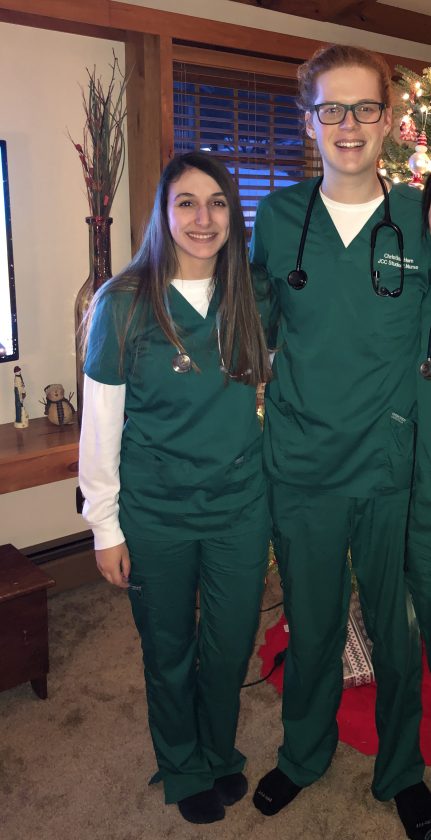
Pictured are Alicia D’Angelo and Christian Hern, students of the Jamestown Community College’s nursing program. Both said they are ready to enter a field in high-demand of medical professionals during the coronavirus pandemic. Submitted photo
Christian Hern knew what he signed up for upon enrolling in Jamestown Community College’s nursing program.
Entering the field in the midst of a global pandemic, however, was something he could have never anticipated. And, while he has his own reservations about what lies beyond the completion of both his degree and a successful result on the National Council Licensure Examination, the sophomore’s commitment to his field has never wavered — even as the novel coronavirus continues to spread.
“Entering the nursing profession as a new graduate is without a doubt going to be nerve-wracking and maybe even scary at times, but I couldn’t be more excited to get out there and do what I love, caring for people who can’t fully care for themselves,” said Hern, who serves as president of the campus nursing club. “It’s hard and it’s going to be challenging, but this is what I have worked so hard to do: save these patients’ precious lives, put smiles on their faces, and treat them with empathy and compassion.”
Sophomore Alicia D’Angelo agrees.
“We knew what comes along with the title of a (registered nurse) and we have to be prepared to work in these situations of high demand,” she said. “We signed up to help people and we are all very excited to start our new careers in such a time of need.”
The attitudes of students like Hern and D’Angelo are what give Kathy Taydus, director of nursing education at JCC, hope in the next generation of registered nurses who will enter the field as the world continues to learn more about COVID-19.
“We’ve not lost any students since the COVID-19 restrictions began,” said Taydus, a doctor of nursing practice and a registered nurse. “No one has said, ‘I can’t do this, I’m not going to do this.’ Many of them have said, ‘This is really hard for me, how am I going to do this?’ That’s where our faculty stepped up to spend remediation time if necessary or even just time management to get them so that they feel like they have some control.”
The virus has still had a great impact on the program’s students, Taydus said, and the faculty has grappled with how to provide students clinical experiences virtually.
“We’re talking about how our students are adapting to this online, distance that none of them signed up for,” she said. “It really wasn’t too hard to move classes to the online setting, but when we learned that we were not going to be able to continue with our clinical facilities, we had to come up with learning activities and experiences that they could do on their own and not at an agency that would equate to the number of hours that they needed to complete for clinical.”
“Luckily for the sophomores, we finished our clinicals the week before the online classes went into effect so that was fortunate, but our preceptorship, which is a 48-hour internship at a hospital or healthcare facility of some sort, which was changed to 48 hours, 12 hours per week, of online coursework,” Hern said.
“It’s been difficult to adjust to online classes,” D’Angelo said. “The virus has cost us some valuable learning experiences in the clinical field, but luckily we are still able to graduate on time and as expected.”
“This is part of the education that they look forward to — getting out to the facilities and being with real patients,” Taydus said of the students’ disappointment in not being able to make the most of out of their clinical learning.
“Fortunately, there’s been a lot of research,” she added. “Even with the National Council of State Boards and Nursing, they’ve said that up to 50% of clinical education could take part in simulation and not damage or bother or negatively impact their experience. But, then that was taken away from us, too, because we weren’t able to get students into the facilities. So, we came up with virtual, clinical facilities.”
While Taydus admitted that the students of most concern right now are sophomores like Hern and D’Angelo who are about to enter the field, she noted that COVID-19 will also affect current freshmen in the program.
“Our sophomore faculty are working on an even more applicable clinical part of their education for the fall semester of 2020,” she said. “We’re going to emphasize how well they’ve done because they’ve really been troopers and have done all the things they’ve asked. I believe that they will be successful at that and we’ll have a year to get them caught up clinically.”
The larger issue that remains, however, is how the remote learning setting will affect the sophomores’ performance on the NCLEX, which certifies a student to become an RN.
“One of the things about JCC that we’re really proud of is our pass rates,” Taydus said, noting that the pass rate last year was 95%. “I don’t know what the pass rates are going to do this year, but I do think the procession is going to be obviously remembering the COVID year and hoping that it doesn’t repeat itself. So, we may take a little bit of a drop in pass rates, but that has nothing to do with the motivation, the effort and the dedication of both the students and the faculty to make them successful.”
“If you could give the grade based on their heart, that’s where we would be,” Taydus added. “But, unfortunately, the test is the benchmark.”
Both Hern and D’Angelo, upon a successful result on the NCLEX, already have jobs lined up for them: D’Angelo will begin working at UPMC Chautauqua, where she currently serves as a patient care technician, on the fifth-floor cardiac telemetry unit while working toward her Bachelor of Science in Nursing from Daemen College online.
“(Working at the hospital) has been an amazing experience in helping me prepare to become a registered nurse,” she said. “There have been some changes due to COVID-19 but working against the virus, I feel has prepared us even faster for the nursing career.”
Hern, meanwhile, will begin work in the Cardiac Neuro Intensive Care Unit at Saint Vincent Hospital in Erie, Pa. — a position that has already been affected by the virus.
“The CNICU I will be on was changed to all negative pressure rooms a few weeks ago to have available for patients with coronavirus, so I’ll actually be going right into a floor with coronavirus positive patients who need negative pressure rooms as transmission precautions,” he said, noting that should the general public continue mitigation efforts, that floor will transition back to its original purpose.
Still, both have confidence in the education they’ve been provided in the most unique time in its history.
“(The program) is a phenomenal yet very challenging program, but the reward of doing what you love and developing trusting relationships with your patients is truly incredible,” Hern said. “The faculty have been troopers throughout this extraordinary change … They’ve had to put in just as much work as we have and I absolutely applaud and appreciate them for that. We all are human and they are experiencing this pandemic just like everybody else.”
“We signed up to help people and we are all very excited to start our new careers in such a time of need,” D’Angelo said. “Our program has taught and trained us exactly how to be amazing nurses and we cannot wait to put these skills to use in the real world outside of the student setting.”
Top stories
City Man Faces Second Child Porn Charge
John Peterson, 42, of Jamestown was arrested and charged by criminal complaint with distribution and possession of ...
Local Lawmakers Back Rural Suicide Prevention Council

Fighting Weeds: CLP Reviews Herbicide Treatment Program
Luv Kia Of Jamestown To Close Its Doors On April 10
A Kia car dealership in Jamestown will be closing its doors by the end of next week. Luv Kia of Jamestown ...
Jamestown Taking Over Parcels With Homeless Squatters
A dozen parcels in the city of Jamestown that are currently owned by Chautauqua County are being transferred to the ...
Former Dunkirk Treasurer Makes Court Appearance
MAYVILLE – A former Dunkirk treasurer who is accused of stealing more than $100,000 from city coffers made an ...