Learning To Fly With The Aero Soaring Club
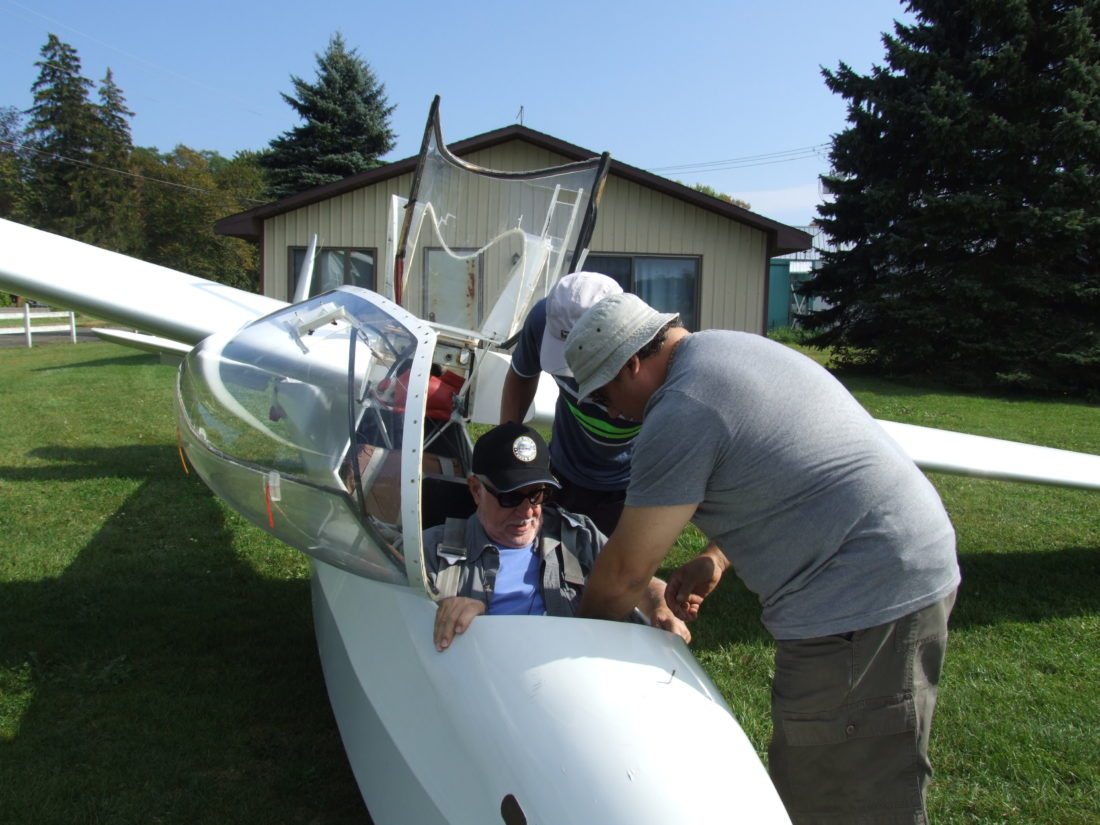
Dr. Galo Grijalva secures Fred Rowland before a glider ride at Aero Soaring Club located at Dart Field, Mayville, New York. Photos by Beverly Kehe-Rowland
With the unseasonably warm temperatures we’ve been experiencing the last few weeks, my husband was inspired to cash in the gift certificate for a glider ride he received from me for Christmas 2015. I was beginning to think he was getting cold feet, but in his defense, we had been away about 20 weeks during the 2016-17 soaring seasons and we both kept forgetting about the certificate when we were available.
As he drove toward Hartfield’s Dart Field on a recent beautiful Saturday, I recognized Fred’s distinct breathing pattern, the one I hear only when he is nervous or anxious. Thinking ahead, I had brought three bottles of essential oil blends and asked his permission to apply them. After debating if it would be Peace and Calming, StressAway, Valor or all three, I chose Valor and daubed it on his neck and forehead. I couldn’t resist taking advantage of this opportunity to ask if he had kept up his life insurance premiums and which cause or organization should benefit from any memorials given in his memory.
As we arrived at the home of Aero Soaring Club on Plank Road, we could see a man preparing for what appeared to be the flight of another, who was seated inside a glider. Later we learned a glider pilot was sitting behind the passenger. A tow rope connected to a small plane parked nearby was attached to the sail plane. The man on the ground continuously gave signals with his arms as the tow plane slowly drove farther down the taxiway. When the rope was nearly taut, the man crossed his arms as a signal for the pilot to stop. He then lifted a long wing that was touching the ground, releasing his hold as the tow plane began to move causing the glider to gently rise a few feet above the ground. It was a group effort to get the simple aircraft off the ground.
“It’s a dying sport and we’d like to have young people get interested in it,” Dr. Galo Grijalva, the signalman, said after he walked over to where I was sitting. “There are not as many people coming into aviation, because it’s expensive, but the glider experience is much less expensive. It teaches you very good manners, in the sense of being a pilot, especially in being a safe, competent pilot. You don’t have an engine. You have to learn to stay up in the air with thermal activity.”
He went on to say that white, puffy clouds “usually denote thermal activity, which means there’s lift and those are the places we seek to go higher in altitude, going from cloud to cloud. Just staying up on the thermal activity, you can stay up for hours.”
Minutes later we had the pleasure of meeting the tow pilot, Grant Pearsoll, after he returned with the tow rope still attached to the small plane and having left the glider 3,000 feet above ground level. Pearsoll, a 40-year army veteran, flew helicopters in Vietnam and in Operation Iraqi Freedom. He is a flight instructor in gliders, airplanes and helicopters, who retired from the Federal Aviation Administration and United States Army in 2007, when he then flew for Star Flight for the next five years.
“When this operation was started in the early 70s, I instructed in gliders here in what became this club,” the Army veteran said.
When it came time for Fred to go up, Dave Carpenter, psychology professor emeritus at St. Bonaventure University, took me out to the end of the taxiway in a golf cart so I could have a better vantage point for taking a video.
The plane towing the glider circled the field one time as it was gaining attitude. When the pilot reached 3,000 feet, he radioed Joe, the glider pilot, who then released the tow rope. From that point on Joe, with God’s help, had control of my husband’s first glider experience.
While we were watching the aircraft disappear into the heavens, the retired professor told me he and his wife actually relocated after retirement to be closer to the field and the club. He patiently answered my questions. I learned the difference between a taxiway and a runway. The first is for traveling back and forth and the latter is for take-off and landing.
After the glider returned and the dome-shape windshield was lifted, my smiling husband emerged.
“Joe is a really good pilot,” the rookie passenger said. “I was really surprised at the gentleness. There was no jerking.”
We learned some interesting information from our conversations with the club members. When conditions are right for long flights, some diehards take a bottle or catheter in which to urinate. Now, that’s being passionate. Surprisingly, teens may start training at 14 years of age and earn the glider pilot’s certificate when they are 16 years old. We also learned it is called cross-country flying when one leaves sight of the field from which they have taken flight.”
“Of course, your goal is to arrive back at the field,” says Dr. Grijalva, a six year United States Air Force veteran and chairman of the surgical department of UPMC Chautauqua WCA. “Otherwise, you have to find a safe place to land and someone has to take a trailer, take the plane apart and bring it back to the field. We call that landing out.”
The last two times he was up, he was able to remain so for two hours, but has been known to soar for over five hours.
Some other members of the club include Paul Maize, an 86-year-old glider pilot who is still active. Dick Farver, a retired Navy captain and helicopter pilot, is also a tow pilot. Roman Kinnitis is the club president and glider flight instructor.
The soaring club consists of three certified flight instructors and some commercial pilots. There are five gliders within the club, three of those which are privately owned. All have been made in Germany, with the exception of one that was made in Poland. The men agreed that “the best gliders in the world are German-made.” The clubhouse and a hangar are rented from Dart Airport, owned by Greg Dart. Small planes come and go from the site that has multiple hangars and is situated on over 100 acres.
“Gliders are still modern aircraft and they are relatively inexpensive. As a matter of fact, a glider just hit a world record of 59,000 feet in Argentina,” Grijalva said. “Interested parties should come on the weekends to experience it until late October. We would love to recruit young people or any people. We have certified instructors who could give instruction. Most of us have wanted to fly since we were little.”
There is no need to be a veteran, surgeon, pilot or professor. Anyone from any walk of life may learn to fly or may just want a ride in a glider. The club members are hoping interested or curious parties stop by the field on a weekend before this year’s soaring season is over.
As we drove away, my husband admitted his apprehension before the ride and said he had thought of the gift certificate every time we climbed anywhere near 3,000 feet elevation in our recent travels through mountains and to national parks. The next words out of his mouth were, “You can give me another glider ride, if you’d like.” I wonder if he is ready for the next level of 5,000 feet, nearly one mile. It is a great gift for anyone, but works especially well for the person who has everything, as was my husband’s case, or at least has everything he wants and way more than he needs.
Aero Soaring Club. Inc. can be reached weekdays by calling 241-8242 or on weekends and holidays from 11 a.m. to 5 p.m. at 753-5125. It is located at 6167 Plank Road in Mayville. Gift certificates are available at the airport or online at www.aerosoaring.org.
Top stories
IDA CEO Shares State’s New Goals For ImmunityBio
Back in 2016, hundreds of jobs were expected for a drug manufacturing plant in the town of Dunkirk. The plant was ...
Dairy Market Pushes Forward Despite Challenges
In the wake of Refresco canceling its local contracts with grape growers, other agricultural markets such as dairy ...
‘Heck Of A Trip’ World War II Veteran, Randolph Man Set To Celebrate 100th Birthday
Setting Sail: Preservation Efforts Continue To Former Chautauqua Lake Ship
Family Owned: Schutt’s Ranks Top 100 Nationwide In Cub Cadet, Hustler Sales