So You Think You Can Drive? Commonly Misinterpreted Rules Of The Road
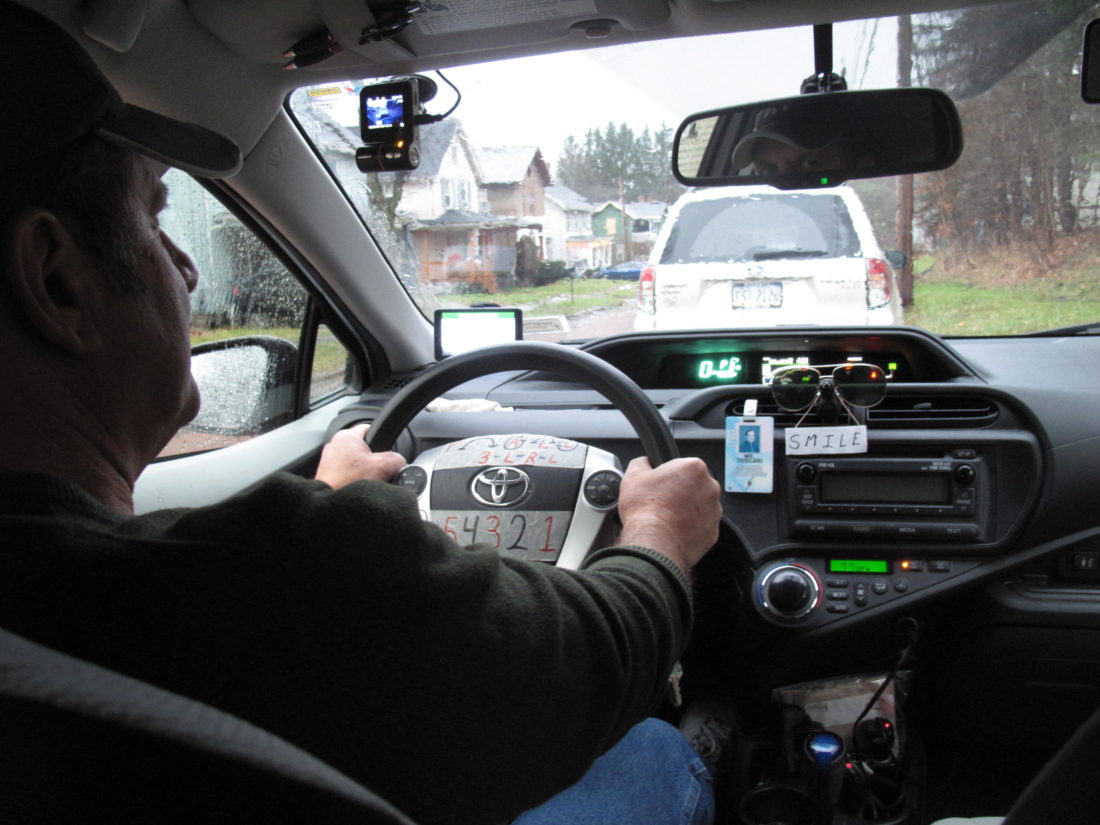
Pictured is Bob Triscari, of Aadvance Driver Training in Jamestown, inside his training vehicle. P-J photo by A.J. Rao
So you think you can drive?
Many of us haven’t taken a learner’s permit exam or a road test in years or even decades.
Those tiny details about how far to park from a curb or when to yield the right-of-way may seem a bit superfluous now, perhaps so baked into our subconscious that we really don’t give them a second thought.
But according to Bob Triscari, co-owner of Aadvance Driver Training in Jamestown, and Chautauqua County Sheriff Joe Gerace, many supposed veteran drivers are actually guilty of a lot more than they think. In fact, our simple, mundane habits can be downright illegal.
The following is a list of some of the most commonly misinterpreted rules of the road as observed by Triscari and Gerace.
“California Roll”
Failing to come to a complete stop at a stop sign — a habit informally known as a “California Roll”–is a common practice among impatient drivers. It also violates New York State Vehicle and Traffic Law or VTL.
“If you’re doing a “California Roll” and you go through a stop sign, you ran a stop sign, period,” Triscari said. “You’ve got to pause and come to a complete stop.”
According to NYS VTL 1172, “except when directed to proceed by a police officer, every driver of a vehicle approaching a stop sign shall stop at a clearly marked stop line.”
Similar violations, Triscari said, include failing to stop at a red light when making a right turn.
“You’re allowed to make right turns when the light is red (unless marked otherwise), but you’re required to stop first and then turn,” Triscari said.
Drivers also frequently stop over crosswalks while waiting at a red light, impeding the movement of pedestrians. If observed by police, drivers can technically be cited for this.
Yielding Right-of-Way
Most drivers know that whoever approaches a four-way stop first has the right-of-way. But what happens when two drivers approach the intersection at the same time?
According to Triscari, the driver of the vehicle on the left yields the right-of-way to the vehicle on the right.
“A lot of people get confused about that,” Triscari said.
Additionally, what happens when two vehicles approach a stop sign from opposite ends of the road and one of them wants to take a left turn?
According to Gerace, this situation leads to a number of mishaps.
“If one car is turning left and the other is going straight, the car going straight has the right-of-way– as well as the car behind that and the car behind that,” Gerace said. “Constantly though, people say they arrive at an intersection first and they start to make that left turn. If someone’s coming straight, they have the right-of-way.”
Left Turns At Intersections
Making a left turn at a traffic light can be another inconvenience for impatient drivers who have to wait for a break in oncoming traffic. While drivers are allowed to move forward into the intersection and wait for that break, the drivers behind them cannot.
“Only one car is allowed to fill up that intersection (when waiting to make a left turn),” Triscari said. “You often see two cars in there, but that second driver can get a ticket for running a red light. There can only be one car in there at a time.”
Use of Center Turn Lanes
Both Triscari and Gerace pointed to the frequent misuse of center turn lanes in the area, particular on roads like Fairmount Avenue.
A center turn lane is bordered on either side by two yellow lines, with the inner line broken or dashed and the outer line solid. The lane is for the exclusive use of left turning vehicles–not for passing or long-term travel.
In fact, drivers are only allowed to stay in these lanes for a couple hundred feet.
“There’s people enter Fairmount Avenue (from Jamestown), move (into the center turn lane) by Brigiotta’s and stay in that center lane all the way down to Wal-Mart,” Triscari said. “You should only go into that lane when you’re ready to make your left turn.”
Unattended Motor Vehicles
With frigid temperatures outside, it’s tempting for drivers to leave their cars running in an effort to warm them up. According to Gerace, however, leaving your vehicle unattended and unlocked can not only lead to potential car thefts, but it is technically a violation.
As per New York State Vehicle and Traffic Law, “no person driving or in charge of a motor vehicle shall permit it to stand unattended without first stopping the engine, locking the ignition, removing the key from the vehicle and effectively setting the brake thereon”
Gerace said exceptions can be made for car remotes that can start an engine, but leave the doors locked.
Headlights
Gerace said visibility remains the No. 1 defense against car crashes and that the proper use of headlights is critical.
“The law says when you’re using your wipers, you must turn your headlights on,” he said. “I see people constantly not turning on their headlights when they have their wipers on … that’s a non-moving violation.”
According to NYS VTL 373, any vehicle driving on a public highway during the period from one-half hour after sunset to one-half hour before sunrise, or at any other time when windshield wipers are in use, should display headlights.
Drivers looking to refresh their skills can contact Aadvance Driver Training, located at 121 Willard St. in Jamestown, at 484-1230 or visit www.drivertrainingllc.com.
Top stories

Chautauqua’s Got Talent Opens 16th Season At Spire Theater
Legislator Wants Elected Officials’ Salaries Disclosed
MAYVILLE — In 2024, the Chautauqua County Legislature, without any Democratic support, approved significant pay ...

UPMC Chautauqua Hosts Trainings For Rare Birth Emergencies
Scott Forster Appointed Police Chief At Voting Session
City Woman Faces 17 Charges Of Child Welfare