
Lake Group Work Continues In Offseason
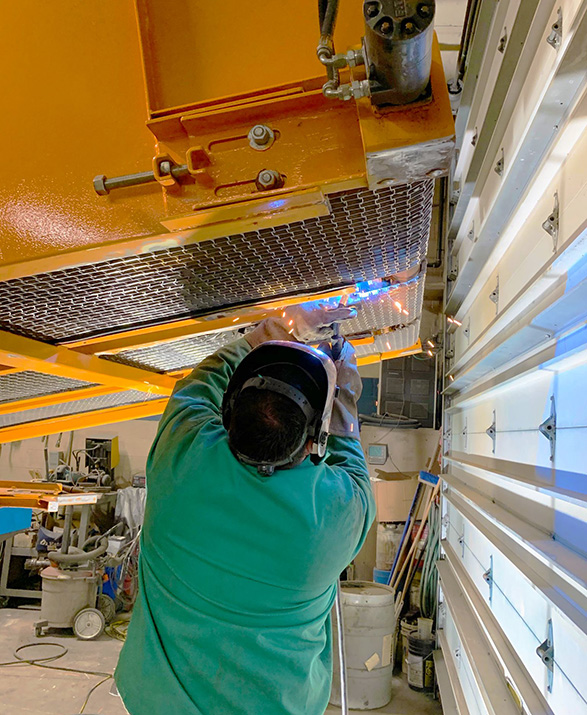
James Cappalino, operations manager and chief mechanic for the Chautauqua Lake Association, finishes some welding during the offseason. Submitted photo
LAKEWOOD — Snow may be continuing to fall around Western New York with the prospect of summertime boating feeling quite far away, but lake maintenance remains a year-round project for the Chautauqua Lake Association.
When cutting and harvesting operations come to an end, shop season begins for the CLA in September. This part of the calendar, which continues through mid May, includes equipment repairs and upgrades, data analysis, inventory and preparations for the coming season.
At the end of each summer, a full-time maintenance crew is tasked with pulling machines from the water and preparing them for storage at the CLA’s Lakewood facility. “Each machine is washed down, winterized, and then overhauled,” said Heather Nolan-Caskey, Administrative and Community Services Manager. “Everything is checked from top to bottom, from the engine to the paint. Every machine needs to be ready for those crucial 2-3 months.”
Leading the way in the offseason is operations manager and chief mechanic James Cappalino.
“Every machine comes in the shop one at a time,” Cappalino said. “We grind, sand, paint the bottoms, weld patches as needed. Sometimes a machine needs a complete paint job, sometimes just a touch-up. We check all the hoses and hydraulic motors to see if anything needs to be replaced, and completely winterize the vessel.”
There is a limited window of time during the summer that the CLA fleet of six harvesters, five shoreline barges, four large dump trucks, four small dump trucks, three transport barges, two skimmers, a loader, a skid steer and a forklift are able to set to work.
As such, completing offseason maintenance on time is critical.
“Your working days (in the summer) are so limited. It’s crucial that the fleet is in fully-operational condition to avoid down time,” Executive Director Doug Conroe said.
In 2020 CLA crews loaded 242 truckloads from Lakewood, 258 from Long Point State Park and 152 from Mayville for a total of 6,505 tons of aquatic vegetation.
“We review our end-of-season results and prepare final reports that outline what we accomplished as an organization,” Nolan-Caskey said. “For the grants, there is a lot of data reviewing, summarizing, publicizing, and applying for new grants.”
During the offseason the CLA also coordinates with other lake organizations and associations to plan for the future, with some of that cooperation going digital in 2021 due to COVID-19.
“There are a lot of interactions with other collaborating organizations this time of year,” Conroe said. “There are three offseason conferences that we attend: The North American Lake Management Society, the New York State Federation of Lake Associations, and the Western New York State Federation of Lake Associations. Lake management and maintenance are continually changing. The ecology of the lake responds to climate change, we need to be up to date on new technology, technique and scientific findings.”
The CLA hosted scientists from the New York State Department of Environmental Conservation and the U.S. Army Corps of Engineers at their Lakewood facility in 2020 for a pilot study of harmful algal bloom mitigation techniques.
Top stories
JLDC Reviews Water Street Brewing Reserves Letter
Previously, a loan was approved by the Jamestown Local Development Corporation for the new brewing company, Water ...
Traffic Fatalities Create New Focus On Safe Streets For All
Another recent fatal traffic accident is leading to a renewed push by city officials for the Safe Streets For All ...
Road Salt Limits Proposed In Assembly
National Networking: JCC Student Veterans Of America Members Attend National Conference
Sales Include Dunkirk Business
Legislators tout ‘Affordability Act’ for county
County Legislators Bob Bankoski of Dunkirk and Tom Nelson of Jamestown, both Democrats, are sponsoring a Resolution ...