Suitcase Living: From New York To Texas, Writer And Husband Take In Lighthouses, Landfills And Patriotism
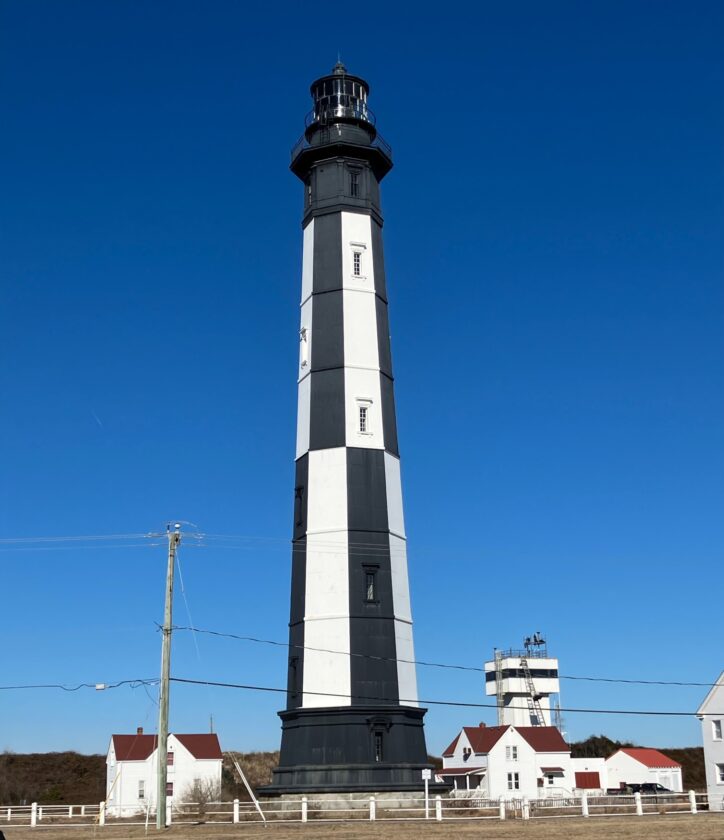
The newer of two lighthouses at Cape Henry near the southern entrance of Chesapeake Bay. Photos by Beverly Kehe-Rowland
-
- The newer of two lighthouses at Cape Henry near the southern entrance of Chesapeake Bay. Photos by Beverly Kehe-Rowland
-
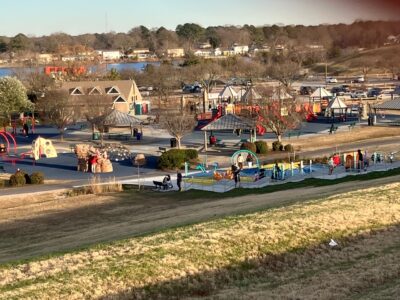
- A view of a handicap-accessible playground from Mount Trashmore in Virginia Beach. A large portion of the park is located on the top of a 60-foot high landfill.
-
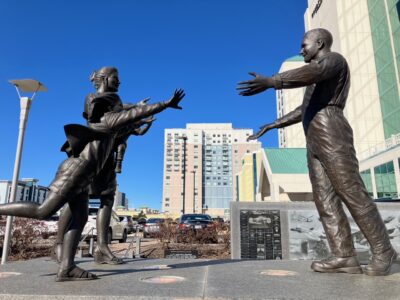
- One of many bronze displays at Naval Aviation Monument depicts a mother and daughter rushing to the arms of a returning loved one. Photo by Beverly Kehe-Rowland
After dealing with my husband’s reoccurring cancer in the winter of 2025, followed by a busy summer, we got back on the road in the fall with a trip to the Smoky Mountains in September and to Williamsburg, Va., in November.
We met up with Fred’s classmate and her spouse on the first trip where we made our annual “we may visit you in Texas” statement.
We needed to burn about three weeks’ worth of timeshare points before January 31, points we had paid to “bank.” If not used, we would either have to pay another fee or lose them. We also needed to celebrate a late Christmas with our Maryland and North Carolina kids, so we went back on the road in January with a goal of visiting our Texas friends at their home.
As I’ve mentioned in other articles, we don’t necessarily enjoy staying in one place for more than a day or two, but like to keep moving. If we do stay in a resort, like we have on this winter trip, we look for interesting things to see. Our idea of interesting isn’t always the same as other people’s. We love traveling through small towns, on back roads and do a lot of meandering and “let’s turn heres.” Because of this, we have come across some unique finds.
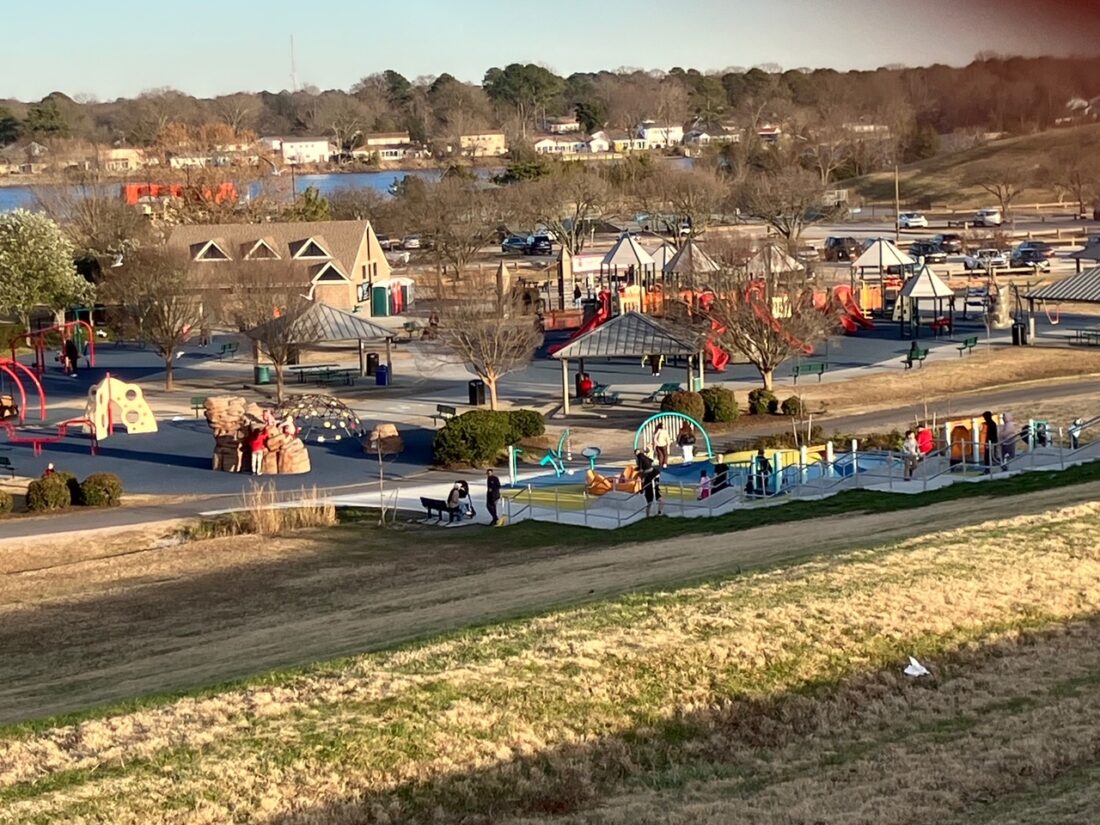
A view of a handicap-accessible playground from Mount Trashmore in Virginia Beach. A large portion of the park is located on the top of a 60-foot high landfill.
As a result of our procrastination and needing to stay somewhere between our daughter’s family’s farm in Maryland and our son’s home in Charlotte, we had to settle for whatever resorts were available on short notice. The first stop was Virginia Beach where our sixth floor balcony overlooked the ocean.
Our days were spent exploring the area. On one of our outings, we drove to Cape Henry to see a pair of lighthouses that stand just 350 feet apart near the southern entrance of Chesapeake Bay and very close to where the first English settlers arrived. The older sandstone lighthouse was completed in 1792. George Washington authorized its construction, the first public building funded by a newly formed US government. During the War of 1812 the light was extinguished to prevent British ships from using it as a navigational aid. After nearly one hundred years of use, large cracks were discovered in the structure and a new lighthouse was built.
The completion of the newer, taller, black and white striped lighthouse took place in 1881.
Both structures are surrounded by the Joint Expeditionary Base Fort Story, therefore guests over 16 years old must show valid government-issued ID. They must also walk through a metal detector and be shuttled to the lighthouses.
Later that day, when the memory came up on Facebook, I was surprised to learn we had visited the lighthouses on the very same date fifteen years earlier.
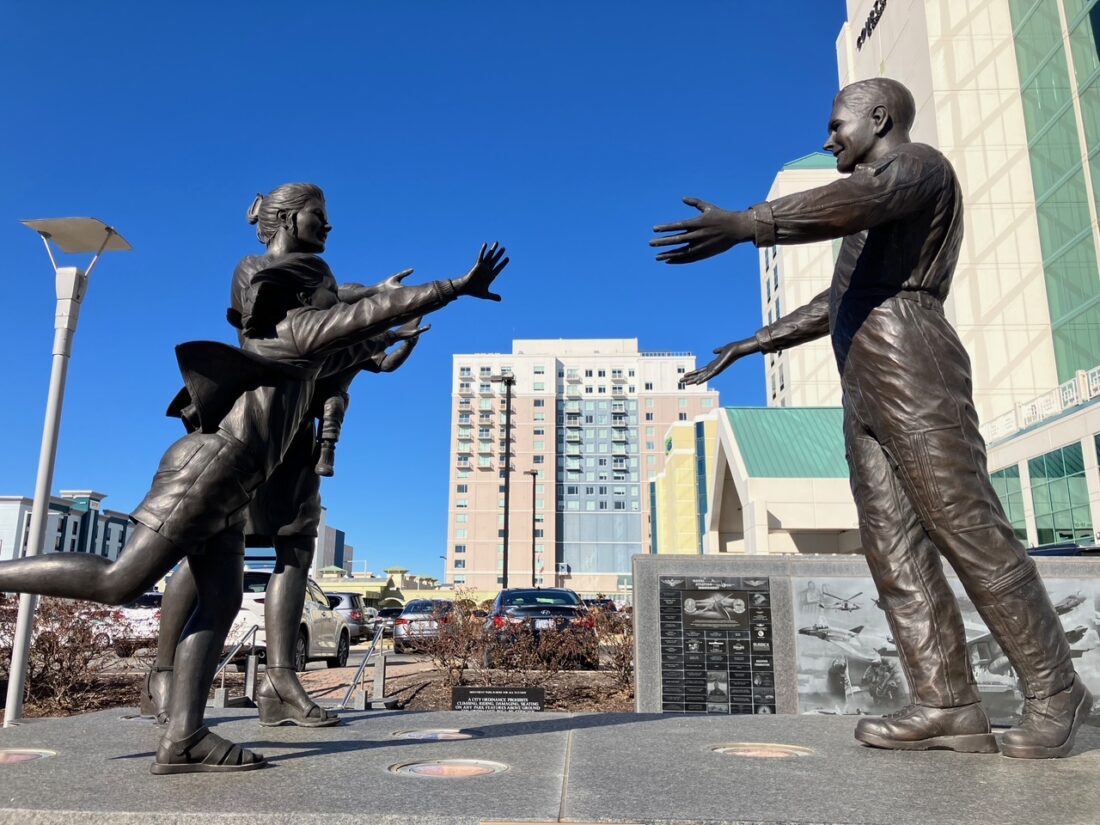
One of many bronze displays at Naval Aviation Monument depicts a mother and daughter rushing to the arms of a returning loved one. Photo by Beverly Kehe-Rowland
On the day we arrived in Virginia Beach, we passed what looked to be a landfill with a very long set of steps leading to the top. I brought this to my husband’s attention, as he was driving at the time, and I pointed out the people who were ascending the stairs. Later that day or the next, he read about what we had seen in an AAA Tour Book, therefore I put it at the top of my list of must-sees having learned more about it.
I found Mount Trashmore, as it was called, to be a most fascinating find. The 165-acre-park built on a landfill has three staircases and pathways that led to the top of two hills, with the tallest being 60 feet high. I counted 88 steps as we climbed to the summit. This well-maintained park has been open since the 1970s, which seemed impossible, since it felt fresh (no pun intended) and new. It has had many improvements over the years. For example, a wheelchair accessible playground which opened in the early 90s was doubled in size in 2010 and has recently had another upgrade.
During our visit we witnessed kite flyers, runners, walkers, with and without dogs, skaters and bicyclists. It is a perfect spot for a picnic either on a blanket or under one of the pavilions. There are many paved walking and biking trails, two lakes where fishing is allowed, one allows kayaking and volleyball courts, fitness stations, a 24,000-square foot skate park and an amphitheater. There is no admission and parking is free. By the way, Mount Trashmore has a sister park called Haginodai Park in Hirohara, Miyazaki City, Japan.
Rarely do we visit a city with an aquarium that my husband misses the opportunity to see it and Virginia Aquarium and Marine Science Center was no exception. We spent an afternoon there, followed by dinner with my husband’s classmate and her spouse, a couple who has lived in Chesapeake, VA for many years.
Our last day in Virginia Beach was very cold and windy, so cold it mimicked a New York winter day, minus snow. We began with a visit to the Naval Aviation Monument, a plaza of bronze statues located a few blocks from where we stayed. A sign near the streetside entrance to the park read: This is the story of American patriots, laser-sketched in stone and cast in bronze. It was a perfect description.
On November 14, 1910, Pilot Eugene Ely took off in a small aircraft from a temporary platform on the USS Birmingham near Hampton Roads, VA. The man, who could not swim, took a bicycle inner tube for his floatation device and a football helmet to protect his head. Later, on January 18, 1911, Ely made the first landing onto the USS Pennsylvania in San Francisco Bay. This was the beginning of naval aviation. The history of aviation by decades was etched into the granite.
An area was set aside for the ZRS (Zeppelin Rigid Scout) airships that were designed to act as scouts for fleets. The maximum speed of the 785-foot long dirigibles was 83 MPH. The eight engine airships carried a crew of 86.
An Aircraft Carrier Tribute lists the names of aircraft carriers throughout history. I made sure to find CVB-42 Franklin D. Roosevelt, the ship my brother-in-law was on during the Cuban Crisis.
My favorite statues were in a grouping of three showing a wife and young daughter rushing to greet their husband/father on his return home. A placard on the base of the display reminds that not all members of the Armed Forces return in this joyful way. A military cemetery is etched on the left side and a flagged-draped casket being carried by uniformed pallbearers on the right side. These lines are etched in the center: Some of our fighting men and women who have returned home have made the ultimate sacrifice and given their lives for our country. They are lain to rest and a grateful nation honors them, now and forever.
Like aquariums, my husband can rarely resist visiting a wildlife refuge, therefore we spent the rest of our daylight on that cold, windy day at Back Bay National Wildlife Refuge. The 9,100-acre habitat boasts of being a home to a diversity of wildlife, but is managed for birds. It was opened in the late 1930s in a strip of barrier islands on Virginia’s coast. Wetlands make up the majority of the acreage, but paths and boardwalks also lead to dunes, beaches and forest. During our time at the reserve, we spotted Mallard ducks, a turtle and other wildlife that were too far away to identify.
When you aren’t interested in water or sand, you take a five-minute walk on the beach on your last day and stick your head in the door of the pool room as you walk to the elevator one final time.
To be continued.
Local News
Suitcase Living: From New York To Texas, Writer And Husband Take In Lighthouses, Landfills And Patriotism

Rural Minds Creates Group
Ripley Gravel Pit Creates Concerns Among Residents
A Peaceful Rest: Wintergreen Cemetery Lost To Time
Clymer Receives Grant For Playground