Clymer Students Prefer Learning Without Tech
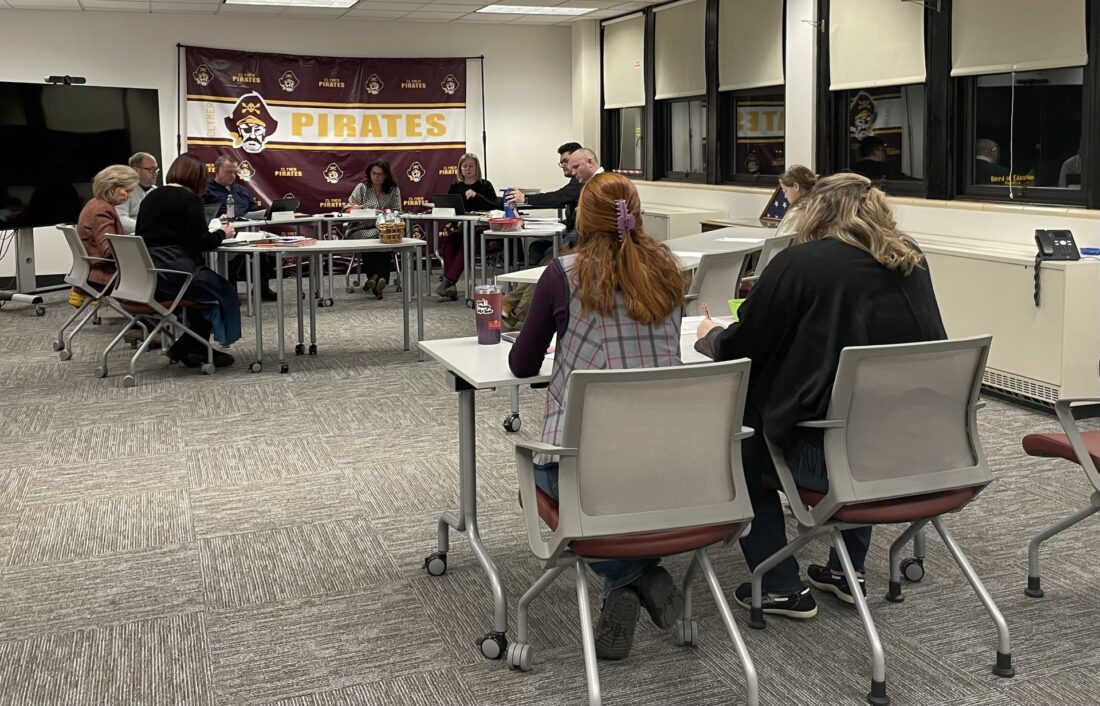
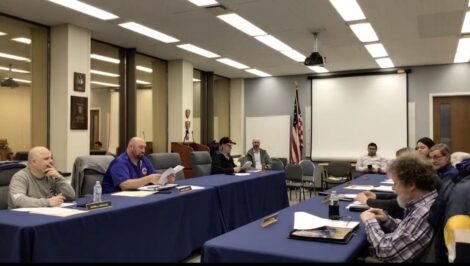
Clymer Central School’s Board of Education continued to discuss the portrait of a graduate and the responses to the recent learning survey sent to teachers and students. P-J photo by Sara Holthouse
CLYMER — Work has been ongoing at Clymer Central School to form the district’s portrait of a graduate, including through a survey that was sent out to both teachers and students on what learning is to them and what is most important when it comes to learning.
During the Clymer Board of Education’s February meeting, Building Principal Brianne Fadale and Director of Learning and Development Andrea Bryant reported on the most recent teacher in-service day where the responses to the learning survey were discussed. 145 students responded to the survey, specifically looking at the areas of what learning experiences they look forward to the most, and what experiences are they most proud of. Teachers were given time at the in-service day to discuss some of the answers and were asked to pull things out that aligned in both student and teacher answers. Some items that were the same included hands-on projects, connections to real life, and creativity, along with active engagement.
Other items pulled out were just some observations the teachers made about the responses, such as students like when learning is not just on computers and preferred to do more learning without technology, and other things that connect to the real world. One other thing students liked was the use of the socratic seminar.
“A good surprise was the socratic seminar, which is a teaching method that only a couple teachers knew what it was,” Bryant said. “Mrs Whitney went through and explained how that worked and how the students really like that. I’ve observed it a couple of times, and it’s almost like a debate.”
Fadale added to that, saying the socratic seminar is really about structure and whatever the topic may be students have to come up with a question first on their own and then everybody at some point contributes, letting the teachers facilitate but the students guide the conversation.
“So that’s the kind of stuff we’re trying to get them to do,” Fadale said. “And that’s how they learn.”
A goal with these learning questions is trying to find more connections like this, something that both teachers and students want, and trying to incorporate more of that into the classrooms. Bryant said the socratic seminar specifically was mentioned 20 or 30 times by students in their responses.
Also during the in-service day Bryant said they discussed department meetings and broke it down into small groups, and then discussed where they were going. Specifically, they began with looking at the learning intentions and success criteria and then connected that to the portrait of a graduate. Fadale said they are working to align it to help people understand how it all fits together. Learning intentions tie into how they are designing instruction and then relevance ties into that to connect to the real world and life outside of the classroom.
Portrait of a graduate has been talked about by the state for about a year now, with a certain time things need to be in place. It was noted that students will still be required to take the Regents exams, but for students that have a hard time with those and the tests are not showing their mastery of the subjects, this portrait of a graduate, Fadale said, provides another pathway to show that students have earned their diploma. She added they are taking their time and being purposeful about this work, and are in a great spot for the changes to be made as they move forward.
The board discussed having a path that is more career focused, saying that the regents do not necessarily reflect that students will be successful after high school, and that students want more hands-on experiences in the classroom to help students who may not be going to college and are going into the work force or a trade school reflect their success as well, and show this success on the other side.
Some of these aspects have begun in pieces in some classrooms, such as ending presentations instead of tests. It was noted that it can be hard to make changes, and teachers are working on figuring out how they can still get students the content they need while trying to make some of the changes as well. Fadale said some teachers are already doing this, as reflected in the student responses, and they want to keep building on that.
Student Board Member Adelie Jackson said in a class she is in now these types of things are already happening and helping her a lot, including teaching her finances and how to make a resume on her own without the use of AI, which she has already used in real life after doing it in the class.
“I understand our core classes, like our math is important and our English, but sometimes there’s kids that that’s not their strength,” Jackson said. “I mean, for me it was, and I didn’t really love the arts and stuff like that, but for some kids, that’s what they’re good at.”
Jackson said having classes like art and agriculture for students too is important, and Superintendent Beth Olson noted that while some students may thrive more in those kinds of classes, there are still aspects such as reading and writing involved in those too, to allow students to still have exposure to certain aspects of the classroom.