Area Residents Find A Riverboat, Tame Deer, Aftermath of a Flash Flood And A Massive Dam
-
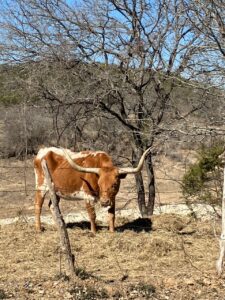
- A Texas Longhorn nibbles on hay.
-
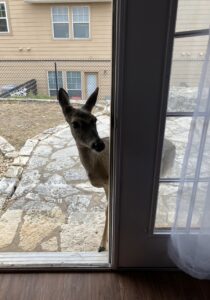
- This deer was one of many where we spent a week in Lago Vista, Texas. He licked my arm after I ran out of the green beans I had been feeding him.
-
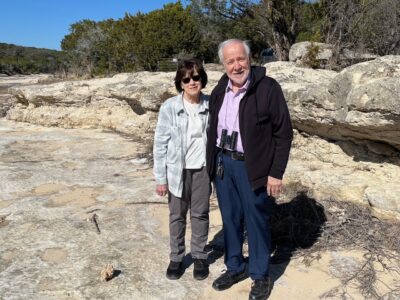
- This sandstone creek bed was exposed after a flash flood washed away the trees and brush that hid it from view. Photos by Beverly Kehe-Rowland
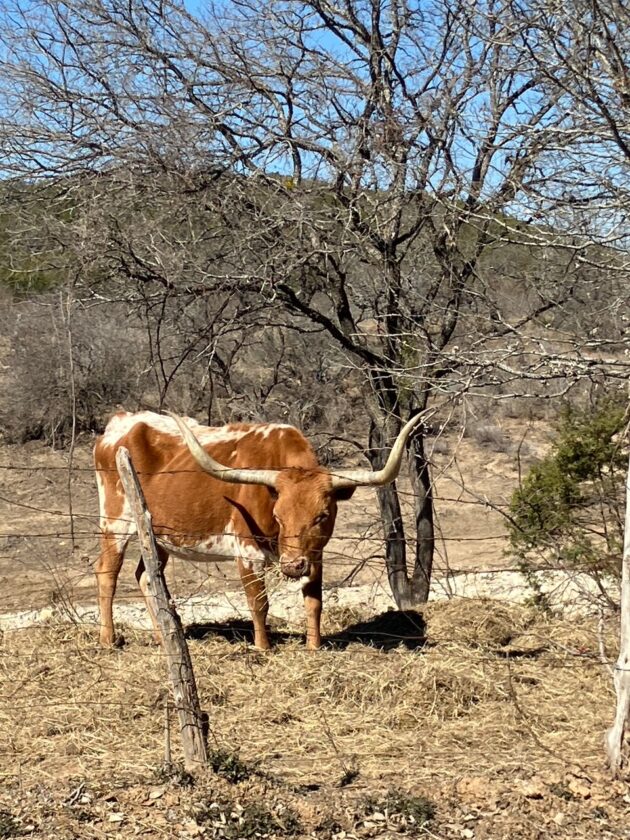
A Texas Longhorn nibbles on hay.
This is the third installment of a trip from which my husband and I returned recently. We were on a mission to visit our friends in Alvin, Texas, after we used expiring time share points and visited two of our kids who live out of state.
After a few days at our daughter’s home in Maryland, we spent a week in Virginia Beach and one in the mountains of Virginia. We left the latter a day early to drive to our son’s home in North Carolina because of repeated warnings of extreme cold and ice or snow.
We had no idea where we would land when we drove out of our son’s driveway four days after arriving, except we knew we were traveling toward Texas. Meteorologists were saying more bad weather was on its way for the eastern part of the country, therefore we chose to work our way southwest, but not until we stopped to see old friends who left Chautauqua County many years ago.
WEATHER WOES
The first night was spent in Lavonia, Ga. Breaking news the next morning warned of an emergency road situation in northern Mississippi. Anyone traveling south of two named cities on interstate routes were instructed to turn around immediately. Refreezing had caused extremely dangerous conditions and road crews were working to remove stranded vehicles. We were planning to travel two hours south of those cities, but not for a day or two.
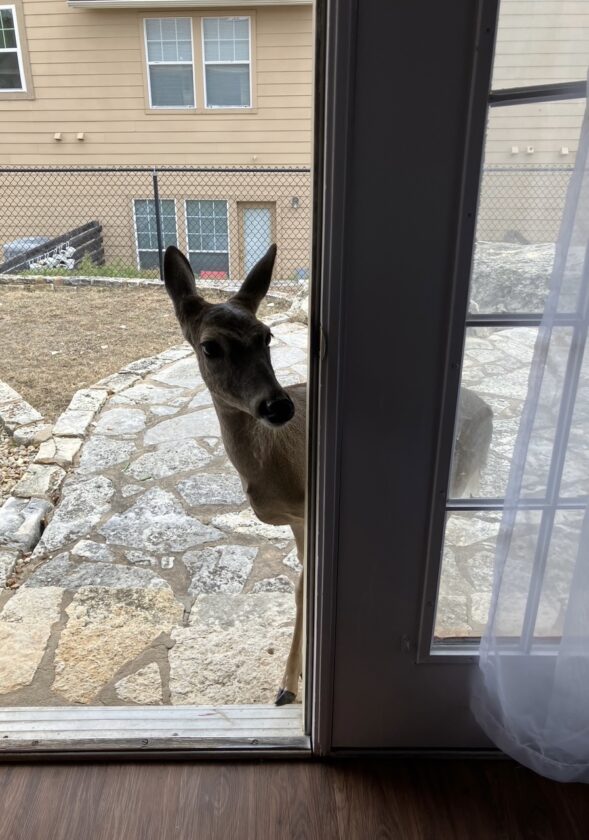
This deer was one of many where we spent a week in Lago Vista, Texas. He licked my arm after I ran out of the green beans I had been feeding him.
We rarely reserve a room because we never know where we will be at the end of the day and very few times have we had a problem finding lodging. When we did start looking for a room, nearly every hotel parking lot was very full of vehicles, including two or three bucket trucks belonging to power companies. The night we stayed in Montgomery, Ala., was no different. We met a woman who had been in the hotel for five days while waiting for the power to be restored in her Nashville neighborhood.
By the time we began to look for a room the third night, we found the first three hotels were full. A clerk at the third hotel found the closest vacancy near our path to Texas was at a hotel in Shreveport, 120 miles away. This was a time when reservations may have been helpful, but maybe not since we were looking for a specific brand in order to earn or redeem points. Otherwise, we may have found a closer option.
We were willing to drive two hours because it had been 14 years since we spent the day in the Louisiana city.
PADDLEBOAT CASINO
The hotel had a strange name, but we were assured it was a decent place to stay. We soon learned it was attached to a small casino, which we weren’t thrilled about. While we were checking in, we learned the casino was built on an authentic 19th century paddlewheel riverboat. After settling into our room, we decided to investigate what that was all about. It appeared there was no one on the non-smoking lower floor of the small casino until a cocktail waitress appeared. When she learned we were curious about a building that was built on a boat, she offered to take us to an area that was not open to the public. We followed her as she wound her way to an exit door in the back. When we stepped through it, we found ourselves looking at the vessel. Afterward we had a conversation with our tour guide about Niagara Falls and returned to our room which overlooked the riverboat we had just left.
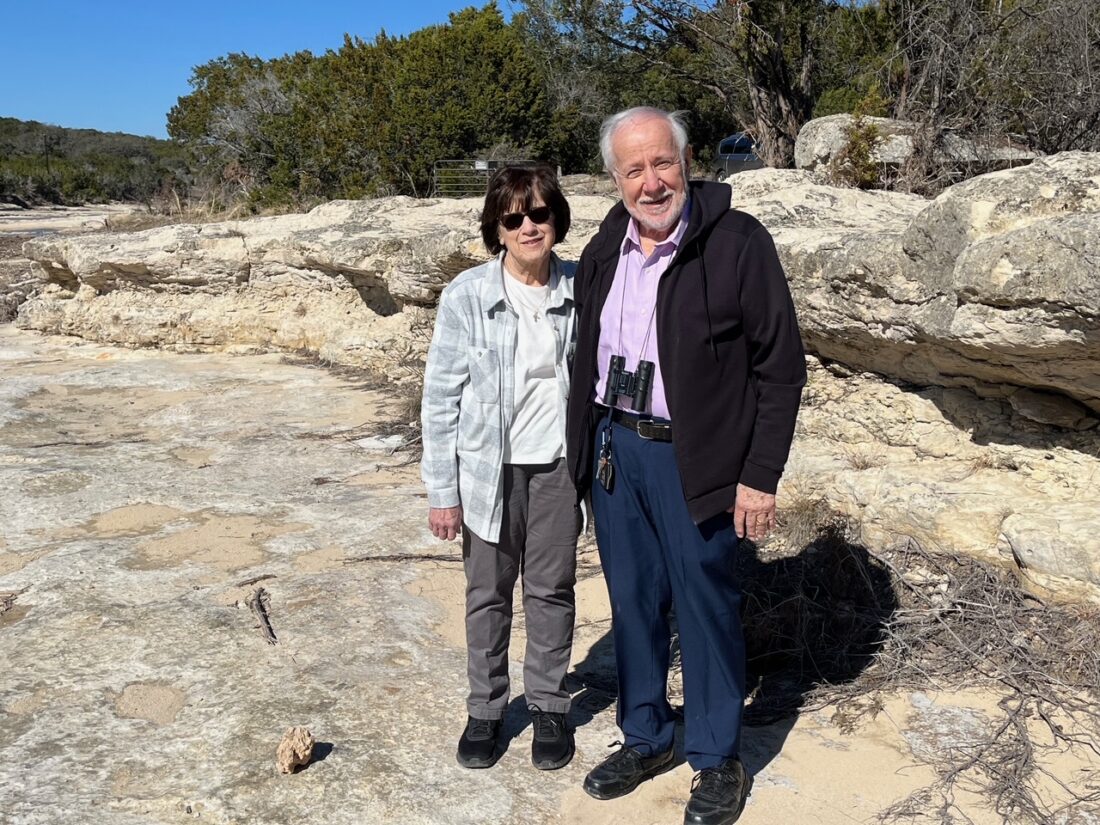
This sandstone creek bed was exposed after a flash flood washed away the trees and brush that hid it from view. Photos by Beverly Kehe-Rowland
FRIENDLY DEER
We arrived at our week-long residence in Lago Vista, Texas, about 8:30 p.m. the following night. We soon learned the office closed at 9 p.m., which caused me to be anxious to get to our unit. Thankfully, our quadplex was across the street from the office, because when we tried our key card there was no little green light and no clicking of the lock. My husband caught the person who checked us in and a new card was made minutes before the man left for the night.
Our welcoming party consisted of two small white tail deer, which we soon learned were abundant in Texas Hill Country. We became accustomed to seeing eight or ten deer lying in the shade to get out of the afternoon sun and grazing in the yards in the evening. Deer corn was sold at the resort office, so these guys were used to being fed. One afternoon I decided to use fresh green beans to treat the single deer standing outside of our patio door. When he finished the beans, he started licking my arm. I believe he would have walked into the house if coaxed.
We were staying on a lake on the Colorado River. There was no ferry or bridge which meant in order to go five miles from our unit, we had to drive 39 miles. This is what happens when you book a time share from a Walmart parking lot and don’t research.
HANGING OUT IN HILL COUNTRY
Sunday was a great day in Hill Country, a long day, but a good one. Our travels are about the people as much as they are about the terrain and views. In many cases, the people make the trip, which was the case on this day.
After attending a church my husband found online, we decided to drive 45 minutes to Marble Falls, but soon after we started our journey, my husband noticed six or eight domed structures in the distance. In an effort to learn what they were used for and to get a closer look, we stopped at a convenience store where we learned they were an Airbnb and were given directions to an unmanned locked gate. We continued on for a short distance when I saw a country road along a very shallow, creek bed that was lined in what I later learned was limestone. We did what we frequently do while adventuring, turn around.
As we drove down Cow Creek Road we came upon two Texas Longhorns who were munching on a pile of hay someone had dropped over the gate. We passed over a cattle grate and saw a hand-painted sign that read “Slow Loose Cattle.” We were first introduced to these grates when we traveled west in 2016. The grates are placed between ranches with rows of steel tubes or bars with a shallow pit beneath. The gaps between the tubes are wide enough for the feet of cattle to enter, but close enough for a human to walk over. Cows usually avoid walking across the grates, therefore they work well to contain free-range cattle. I learned later that free-range was no longer allowed in this area.
Shortly after we crossed the grate, I exited the van to get a few pictures of the wide limestone creek bed. A man in a pick-up truck waved as he passed by. It was clear the land along the road was not to be entered by an abundance of signs stating such.
My husband had parked a few hundred feet from where he left me. The truck turned off the road, drove through the water and parked parallel to the creek. The driver got out, walked to the side of the truck box, got back in and drove back to where my husband was standing. By the time I reached the men they were deep in conversation. We learned the man was the ranch manager and was checking to see what we were doing. We had a great visit and learned about several topics: Lawton was a retired chef who had been helping at the ranch for twenty years, there was a Civil War grave on the property and Kodiak, one of the Longhorns, was a champion and was now living out her days on the ranch. We also learned a very damaging, unexpected flood had come through on July 4, 2025, when a fire chief died attempting to save a girl. His body was never found.
We were given permission to walk the creek bed and were told if the neighbor across the creek came along on the easement, to tell her we had spoken with him. Within five minutes of Lawton’s departure, Kaylyn came off the hill and drove through the water headed to the store to buy ingredients for her husband’s birthday dinner. She spoke about the piles of debris the flood had left, but now were taken away and told us about two small waterfalls made by crevices in the creek bed.
While we were admiring the waterfalls, we noticed a Tesla and a small sports car had stopped near our van. Two men, two women and a toddler exited the vehicles and were walking toward us. Malcolm, the oldest man and owner of the cars, said we wouldn’t have been able to see the creek before the flood, due to the thick cedars and brush. He told about many things, including coming to America and his car collection. He also told about how his Scottish grandfather spoke through tears about being on a ship that could have saved those that perished when the Titanic went down. The grandson remembered the sad story told to him when he was seven years old about how some of the men woke the captain to tell of the emergency and how the captain did nothing. Recently, he did some investigating and learned the grandfather’s name was indeed on the ship’s roster at the time of the accident and that the captain had been court martialed for ignoring the dire situation.
About this time, Kaylyn returned from the store and stopped to see what all of the cars were doing there. We introduced our new friend who told her he had brought some of his equipment to help clean-up after the flood. She thanked him and took his contact information in order to invite him and his wife for dinner.
Had I not wanted a better view of the creek, we nor the others may not have been brought together, but then God works like that.
It wasn’t until the next day that we learned the flash flood was the same one that washed through Camp Mystic killing 27 campers and counselors.
BUCHANAN DAM
Another of our day trips was to Buchanan Dam. It is the largest multi-arch earthenware dam in the world and the first in the region to provide hydroelectric power. A private family began building the damn in 1931, but the project was abandoned when the Great Depression hit. Later, Senator James Buchanan and an intern named Lyndon B. Johnson were instrumental in the completion of the dam. Unfortunately, Buchanan died about six months before the dam was completed.
If the dam were to be breached, the water would destroy communities all the way to Austin, the state capitol. It was closed by Homeland Security after 911 because of lack of funds to be able to keep the dam open and secured.
To be continued.
Local News
The Old Immigrant
I met him on a playground by chance while visiting my daughter—an old man who had grown up in Cuba, under the ...
Thanks, Reginald, For Lending Me A Song
Around this time of year, Sally and I have a four-week period of time, which we could call our Celebration ...
Former Mayville Rite Aid Sold
Area Residents Find A Riverboat, Tame Deer, Aftermath of a Flash Flood And A Massive Dam
Maple Grove Junior Eyes Future In Heavy Equipment