SWCS Presenting Inclusive Education Practices
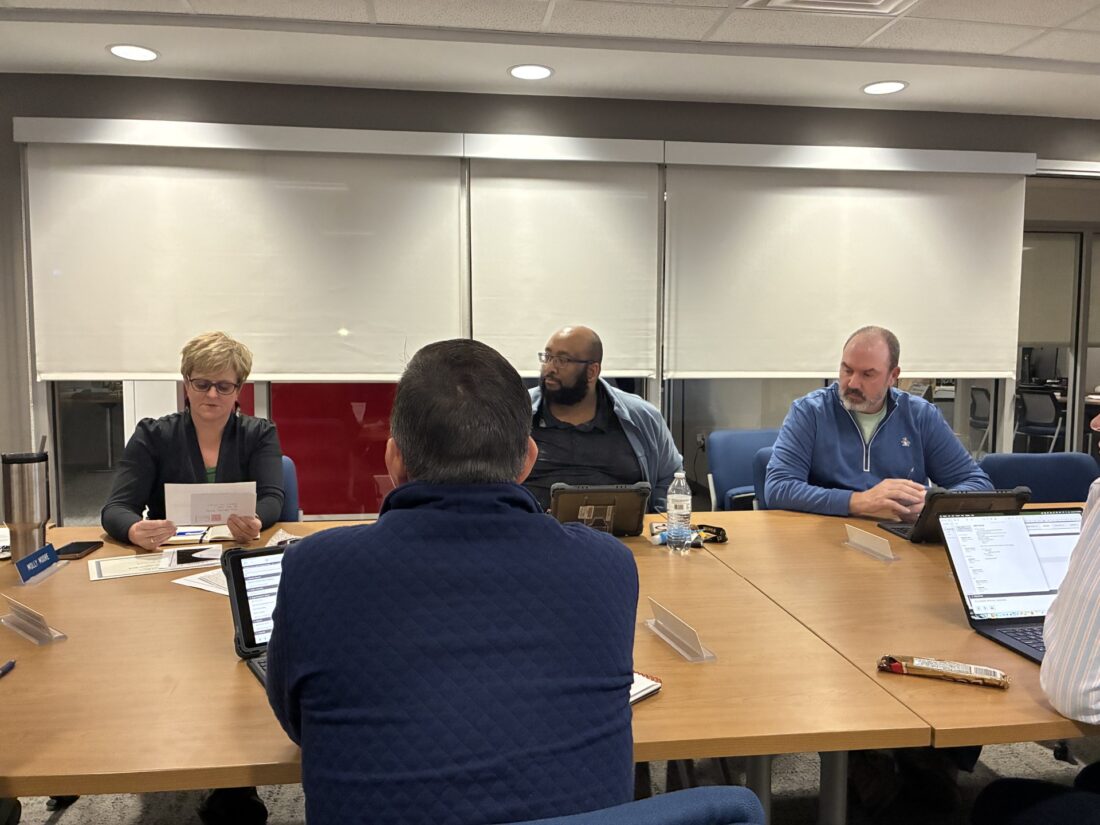
Superintendent Molly Moore (left) leading the board through business.
Southwestern Central School board members recently learned more about inclusive education practices in the district.
The presentation showcased the professional learning community work that these instructors have been working hard at implementing, with the hopes of furthering learning opportunities for students with even the most significant learning hurdles.
The presentation was led by a host of special education teachers, two speech language pathologists, and the district’s occupational therapist. These individuals included Mary Rapp, Katie Skoglund, Lily Schrader, Ally Genco, Liz Jagoda, and Peter Conley. Presenters initially began the presentation by noting the inspiration behind this approach is from the district’s “Learning For All” initiative. This initiative sees that all students have equitable access to quality education. Those presenting stated that the curriculum that was to be presented to the board was created to allow unique learning opportunities that will fit the individual needs of each student based on ability.
The teachers and providers detailed a plan that had been devised to help further this objective. The first step of the plan is to show the need for equitable assessments, which will help to assess all students at their unique developmental level. The group then stated an increase in collaboration between the special education teacher, and various service providers, which will assist in examining any current assessment limitations. Lastly, goals will be set to reflect student growth throughout their academic career.
A specific method that will be used to show this academic growth will be the new addition of an inclusive report card specifically for the self-contained students from kindergarten to fifth grade. These report cards are designed to show each student’s meaningful progression, focusing on that student’s individual growth rather than comparing their work to that of other students. The report card rubric was designed on a grading scale that will score with a number between one and four. The rubric was specifically made to create prompts and models that students will need to gain necessary skills. Additionally, the grading scale was designed to be able to accommodate both verbal and non-verbal students.
“They shared how they have changed the report card that is used for our students in our 811 classrooms, so that it shows individualized student growth and it can have a more positive reflection on the growth that those students are making,” said Superintendent Molly Moore. ” For me personally, I was overwhelmed with gratitude for their passion and their commitment, which showed through in their presentation.”
Each number in the grading scale represents a different point in the student’s development. One represents modeling, a beginning stage where the student will still frequently model adult behavior. A two is for emerging, meaning that the student needs frequent support in order to demonstrate skills. Three represents progressing, meaning that the student performs skills with minimal support. Lastly, a four represents mastery, meaning that the student is able to perform skill independently and consistently.
The next steps for these teachers and service providers is to begin planning on what skills to target next. Parent communication will be provided regarding the new report card system and rubric. For any further information contact 716-484-1136.
Local News

Expanding Engagement: Falconer Public Library Appoints New Director
Sheriff’s Office, AXON partner to assist in public safety
The Chautauqua County Sheriff’s Office has announced a new partnership Wednesday with AXON to deploy its ...
Free Fair Housing Training For Landlords Coming In March
Zone Capital Corp. Looks To Future
The Greater Jamestown Zone Capital Corporation is looking toward the future of its organization with plans to ...
Federal Judge To Deliver Jackson Day Address in Warren