
Future Implications: Lots Riding On Latest County Merger Effort
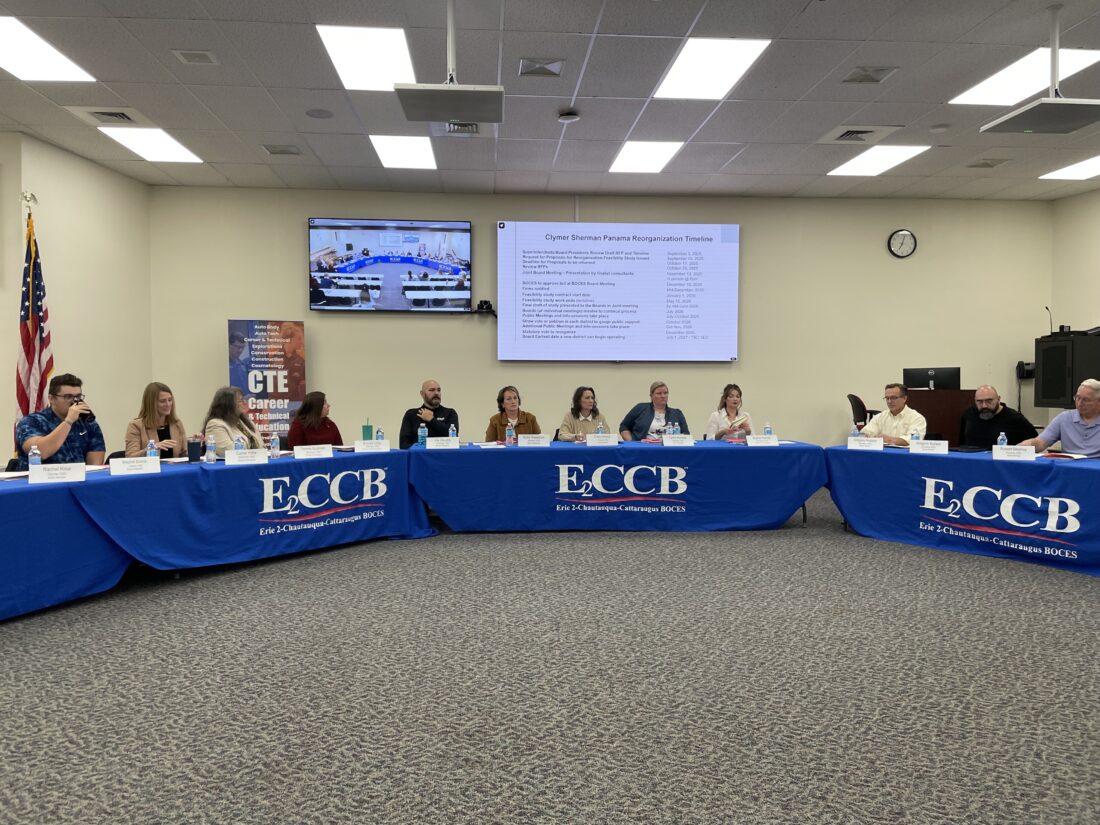
School boards of Clymer, Sherman and Panama met in November to discuss the merger feasibility study process. P-J file photo
Pressures will soon begin to mount on the school boards that oversee Clymer, Panama and Sherman. It is through no fault of those who have been elected to serve. They are only following through on community wishes.
During last May’s school vote, each community indicated in a referendum a willingness to explore the idea of a potential merger. It was far from overwhelming, but still fairly strong.
Responses at the time included: 221 yes and 49 no from Clymer; 144 yes and 41 nos from Sherman; and 102 yes and 57 no with 25 undecided from Panama. That is a total of 467 yes and 147 no votes between the three, along with 25 undecided votes — or 73% in favor.
From a distance, the synergy of these districts coming together as one makes sense. For starters, the schools team up consistently when it comes to athletics. The Clymer-Sherman-Panama Wolfpack football team has a winning tradition with three state titles in eight years.
Sports, however, also can be a double-edged sword. Though combining teams promotes participation, it can also discourage consolidation. If student athletes have the option to play elsewhere, then there is no need to look at the academics and course offerings that would likely improve for a larger district.
It is a lot like the multi-million dollar building projects that keep being approved by tiny district voters that include Ripley and Brocton. As long as big chunks of funds from the state are going into buildings with shrinking student numbers, there is a lack of urgency to partner with other schools for academics or to become one.
Another characteristic shared by Clymer, Panama and Sherman is the dwindling enrollment numbers. All are below 400 students. According to the state Education Department, there are 382 in Panama, 380 in Sherman and 317 in Clymer.
All told, those figures do not even add up to 1,000. Even if the schools do agree down the road to become one, they’re still relatively small.
Having low enrollments is one of the reasons that Ripley secondary students are not receiving an education from their hometown school. Instead, they are transported to Chautauqua Lake Central School — about a 25-minute ride — in a tuition deal between the two districts.
This difficult and proper decision made by the school board more than a decade ago allows seventh- to 12th-graders at Ripley to have more options when it comes to the curriculum and extracurricular activities. Those additional options are something that would have never come to fruition at the smaller school due to the dwindling numbers being served at the district.
Ripley, which still maintains a highly paid superintendent and relies on an elementary school principal, has 126 students from prekindergarten to grade six. Its budget is around $10 million, but could be less expensive through sharing administrators with neighboring districts.
Across New York state, rural schools are starting to become more aggressive in looking at options. In Central New York south of Syracuse, Cazenovia Central School District and the Morrisville-Eaton School District are considering a merger option due to decreasing class sizes and a shrinking tax base.
Near Albany, the Troy and Wynantskill school districts will hold a public vote in April that could allow the city district of Troy to annex its neighbor. If the vote passes, $241 million in additional aid from New York could go to the combined district.
“It seems like every corner of the state is encouraging us to figure out what we can do to share, and I think it’s only a matter of time, especially if the state aid stagnates, before we have to start taking a really, really close look at that,” said John Cain, president of the Copenhagen Teachers Association and chair of New York State United Teachers’ Small and Rural Locals Advisory Council.
Back here in Chautauqua County, whether they like it or not, Clymer, Panama and Sherman will be a barometer for other potential partnerships in the future. When mergers are defeated, there is a tendency for other nearby school boards to shy away from discussions and proposals with neighboring districts.
More than eight years ago was the last local attempt. Ironically, it was an effort by Clymer and Panama. At the time both were sharing one superintendent, which brought some optimism regarding the proposal.
An advisory referendum, better known as the straw vote, quickly dashed those hopes. Though Panama voters said yes by a slim margin of 192 to 168, Clymer overwhelmingly rejected the idea, 654 to 186.
Those results alone explain the potential powderkeg that could be looming as the studies, questions and input from residents begins. Community members and advocates for education always say that doing what is best for the children has to be the priority.
We would agree. With 18 school districts currently in existence that rely on growing property taxes in a county losing population, that’s far too many.
Our youth will adapt to fewer and larger schools with more educational offerings just fine. It is the adult population that always has the trouble with letting go.
John D’Agostino is editor of The Post-Journal, OBSERVER and Times Observer in Warren, Pa. Send comments to jdagostino@observertoday.com or call 716-487-1111, ext. 253.
Local News
Bemus Point Elementary School To Present ‘Aladdin Kids’
Westfield Appoints New Police Chief
Carroll Officials Raise Town Hall Concerns

Four Charged After Drugs, Weapon Found In Dunkirk Home

‘Incredible Experience’: JHS To Present ‘Pirates Of Penzance’
BPU Board Member Wants ‘Double’ Poles Removed
As the Board of Public Utilities continues its work on installing its fiber internet, board members are talking ...