
State Steady In Its Love, Hate For Taxes
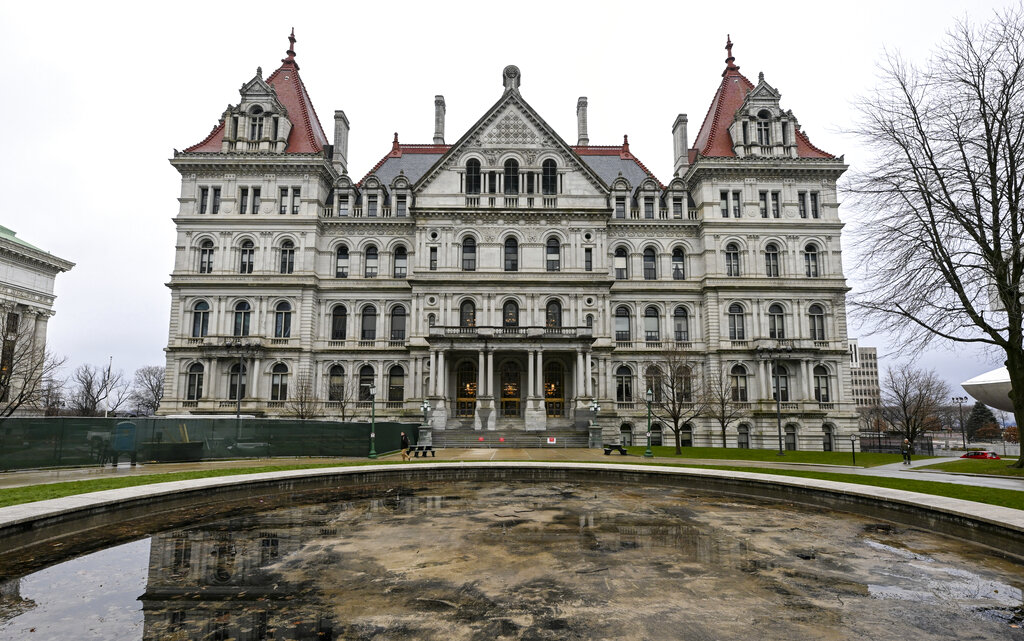
New York’s state capital is blamed for high taxes, but state residents consistently vote and say in a survey more taxing is needed. AP photo
New Yorkers appear to be consistent gluttons for punishment. Not only do many of us understand what is holding back the once great Empire State from prosperity, we also are having a tough time breaking away from it.
So says a poll commissioned by the Invest in Our New York Campaign that was done by the Siena Research Institute and released the week of the November election. Its findings: a decisive 78% of New Yorkers — including majorities across party lines — support raising taxes on large corporations and the wealthiest 5% of earners to address the likely funding cuts that are expected to take place starting in January.
“New Yorkers have delivered a clear mandate to Gov. (Kathy) Hochul and state legislators: make the wealthy pay their fair share rather than cutting the schools, hospitals, and housing programs our communities depend on,” said Maria Duarte, campaign organizer for Invest in Our New York. “With the federal government stripping billions from our state budget, Albany can either protect billionaires’ tax breaks or stand with working-class families. This poll shows voters know which choice is right. Lawmakers need to listen to their constituents and act accordingly.”
To set the record straight, Invest in Our New York is far from an objective organization when it comes to the state’s wellbeing. It is a coalition of community organizations, labor unions, and advocacy groups working to create a more equitable tax system — in their eyes.
Frankly speaking, it is a collaboration that already heavily relies on your tax dollars — but always needs more. At the moment, their target is the top 5% of earners, including New Yorkers who generate wealth through passive income, and highly profitable corporations.
Based on demographics alone, we know a small slice of that population may be evident in Western New York. But it is prevalent in far greater numbers downstate in Manhattan and Long Island — or the location where 11.2 million of the 19.9 million of the state’s population reside.
Median household gross income from the U.S. Census reinforce that case. For instance, Chautauqua County stands at around $57,000 per year. In Westchester County, just to the north of New York City, it is $114,000 — double the amount here.
As we’ve witnessed from the crippling tax increases in the city of Dunkirk at 84% this year and the village of Fredonia at 54% in the spring, residents here are already struggling when it comes to those high burdens.
But they also are their own worst enemy. Every year, residents of this high-tax county approve growing school budgets that signal their approval of the hostile ways New York treats residents and businesses.
As was noted in this corner, thanks to recent propaganda issued from Chautauqua County, a report “Blueprint for New York: Creating a Roadmap for Change” details the state is already not conducive to cultivating business and industry. Despite the study’s heavy focus on Albany, tax increases on a local level are a major factor in a declining upstate population and economy.
That being said, the Siena Research Institute poll of 1,010 registered voters conducted in October revealed broad and growing public support for progressive taxation, with 86% of Democrats, 63% of independents, and 53% of Republicans backing increased taxes on the wealthy to fund universal childcare, affordable housing, and public transportation. Support extends across all regions of the state, including 80% in New York City, 74% on Long Island, and 65% upstate.
That speaks to a troubling reality. New Yorkers, through years of decline, are resigned to the sense there is no hope for growth here. The only way, in our eyes, to fix the current problems is to pile on more penalties for those who have the means as well as big business.
This attitude has been prevalent for decades that has led to a five-decade exodus, especially in upstate and Chautauqua County. Lack of investment from industry and the private sector increases a region’s rate of poverty. That makes those connected to the high-tax system — in government and schools — some of the highest-paid individuals locally.
According to seethroughny.net, there are 451 employees in the county’s schools and governments compensated more than $100,000 at the moment. Compared to 2020, when the number was 155, those earning six figures have increased by 291% — all funded through your taxes.
To our south is Pennsylvania, which is seeing much different results when it comes to the economy. According to Site Selection Magazine, the state has the 11th best business climate in the nation this year and the top business climate in the Northeast. Pennsylvania also claimed the eighth spot for most Inc. 5000 companies — the fastest-growing private companies in America.
The Site Selection Magazine ranking comes less than a month after new analysis from Moody’s Analytics Chief Economist Mark Zandi confirmed that Pennsylvania is the only state in the Northeast with a growing economy. That report also found Pennsylvania is among just 16 states nationwide where the economy continues to expand.
Government’s approach over the border is evident through its borough, township, city and school system that is sustainable. For instance, in the city of Warren, Pa., the budget decreased $160,000 to $10.4 million for 2026.
In New York, that is not happening. Residents here are still being smothered — and there are no signs it will be letting up.
John D’Agostino is editor of The Post-Journal, OBSERVER and Times Observer in Warren, Pa. Send comments to jdagostino@observertoday.com or call 716-487-1111, ext. 253.
Local News
WCA Foundation Launches Year End Campaign
The WCA Foundation has officially launched its year-end fundraising campaign, calling on the community to help ...
State Steady In Its Love, Hate For Taxes

Ashville Library Expanding Christmas Celebrations

Audubon Announces 2025 Nature Photography Contest Winners

Lucia Pageant Is Saturday In City
Sensory Sensitive Santa Coming To Fenton
The Fenton History Museum and Research Center will be welcoming Santa Claus soon as part of a yearly program to ...