
Right And Wrong
Dr. Karen Korematsu, Daughter Of Famous Supreme Court Plaintiff, Visits Jackson Center
-
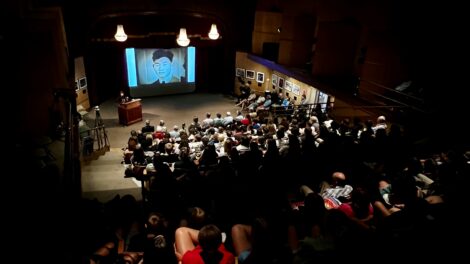
- The Robert H. Jackson Center’s Cappa Theatre was filled to capacity with community members, mostly area students, for the Center’s annual Constitution Day lecture featuring Dr. Karen Korematsu, daughter of civil rights icon Fred Korematsu. This year is the 80th anniversary of the Korematsu v. United States decision, upholding his incarceration for defying military orders excluding Japanese-Americans from the United States West Coast. Justice Robert H. Jackson famously dissented and 40 years later the conviction was overturned.
-

- Dr. Karen Korematsu addressed an audience of more than 200, mostly area students, at the Robert H. Jackson Center Tuesday morning as the keynote speaker for its annual Constitution Day observance. Dr. Korematsu, daughter of civil rights icon Fred Korematsu and Founder of the Fred T. Korematsu Institute, emphasized the importance of civic engagement and cross-cultural understanding.
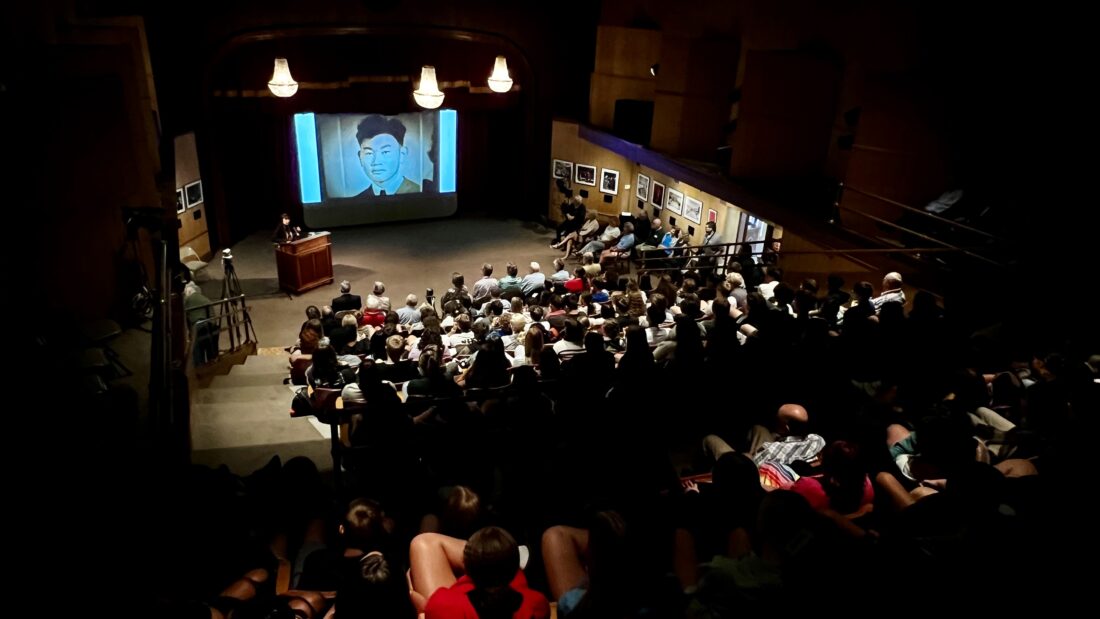
The Robert H. Jackson Center’s Cappa Theatre was filled to capacity with community members, mostly area students, for the Center’s annual Constitution Day lecture featuring Dr. Karen Korematsu, daughter of civil rights icon Fred Korematsu. This year is the 80th anniversary of the Korematsu v. United States decision, upholding his incarceration for defying military orders excluding Japanese-Americans from the United States West Coast. Justice Robert H. Jackson famously dissented and 40 years later the conviction was overturned.
The Robert H. Jackson Center welcomed Dr. Karen Korematsu on Tuesday as the keynote speaker for its annual Constitution Day observance.
Korematsu, daughter of civil rights icon Fred Korematsu and founder of the Fred T. Korematsu Institute, addressed an audience of more than 200, mostly area students, emphasizing the importance of civic engagement and cross-cultural understanding.
In her address, Korematsu discussed the landmark Korematsu v. United States Supreme Court decision, which will mark its 80th anniversary in December. She described it as “one of the worst Supreme Court decisions in history,” highlighting the continued relevance of her father’s fight against injustice.
Dr. Korematsu shared the story of how her father’s arrest for defying military orders excluding Japanese-Americans from military zones on the U.S. West Coast established under Executive Order 9066. He briefly became a fugitive and was eventually arrested.
She said that Ernest Besig, then-director of the ACLU, visited Fred Korematsu in his jail cell after reading about him in the newspaper. Besig asked Korematsu if he would be willing to serve as a test case challenging his arrest and the exclusion, and internment of Japanese and Japanese-Americans on the United States’ West Coast.

Dr. Karen Korematsu addressed an audience of more than 200, mostly area students, at the Robert H. Jackson Center Tuesday morning as the keynote speaker for its annual Constitution Day observance. Dr. Korematsu, daughter of civil rights icon Fred Korematsu and Founder of the Fred T. Korematsu Institute, emphasized the importance of civic engagement and cross-cultural understanding.
She also recounted a personal anecdote about learning of her father’s case at age 16.
“When I asked him about it, he simply said, ‘It happened a long time ago. I thought the government was wrong and I was right.’ I saw the sadness on his face and couldn’t ask any more questions,” she recalled.
Despite the initial setback, Dr. Korematsu emphasized her father’s perseverance: “He had never given up hope after more than 40 years that his conviction would be overturned… His strong moral principles of right and wrong, that’s why his legacy lives on.”
Fred Korematsu’s conviction was overturned on November 10, 1983.
Karen Korematsu told the audience to broaden their education, remain vigilant against misinformation and engaged in civic life. She stressed the importance of considering diverse cultural perspectives when approaching societal issues.
“Dr. Korematsu’s message resonates deeply with our mission to advance justice and civic education,” said Kristan McMahon, president of the Robert H. Jackson Center. “Her father’s story and her ongoing work serve as powerful reminders of the importance of standing up for our constitutional rights. We are thrilled so many teachers and students joined us to hear directly from Karen.”
Justice Robert H. Jackson famously dissented in the case, writing an opinion that differed with the majority of the court on three major points. First was that the military order was racist because it was an attempt to hold a person guilty for the crime of being born of Japanese ancestry. Jackson also argued that civilian courts in times of war should not review the constitutionality of military actions because a civilian judge in wartime would defer to military judgment and never term what was said to be militarily necessary as unconstitutional. Jackson also argued that even if such racially discriminatory orders were able to be considered reasonable under military terms, the civilian courts could not constitutionally assist the military in enforcing them and should leave it up to the military to act on them alone.
“[I]f any fundamental assumption underlies our system, it is that guilt is personal and not inheritable,” Jackson wrote in his dissent. “…But here is an attempt to make an otherwise innocent act a crime merely because this prisoner is a son of parents as to whom he had no choice, and belongs to a race from which there is no way to resign.”
Korematsu also visited the Smithsonian Institution’s traveling exhibit, Voices and Votes, Democracy in America, visiting the center through Oct. 18. Voices and Votes includes historical and contemporary photographs, educational and archival video, engaging multimedia interactives, and historical objects like campaign souvenirs, voter memorabilia, and protest material. The Jackson Center’s companion exhibit, The Story of Our Participation, highlights artifacts of local significance from partner organizations including antique voting equipment, vintage suffragist pins, and Jackson’s Supreme Court chair.
The Voices and Votes exhibition is adapted from American Democracy: A Great Leap of Faith currently on display at the Smithsonian’s National Museum of American History. Voices and Votes includes historical and contemporary photographs, educational and archival video, engaging multimedia interactives, and historical objects like campaign souvenirs, voter memorabilia, and protest material.
Local News
Federal Judge To Deliver Jackson Day Address in Warren

Ready To Grow: Impact Campus Ministries Looks To Expand
Fredonia may halt comment portion

Panama Talks Sidewalk Snow Plow Work

BOCES Students Help In Fight Against Hunger
Dunkirk Town Sued Over Solar Farm Permit
The legal fight over a proposed town of Dunkirk solar energy farm continues. A Fredonia-based lawyer who owns ...