
Sen. Borrello Debates Portable Voting Site Bill
Trending
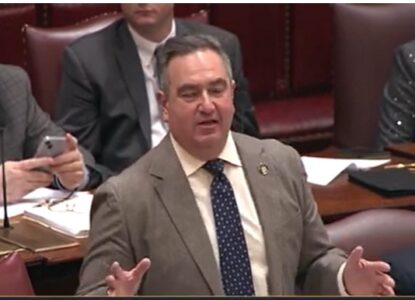
State Sen. George Borrello, R-Sunset Bay, began the 2024 legislative session debating a familiar topic – portable voting sites.
Borrello debated Sen. Rachel May, D-Syracuse, for the third consecutive year on the topic. S.242 has now passed the Senate for a third consecutive year, but has yet to pass the state Assembly. It was one of several elections-related bills to pass the Senate this week as the 2024 legislative session opened.
May proposes allowing counties the option to establish two or more locations for portable polling places for no fewer than three consecutive days -- though portable voting is not to replace or otherwise decrease the number of mandated early voting locations. The location of portable voting sites would have to be determined no more than 14 days before the election and be communicated by the county Board of Elections.
Borrello has raised the same concerns in each of the last three years, questioning the security of the sites. May said it will be up to county Boards of Elections to come up with a system that is as secure as in-person voting and existing early voting sites.
"The reality is that on election day we have one-day voting sites," May said. "These will be three-day voting sites. To imagine that they are somehow more flighty or difficult to imagine is really, I think, taking out of context what we're trying to do here, which is creating flexibility and bringing the ballot box to people where they are and making sure the most people possible who are eligible to vote can exercise the franchise to vote."
Borrello said he is troubled that after three years of debating S.242 he still doesn't get a solid answer exactly what the portable voting sites will look like other than it will be up to the Board of Elections to decide. He also questioned how S.242's reliance on local Boards of Election works with another proposal before the state Legislature to professionalize local Boards of Elections.
"And I do have faith in our local Boards of Elections to act in a bipartisan manner," Borrello said. "However we've also at the same time been pushing to 'professionalize' our Boards of Elections. So how much longer will we have a Republican and a Democrat in every county in upstate New York so that we can have that bipartisan discussion? The answer is possibly not for much longer, so something like this could all of a sudden come under the purview of someone who is not having the best interests and acting in a bipartisan manner. Let's just go back to the fact that we really don't know what this is going to look like. This has got a lot of problems It continues to have a lot of problems. As I've said many times before, the most important thing Is to ensure that the people of New York state believe that our elections are secure and that their vote counts."
Other bills passed by the Senate on Monday include:
S.263, which prohibits deceptive practices and the suppression of voters, and increases penalties for violations of the elective franchise. If signed into law, S.263 would make it a misdemeanor to knowingly spreading deceptive information aimed at interfering with others' right to vote. Repeat offenders could face felony charges.
S.371, the Democracy Preservation Act, which bans political spending by foreign-influenced business entities in New York's state and local elections. The bill was originally proposed during the 2023 legislative session.
S.610, which would authorize local Boards of Elections to establish absentee ballot drop-off locations.
S.616, which amends the state Election Law to allow an individual connected to an election to provide items during voting hours to voters as long as the items have a nominal value, like water or snacks.
S. 657, the Doctor John L. Flateau Voting and Elections Database and Academic Center of New York Act." The bill would create a state Voting and Elections Database in the state Board of Elections and an Academic Center which will compile New York's election data and administer it for research; and
S.675, which would require the state Election Law to include public-facing websites in the list of political communications that are required to feature a disclaimer identifying the political committee responsible for the communication; specifies that such disclaimer must be clearly displayed on each navigable page of a website paid for, hosted, and/or operated by a political committee.