
Former Farmers Market Leader Hired By Cornell Cooperative Extension
Trending
Cornell Cooperative Extension of Chautauqua County's Nutrition Program has added a new coordinator to take reins of food education and ramp it up to combat food deserts and insecurities.
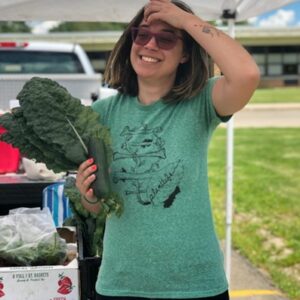
Linnea Haskin, former Jamestown Public Market director, has been hired as a food resource educator for the Grow Chautauqua Food System Program. Haskin aims to educate the public not only about healthy eating, but about the plethora of fresh, locally grown products available to the public and other state incentives and subsidies which encourage the farming and commerce of New York-grown produce.
"I'm hoping to help aid the access to healthy food choices and to build off the food access program already in existence for our area," Haskin said. "Food insecurities are a real issue and challenge in Jamestown and some surrounding areas. Plus, getting local farmer's produce into local hands not only is a healthy option, but it keeps funds circulating within our area's economy."
According to the U.S. Department of Agriculture, a food desert is defined as an area that has either a poverty rate greater than or equal to 20% or a median family income not exceeding 80% of the median family income in urban areas, or 80% of the statewide median family income in nonurban areas. To qualify as a food desert, an area must also meet certain other criteria. In urban areas, at least 500 people or 33% of the population must live more than 1 mile from the nearest large grocery store. In rural areas, at least 500 people or 33% of the population must live more than 10 miles from the nearest large grocery store.
Holding the Forward Edge of the Battlefield CCECC received a state grant totaling $800,000 from the state Department of Agriculture and Markets "New York Food for New York Families" to not only fund Haskin's position.
"We're working with the schools to continue the 30% program," said Emily Reynolds, a supervisor with Cornell Cooperative Extension of Chautauqua County. "Schools who purchase locally grown fresh fruit and vegetables and 30% of their menus constitute locally grown produce are eligible for even more funding/state-aid. Sherman School Systems are a prime example of this. They purchased and stored enough sweet corn and berries that they qualified for this. The kids are eating healthier than if the school purchased processed vegetables. The money stays local, and the school qualifies for more state-aid. It's a win-win situation for everyone."
For both Reynolds and Haskin, the lack of quality fresh produce, poverty, the economy and food insecurities all go together.
"It's all intertwined," Haskin said. "You can see direct correlations between poverty and food insecurities. You can see the lack of storefronts who offer fresh, affordable foods and the rise of health related issues in geographic areas- tied together. They're [issues] are all related in one way or the other."
For those wanting more information about Cornell Cooperative Extension of Chautauqua County's Nutrition Programs or how to connect produce sellers and buyers contact them at 716-664-9502 or visit chautauqua.cce.cornell.edu. Haskin is available at 716-664-9502, ext. 210.