
Flood Insurance: North Harmony, Lakewood Projects Ready To Help Lake
Trending
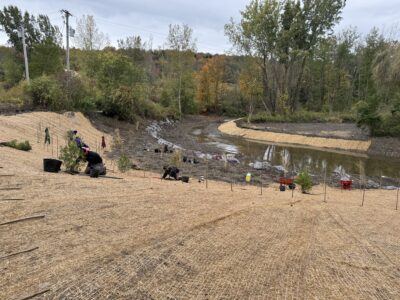
Two local watershed projects will be ready to handle spring rains next year after wrapping up this fall. Major construction has been completed on both Lakewood's Grandview Stormwater Management Project and North Harmony's Ball Creek Stabilization Project, both of which stem from Alliance-partnered state grants awarded in 2021. These stormwater management projects will help reduce the impacts of flooding and erosion, and work for years to come to limit sediment and nutrient runoff to the lake. State grant awards typically play out over the course of several years, and offer local municipalities and organizations a path to address longer-term goals like watershed improvement. Ball Creek, a main tributary of the lake near the I-86 bridge, has undergone around 500 feet of bank stabilization and restoration in two phases over two years. Engineering and design work on both phases was performed by EcoStrategies Engineering and Surveying. Construction of the second phase of the project was completed by Legend Excavating late this fall, and included regrading the eroded bank and armoring it with rock and plants. Bank restoration also included native plantings by Greener Gardens of Dunkirk, which will improve the local habitat, further stabilize the bank, and filter water. Local project partners include the Chautauqua County Soil and Water Conservation District, Chautauqua Watershed Conservancy, and the County of Chautauqua. State funding for both of these projects was provided by the Environmental Protection Fund as administered by state DEC via the Water Quality Improvement Project program. Local funding was provided by the Alliance/Foundation Match Fund supported by the Chautauqua Region Community Foundation, The Lenna Foundation, and the Holmberg Foundation, and a portion of an Alliance Consolidated Foundation Grant provided by The Lenna Foundation, the Ralph C. Sheldon Foundation, and the Chautauqua Region Community Foundation. These projects share the overall goal of helping the lake's long-term health, however, the engineering approach of the Grandview project is quite different. At the worksite just below Grandview Estates, 100,000 cubic feet of stormwater storage has been added with the construction of engineered wetlands. Engineer EcoStrategies worked alongside contractor Rock of WNY to design and build a series of swales and ponds which will slow and filter rainfall before it enters the lake. This project will also help to reduce flooding along Fairmount Avenue, serve as a public nature trail, and include new habitat features for turtles, birds, and bats. The CWC plays a key role in this state WQIP grant as well, with staff advising on habitat restoration and native plantings. Chautauqua County's 2% occupancy tax for waterways has also provided a large portion of the local funds needed to leverage the state's majority investment. Several key contributors have championed the Grandview project and made this work possible, including Lakewood Mayor Randy Holcomb and former Deputy Mayor Ted McCague, CWC Special Projects Coordinator John Jablonski, Busti Councilman Jim Andrews, and the County's Executive PJ Wendel and Watershed Coordinator Dave McCoy. As these two projects near completion, we get a sense of the timescales and the partnerships involved in bringing watershed improvements to Chautauqua County. Projects first have to be identified and positioned properly for state funding, which often includes engineering studies or site work. Project partners then collaborate to submit a grant application, which competes against other statewide applications for a limited pool of money. Local match funding often has to be secured during this process. If the grant is awarded, the project then needs to be implemented and managed by many different partners. Grant closeout often occurs three to four years after the project has first been imagined. These individual steps may not seem all that impactful at a glance, but like stormwater projects they come together slowly and do a lot of good for the lake and watershed over time. Long-term work of this sort also complements the significant investments that are made each year to address plant, algae, and debris issues. We look forward to continuing this balanced management strategy with our Alliance Members in the future, and to laying eyes on the Grandview and Ball Creek sites come springtime. More information can be found on our projects page at www.chautauquaalliance.org/projects/.