
Shelter From The Storm
Lakewood To Break Ground on Latest Watershed Work
Trending
The next few months will be a busy time for those working to improve our watershed, and the lake that it feeds.
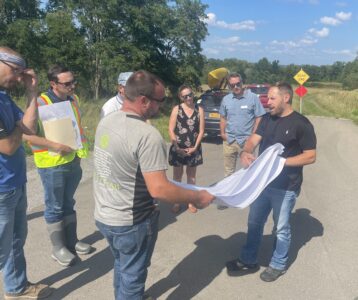
Three alliance-partnered grant projects secured in late 2021 through the state's water quality improvement program are taking major steps forward this fall. Last week the Grandview Stormwater Management Project team held a kickoff meeting at the construction site on Davidson Lane, near the Village of Lakewood/Town of Busti border. Project engineer Andy Johnson of EcoStrategies outlined design features of the constructed wetlands, which will add around 100,000 cubic feet of stormwater storage to the area to combat flooding and improve water quality. Rob Hetrick and Dave Gambino from Rock of WNY gave an overview of their construction schedule and the techniques that will be used to build new features like swales and pools to store stormwater. When completed, the project site will also serve as a public nature trail.
Staff from the Chautauqua Watershed Conservancy will also play key roles in completing the Grandview project. The site will include native plantings of trees and shrubs which will help to filter sediment and nutrients from runoff, as well as stabilize soils. In addition to advising on these new features and performing public outreach, CWC staff will work with Johnson and Hetrick's construction crew to ensure that the area continues to provide good habitat for local wildlife. The Alliance's consolidated foundation grant program and Chautauqua County's 2% occupancy tax grant program have provided a large portion of the local funds needed to leverage the state's majority investment. Several key contributors have championed the Grandview project and made this work possible, including Lakewood Mayor Randy Holcomb and former Deputy Mayor Ted McCague, CWC Special Projects Coordinator John Jablonski, Busti Councilman Jim Andrews, and the County's Executive PJ Wendel and Watershed Coordinator Dave McCoy.
In addition to stormwater projects like Grandview, state WQIP grants are also often used to fund stream stabilizations. The Ball Creek Stabilization Project in the Town of North Harmony is also scheduled to begin its final phase of construction in the coming months, and shares the common goal of reducing sediment and nutrient flow to the lake. The work targets two severely eroded banks, and will restore around 440 total feet of stream, in addition to protecting roadways. An Alliance grant funded the first phase of construction in 2022, which can now be seen along Stow Road opposite the Ashville Fire Department. This local investment was used as match funding to secure the state grant for the final phase of construction. The Ball Creek Project team includes North Harmony Supervisor Rob Yates, engineer Andy Johnson, contractor Legend Excavating, and the CWC. Also assisting is the Chautauqua County Soil and Water Conservation District, which leads a host of local watershed and agricultural programs.
The third alliance-partnered WQIP in development this fall is the Chautauqua Roadside Swales Stabilization Project. Around 16,600 feet of roadside ditches at 11 different sites are slated for improvement to reduce sediment and nutrient flow and improve function. Roadside ditches are one of the primary pathways for water entering the lake, and as such are key areas for watershed improvement work. Barton and Loguidice will serve as project engineer, while Dan Thorsell and the Town's highway department will carry out construction as in-kind match.
These three grants, and many watershed projects, require significant planning and preparation before shovels are ready to go in the ground. Project partners need to align several pieces of the puzzle, including the needs of the environment, the funding opportunities that are available, the priorities of grant seekers, and the recommendations of documents like the lake's 2010 watershed management plan. Engineering studies must often be performed years in advance before we can even think about constructing new wetlands or stabilizing stream banks. These studies have recently been performed for areas of Lakewood, Busti, the Town of Chautauqua, and the Village of Mayville, and continue to pay dividends years later as they are put to work to design and fund shovel-ready projects. This year, Alliance-partnered grants will fund three new engineering studies. These seek solutions to high-priority issues at another eroding section of Ball Creek, flood-prone areas along Mall Boulevard in Lakewood, and aging culverts in Chautauqua.
While different in their scale, method, and focus, each of these undertakings serves a common goal. Each piece of work will provide lasting water quality improvements that benefit the lake and its many different users. While they may seem small in scale when viewed individually, over time these many different watershed improvements have a significant cumulative impact. The whole is greater than the sum of its parts. The Alliance would like to thank all of the partners who have made these projects possible, as well as the generous financial contributions of The Lenna Foundation, the Holmberg Foundation, the Ralph C. Sheldon Foundation, the Chautauqua Region Community Foundation, and the County. State funding is provided from the Environmental Protection Fund as administered by the New York State Department of Environmental Conservation.