
Combined Efforts
Invasive Species Control Projects Completed At Camp Timbercrest
Trending
A group of former campers and camp staff from Camp Timbercrest, a 950-acre Girl Scout camp in Cattaraugus County, worked on three projects over the summer to decrease invasive species at the camp.
Friends of Timbercrest and Girl Scouts of Western New York partnered with Western New York Partnership for Regional Invasive Species Management (WNY PRISM) to address invasive species issues at Camp Timbercrest. The Girl Scouts was awarded assistance through two of WNY PRISM's programs, the Boot Brush Station Program and the Crew Assistance Program. The first award provided materials for a boot brush station that was built and installed by Friends of Timbercrest volunteers. The second provided assistance from WNY PRISM's Crew for herbicide treatment of knotweed.
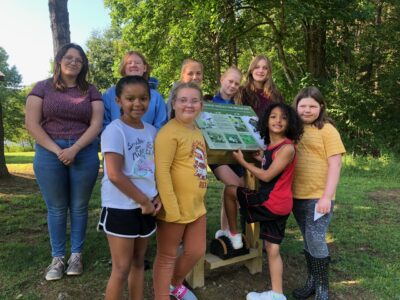
The Girl Scouts was one of six partners selected to receive a boot brush station from WNY PRISM, and it was installed at Camp Timbercrest just ahead of New York State Invasive Species Awareness Week in June. On arrival and departure, campers are encouraged to use the boot brush portion of the station to remove mud, dirt and seed debris from their boot treads. Campers are also encouraged to read the sign about the impact of nearby invasive species.
"Boot brush stations are an effective and cost-efficient means to help prevent the spread of invasive species along trails and in natural areas and are a great way to educate the public on invasive species," said Rachel Taylor, WNY PRISM community science and engagement program manager. "WNY PRISM's Boot Brush Station Program provides partners with the supplies and materials necessary for partners to install and maintain the boot brush station on their property. Partnerships like this are crucial to addressing invasive species issues in the Western New York region and help to spread the word, not the species."
The boot brush station sign feature knotweed, a vigorous growing bamboo-like invasive species that forms massive stands along streams and the roadside that shade out other native plants.
"We appreciate WNY PRISM for its support through this partnership," said Ro Woodard, Friends of Timbercrest invasive species project manager. "It gives us the opportunity to educate summer campers and troop campers throughout the year about the importance of good land stewardship starting with each of us. By simply cleaning our shoes and boots when we enter and leave camp, we minimize the potential movement of invasive species seeds into camp and to our homes."
Through the Crew Assistance Program, WNY PRISM provided a crew to treat an area of knotweed growing along the road to the entrance of the camp. Knotweed was introduced as an ornamental plant in the 1890s and comes from Eastern Asia. By the 1930s it had already become a concern due to its rapid growth and quick spreading. Volunteers from the Friends of Timbercrest chopped down the six to eight foot tall plants in early July. In early August it was treated with herbicide where the new growth would take up the herbicide and begin to weaken and die.
WNY PRISM Field Operations Manager Douglas Knoph stated, "The best way to manage invasive species is through prevention, which is a big component of the knotweed treatment at Camp Timbercrest. Given enough time, the knotweed would continue to spread down the Little Conewango Creek into the camp, so pushing it back through early active management is important for the preservation of the native species growing throughout the camp property."
While knotweed is difficult to eradicate and will need several years of monitoring and continued treatment to be successful, Woodard says, "We can expect the knotweed to come back next year in much lower numbers."
In its fourth year, the Friends of Timbercrest's third project was the ongoing surveying and removing of the invasive water chestnut from the 33-acre Keyser Lake in the middle of Camp Timbercrest. Native to Eurasia, the plant is a floating annual that can quickly cover a lake with an impenetrable mat of vegetation that chokes out other plants and animal life and disrupts boating and swimming. Yearly vigilance by manual pulling of the plants before the seeds are released in late July is an effective control mechanism.
"Our camp properties are very important places to our Girl Scouts, our camp team, and our alumni," said Javeena A. Edwards, Girl Scouts of Western New York interim CEO. "We're grateful to WNY Prism and the Friends of Timbercrest for their continued support to this camp's upkeep and well-being. Maintaining our camp grounds and doing our part of control the spread of invasive species is essential to our land maintenance plans and it also provides relevant education for our Girl Scouts."
For more information about the Girl Scouts of Western New York, visit www.gswny.org or call 888-837-6410.