
Osprey At Radio Station Succumbs To Injury
Trending
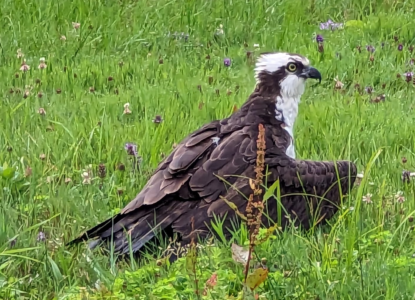
Around 5 a.m. on Monday, Aug. 7, Media One Radio Group on Orchard Road in West Ellicott had a surprise visitor.
"There's a door to the building on the South side where I normally stick my head out to check what the weather is doing," Dennis Webster, morning announcer on WJTN radio, said. "There's a patio out there and I immediately knew I was not alone as there was a bucket out there that had been knocked over and I heard rustling."
Webster went back inside for a flashlight and when he came back out, discovered an injured osprey. Andrew Hill, general manager for Media One Radio, assisted Webster with figuring out what to do, but because of the early hour, they struggled to get in contact with anyone until around 10 a.m.
Webster said this was a challenge they had never faced before and they were not sure what to do.
Hill said they were eventually able to connect with Wildlife Rescuers, which came out to help.
"This bird was in distress but it couldn't fly," Hill said. "It was obviously severely injured. We got in contact with the Audubon who suggested Sandra Emke of TSE Wildlife. We connected with Cheryl Burns of Emusing Wildlife in a separate call and they both came to help."
Hill said the main concern was the fact that the day was very hot, so he and Webster were charged with figuring out a way to get the osprey into a shelter of some sort and out of the sun.
The bird, while unable to fly, did stretch its wings a little and could hop. It was suggested that they put a blanket over it and try to move it into the shade. Hill said because the wingspan was so large -- 5 or 6 feet -- the two of them were able to get as close as they were comfortable.
"I was able to make a makeshift shelter for the bird with boxes that had ventilation," Hill said. "I did not sneak up on the bird, so it saw me coming but we got the box over it so it was out of the sun. It was not able to see as much anymore either, which was good because they say the more these birds can see the more anxious they are."
Burns and Emke came and were able to transport the bird safely from the studio around 11 a.m. On Tuesday, Aug. 8, Emke brought the bird to SPCA of Erie County in West Seneca, where a team led by Jimmy Sevigny -- Wildlife Administrator -- examined it.
"They examined it and found it had a dislocated elbow," Webster said. "It would never fly again. They also found bird shot in the foot and ankle, though it is unclear if that was a recent injury connected to this, or if it was a past injury. I believe the final conclusion was that it was not recent or connected to what happened."
Webster said rarely can ospreys be rehabilitated when they have dislocated wings. Dislocation can be very bad in birds, though sometimes they can get lucky and the elbow will pop back into place and stay there. Ospreys are not good in captivity either and can be under extreme stress when placed there. There was no chance the osprey could ever return to the wild, and the SPCA had to make the choice to euthanize it.
Hill said, following the incident they are working to spread the story on the airwaves so people can gather more information on what to do if they encounter something like this, as it was very hard to find any information for them. The SPCA also reported the incident, as it is illegal to shoot ospreys.
Burns said often what people are asked to do if they encounter any injured wildlife is to go to the Department of Environmental Conservation's website and find a list of Wildlife Rescues nearby. She added that sometimes people are able to bring the animals in, but for emergencies rescuers will come out to the scene. It is always recommended to consult with the DEC or the rescuers first, as the rescuers are often very busy.
Burns added that this was actually the first time rescuing an osprey for her.
"I've had calls about them before," Burns said. "Actually, just (earlier this month) a woman called concerned about one that was still in the nest and I told her to just keep an eye on it because the parents will probably come back. They are fledging right now, so they are building up their muscles and learning to fly and hunt and learning the ways of the wild."
Burns said that often the birds may fall out of the nest at this stage and people will think they are injured but they are just working up to being able to fly.
An osprey can be identified by its pointed wing span and the black patch on each shoulder, Burns said. When perched, they can often be mistaken for an eagle due to the white head, but they are also brown around the head and on the back. They are listed as a species of special concern, due to a drop in their population, but nesting platforms can be found locally which are encouraging them to come back.
"At one point, they were like the Bald Eagle and their population dropped," Burns said. "DET was the culprit and was causing thin egg shells. Bigger birds get more notice, especially when it is the nation's symbol so DET was banned and now they are building the population back up."
Emke said there are a few crucial steps to take if ever in a situation similar to this.
"Although the story with the osprey ended tragically, all the right steps were taken and we did the best thing for the beautiful bird," Emke said. "If you are to come in contact with any injured or orphaned wildlife, there are a few key things to do. First, make sure you and the animal are safe. Call either TSE Wildlife Center at 716-969-0853 or search the DEC website for wildlife rehabilitators near you."
Once you have contacted a wildlife rehabilitator Emke said they will walk the caller through the next steps including a few pointers such as using a sheet or box and placing it over the injured animal, securing animals in a box or tote with plenty ventilation,and do not peak once the animal is in the box to avoid further stressing the animal. When transporting Emke said do not have music on, and place the box on floor boards of the back seat. Never place animals in the trunk.
Media One Radio Group has posted the story of the osprey both on their radio stations and their website.