
Mobitracs, Shoreline Crews Scheduled To Start
Trending
You can expect the waters of Chautauqua Lake to be a bit busier this week as plant management programs continue to roll out for the summer.
Since the week of June 5 the Chautauqua Lake Association has had three separate crews cutting and collecting plants. Areas of focus in the south basin have included marinas in Celoron, Shore Acres, Sherman's Bay, Fluvanna, and Hadley Bay. Work is also underway in the upper basin as the north crew, mid-lake crew and south crew traverse the lake's 42 miles of shoreline.
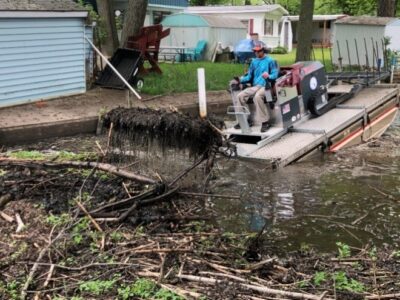
Over the past few weeks invasive curly-leaf pondweed has started its natural die-off, in addition to herbicide treatments of permitted areas on May 25 and early-season harvesting. Those traveling over the I-86 bridge may have noticed that stands of early-season plants prominent in late May and early June now appear to have dropped back in some areas. With the decline of pondweed, as well as increased boat traffic, comes more debris on shorelines. Today is the scheduled start of both the CLA's shoreline cleanup crews as well as the town of Chautauqua's Mobitrac program (throughout the season lake maintenance work is at the mercy of weather conditions due to safety concerns). Shoreline barge crews use manual tools like pitchforks to clear areas of decayed plants and debris. Since 2019, Mobitracs have provided the lake with some additional horsepower for near-shore cleanup. Working alongside CLA equipment, these 'Mobis' can lift around 600 pounds of material on their front forks, and are able to travel on water as well as land. In 2022 the Mobis increased the amount of material they collected by around 50 percent year-over-year to around 1,750 tons. Since they were first deployed four years ago, the Mobis have become a valuable tool to address debris in areas of accumulation like bays and canals. Since 2020 the Mobis and different pieces of CLA equipment have been fitted with GPS, which allows mapping of work over the course of the season.
Coordinating with local municipalities, the Chautauqua Lake Partnership organized an herbicide treatment with ProcellaCOR EC to control Eurasian watermilfoil in Department of Environmental Conservation-permitted areas on June 15. Treatment was performed by Solitude Lake Management in areas of Arnold's Bay (Ellery) and Sherman's Bay (Busti/Lakewood). In addition to the management of established invasive species like curly-leaf and milfoil, more targeted programs are also getting underway to prevent new invasives from taking hold. The Chautauqua Watershed Conservancy reported last week that no water chestnut (or other invasives) were found during its first on-water invasive species survey in the Chadakoin River. Over the last decade isolated populations of water chestnut have been managed by hand removal and monitoring from kayaks and canoes.
See XXX, Page A6
The next volunteer survey paddle is scheduled for Wednesday, June 28 at Ashville Bay, and more information can be found on CWC's website.
Reports on harvesting and shoreline cleanup along with work plans will be posted on CLA's website and Facebook page throughout the maintenance season. CLA also recently hosted its Annual Meeting on June 20 at Chautauqua Institution, which featured presentations by Paul Lord of SUNY Oneonta, Melanie Rooney of Rooney's Aquatic Biologists, and CLA Executive Director Doug Conroe. DEC Region 9 Director Julie Barrett O'Neill served as the evening's guest speaker, and discussed the many different roles and objectives of the DEC with those in attendance. As lake conditions evolve over the course of the summer, so too will these plant management programs. We thank the Alliance members performing this important work, additional stakeholders, and the funders that make it possible.