
Projects Working Around the Clock to Protect Chautauqua Lake
Watershed Moments
Trending
When you head out of your front door in April or May, it usually makes sense to take an umbrella or a raincoat along with you.
Assuming that spring raindrops don't end up messing your hair on a dash to the car, plenty of them make their way into the streams and ditches that wind across Chautauqua County -- and down into the waters of Chautauqua Lake. The journey that this water takes on its way into the lake is something we might not think about very often, but it is a story that matters when it comes time to put on a swim suit or set out on a summer fishing trip.
The watershed -- the area of land that all drains into the same place -- is the lifeblood of our lake. Natural tributaries and human-made drainage systems feed the lake with a diet of water, and plenty of things come along for the ride, like sediment and nutrients. The features of a watershed play a major role in determining water quality and have long-lasting impacts on the issues concerning lake users, like plant and algae growth. The 2010 Chautauqua Lake Watershed Management Plan notes that "The lake is impaired by an excessive inflow of nutrients and sedimentation" and says that "The runoff of nutrients and sedimentation from human activities in the watershed now exceeds the lake's natural capacity to dilute and purify."
A goal of the alliance, its members and other stakeholders is to plan, fund and implement projects in the watershed that improve these conditions.
This is an exciting time for the 100,000-acre watershed, with several projects recently finishing construction while new efforts are in the early stages. Alliance-partnered work in this area stretches back to 2015, when the county was awarded six New York State Consolidated Funding Application grants through the Water Quality Improvement Project program to address streambank stability at eight priority sites. Stream stabilization is a cornerstone of watershed management, as eroded banks and unstable channels cause excess sediment and their associated nutrients to runoff downstream, in addition to causing property loss and potentially damaging infrastructure like roadways.
In order to improve the quality of water moving through these streams, banks can be sloped back and armored with rock and vegetation while in-stream features designed to resist erosion or re-direct streamflow can be installed to help dissipate energy, maintain a more consistent main channel, and stabilize the channel slope. Once stabilized, trees and shrubs such as willow and dogwood are planted along the streambanks, which provide additional stabilization and offer their own water quality benefits. These best management practices were used at sites along Prendergast Creek, Bemus Creek (two sites), Goose Creek, Ball Creek, Dutch Hollow Creek (two sites), and West Dutch Hollow Creek as part of the county's 2015 WQIP grants. Construction on the Dutch Hollow Creek Phase 2 location was completed in the fall of 2021, concluding years of important work at these priority sites.
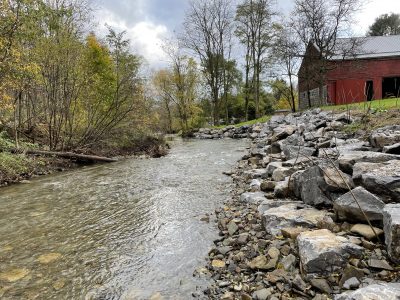
In the picture above, a newly armored section of Dutch Hollow Creek can be seen to the right of the frame. A previously eroded bank being stripped of sediment and encroaching on a nearby barn is now protected with rock and woody plants. These features will be at work improving water quality in the stream and lake for years and years to come, offering gradual improvements that add up to significant benefits in the long run. These projects were funded in part by the Environmental Protection Fund administered by the state DEC and by securing local matching funds, which were provided in part by the county's Occupancy Tax Program for these six grants. The projects stabilized approximately 5,000 linear feet of streambanks across five of Chautauqua Lake's major tributaries. The Chautauqua Watershed Conservancy (CWC) and the Chautauqua County Soil and Water Conservation District played vital roles in these projects.
The Village of Lakewood and Town of Busti completed two new watershed projects in 2021 as well, building off of their 2018 Stormwater Management Engineering Study, which outlined the drainage system, identified issues, and prioritized and recommended solutions. In November, Lakewood welcomed the public to a ribbon cutting ceremony for its Chautauqua Avenue Green Street Retrofit Project, which was funded through the state Environmental Facilities Corporation Green Innovation Grant Program.
Like stream stabilization, green infrastructure is a common technique used to improve water quality. In this case, the goal is to construct human-made surfaces and drainage features that function more like natural surfaces.
'Grey infrastructure' -- like traditional piping or concrete -- is not designed to slow down storm water so that it can be filtered by plants and soil. In contrast, Chautauqua Avenue's three intersections and curb areas are now made from permeable interlocking pavers supported by beds of stone, which allow storm water to filter downwards rather than running directly off and into the lake. The project also includes trenches with 11 new tree plantings, porous pavement tree surrounds, landscaping, signage, new drainage features and curbs. All of these new features were engineered using green infrastructure practices, so that they work in concert to feed the lake a better diet of storm water.
Importantly, they will be silently at work in the background for years and years after construction, just like stream stabilization projects. During just a one-inch rainfall event, the retrofit project area will handle around 34,000 gallons of storm water. Think about how many gallons that is over the course of an entire summer, let alone five or ten years of rainfall.
Construction on the Busti Precision Swale Storm Water Retrofit Project was also completed in the fall of 2021 thanks to a state DEC EPF-funded WQIP grant awarded in 2018. In this case, project leaders focused on a watershed feature that we are all pretty familiar with but probably don't think about unless we get stuck in them -- roadside ditches (sometimes referred to as swales). Ditches convey storm water to streams and eventually the lake but can become eroded over time, resulting in increased sediment and nutrient loading.
Ideally, we want storm water to move more slowly in these swales, which promotes the deposition of suspended sediment and the natural filtration of nutrients. In Busti, 16 locations and around 4,800 total linear feet of swales were identified to construct features such as stone check dams and add deep-rooted vegetation, which help to slow and filter runoff. Grains of nutrient-binding materials, which capture phosphorus and other compounds present in storm water, were also added to swale locations. Over 100 new shrubs and over 500 new native plantings were installed during construction. In total it is estimated that the retrofit will reduce the lake load by 2,264 pounds of nitrogen, 498 pounds of phosphorus, and 120 tons of sediment over the lifetime of the project.
The alliance and our members are now in the process of starting three new watershed projects, which were awarded funding during the 2021 NYSCFA. The Chautauqua Roadside Swales Stabilization Project will target 11 priority sites in the Town of Chautauqua, stabilizing around 16,600 linear feet of ditches. This project will include many of the same techniques that were used in the Busti Swale Retrofit Project. The Ball Creek Stabilization Project aims to improve two severely eroding banks in North Harmony, adding to the stabilization completed on the creek in 2017. The Grandview Stormwater Management Project will construct engineered wetlands in Lakewood, helping to reduce sediment and nutrient runoff in addition to reducing flooding impacts along Route 394. With proper maintenance, projects like these will work to improve the water quality of the lake for years to come.
What we are really talking about with storm water management is the diet of the lake. In many cases, the best thing you can do to improve your personal health is to fix your diet -- start by giving your body more of what it needs and less of what it doesn't. That is the main goal of working in the watershed -- to improve the diet of the lake. If you can improve the quality of what is flowing into the lake, you will see benefits in time. Using different approaches at different locations implemented over several years provides us with an extensive timeline of future benefits.
It doesn't mean that we won't have other challenges to tackle in the short term or even farther down the line, but it is a necessary step in our efforts to address excess sedimentation, nutrient loading, plant growth, and algae growth.