Stow Resident Discusses Role In Creation Of WWII Memorial
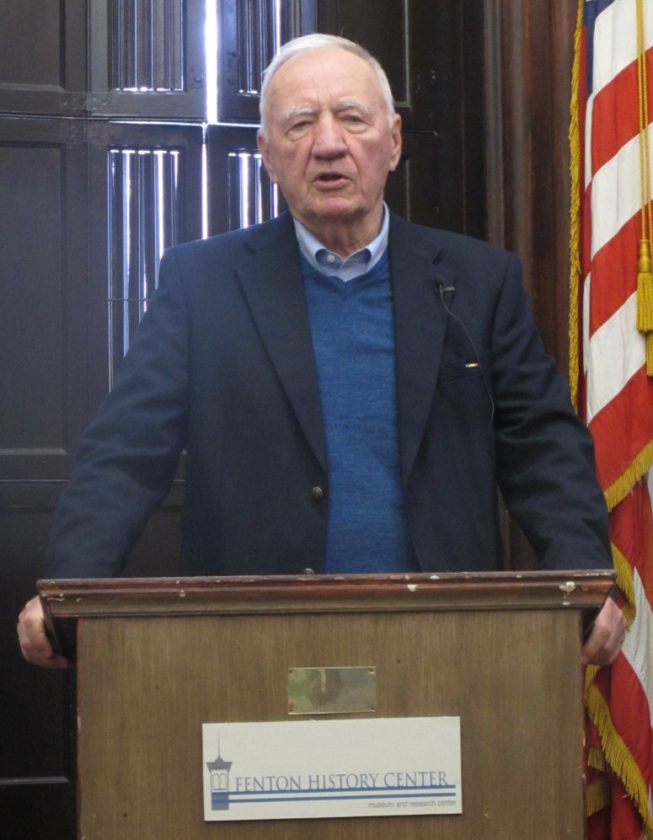
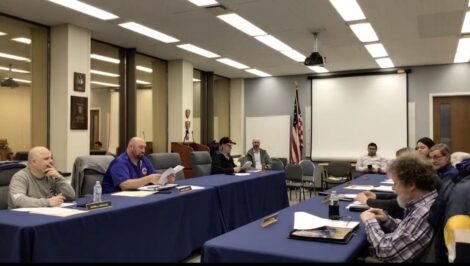
Rolland Kidder speaks during a special lecture at the Fenton History Center Wednesday. P-J photo by Dennis Phillips
Everybody has experienced sitting at home and receiving a phone call. However, few have experienced that same situation and had the White House on the other end of the line.
Well that is what Stow resident Rolland Kidder experienced in 1994. Kidder, former state Assemblyman and Chautauqua County legislator, talked about how he received a call from President Bill Clinton’s administration after advocating to be included in the creation of the World War II Memorial during a special lecture at the Fenton History Center Wednesday.
Kidder said after visiting the Arezzo War Cemetery in Italy in 1992, Kidder wanted to be included on the Memorial Advisory Board to advise the American Battle Monuments Commission on the World War II Memorial.
Kidder was one of 12 members appointed to the Site and Design Committee, who met once a month in Washington, D.C., starting in 1995. He said one of the first steps in the process was selecting the site for the memorial. After considering a few locations, the committee decided they wanted the monument to be located in the Constitution Gardens where the Rainbow Poll was located, Kidder said. After fighting for the location because there was opposition, the committee received the necessary approvals to locate the monument between the Washington and Lincoln memorials.
In 1997, Kidder said there was a national competition to design the memorial. He said there were 406 entries, with the winner of the competition being Friedrich St. Florian, who Kidder said was a graduate of the Rhode Island School of Design.
Kidder said even though they had their design winner, the original design was not approved by the United States Commission of Fine Arts. After some alterations, a new design by St. Florian was approved in 1999.
St. Florian’s design includes two memorial arches, one representing the warfare in the Pacific and Atlantic oceans, each having laurel wreaths suspended in the air with four eagles carrying them. The chandelier sculpture symbolizes the victory of the War with the Nation’s bird carrying a Grecian symbol of victory, but with an American adaptation of oak laurel wreaths to symbolize strength.
Each of the 56 pillars consist of oak laurel and wheat laurel wreaths. The oak symbolizes military and industrial strength, and the wheat symbolizes agricultural and breadbasket during the U.S. part in the war.
Kidder said each of the pillars represents each of the 48 states and eight territories at the time. Hawaii and Alaska were still territories during World War II. He said each pillar is connected by a bronze rope between each to symbolize national togetherness. The memorial also includes more than 4,000 stars representing the more than 400,000 U.S. servicemen who died. He added that he was instrumental in one section of the monument including significant battles of World War II, which were inscribed onto the memorial.
“It was meant to be a celebration of what the country can do if we all pull together,” he said. “It is a tribute to a generation.”
Kidder said he attended the grand opening of the memorial in 2004. He said at first the committee was given $25 million to create the monument. However, by the time they were done the final cost was around $200 million, which was funded through a national fundraiser for the memorial. Kidder said now they are working toward raising money to maintain the memorial.
For more information on the World War II memorial, visit wwiimemorial.com.