Law And Order: Felon Turned Attorney Speaks To Students, Community
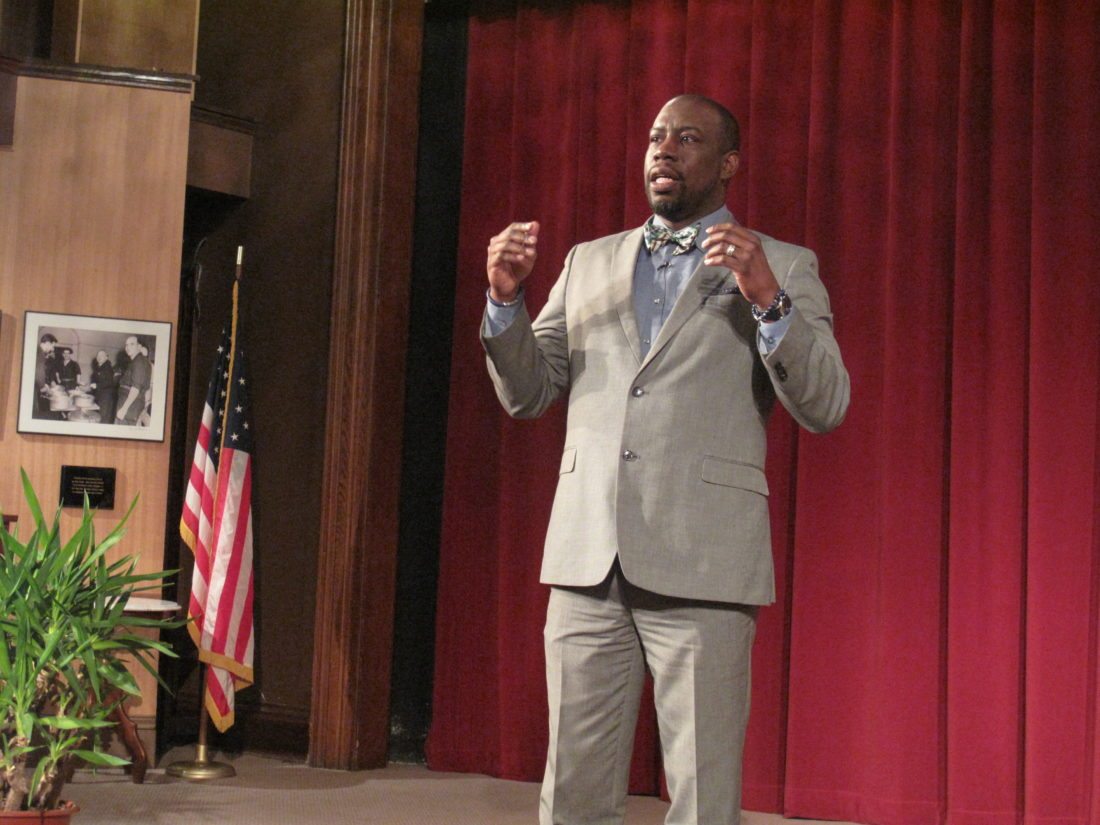
TheArthur A. Duncan II, esq., Buffalo attorney, shared his story with Jamestown High School students and community members. Duncan, a convicted felon, decided after he left prison to become an attorney, and achieved his goal. P-J photo by Katrina Fuller
At first glance, TheArthur A. Duncan’s labels are a paradox: a felon and an attorney.
Yet, Duncan said he remains both as he addressed local students and community members on Friday morning at The Robert H. Jackson Center. Duncan’s tale seemingly encompasses the American “boot-straps” theory of people reaching for their dreams and achieving them with hard work and perseverance.
“Felon-Attorney,” he said. “Which one would you say stands out more? Felon or attorney? I am still both.”
Duncan said he did not get his record sealed or expunged. He remains a felon to this day.
“I came here today to challenge you guys,” he said. “Despite your circumstances, despite what you may go through in life, despite the hurdles and anything that is in your life that may hinder you from seeking things, from peer pressure to people trying to steer you in the wrong direction — I am here to tell you that I went through all those things, and despite all that, I stand in front of you as a licensed attorney.”
Duncan said he is currently working on a trial in Mayville. He said to go from being a person facing and serving time in prison to representing someone facing the same fate is “surreal.”
Born in Los Angeles, California in 1969, Duncan was raised in Buffalo by his grandparents. After eighth grade, he moved back to Los Angeles to live with his mother where he experience gang violence and other such activity first-hand.
“I pretty much hated L.A,” Duncan said. “Every time I would go out to L.A., my mother would be moving around because she was out there by herself. She was all over the place. I hated it out there. I stayed in Buffalo till I was 13.”
He said at that time, he decided to move back out to L.A. to get to know his father.
“So, I go out to L.A., not knowing that in the 80s gang violence in L.A. was at its peak,” he said. “Drugs, this is when the crack epidemic hit L.A., so there was a lot of drug dealing, gang banging and I went out there, a guy from Buffalo, not knowing anything.”
He said his cousin told him he couldn’t wear specific colors because they were associated with rival gangs from the area. Duncan said he lived in a Bloods neighborhood as opposed to a Crips neighborhood, which were two rival gangs in that area. His cousin said someone would hurt him if he wore the wrong color.
“I couldn’t believe that,” Duncan said.
Instead of conforming, Duncan said he fought against the enforced color-coding of clothing. One day, he wore a blue shirt and walked down to the store. Bloods wore red and Crips wore blue.
When he got to the store, there was a group of gang members wearing red. He said they came right up to him, looking him up and down.
“They said, ‘Yo blood, what’s with all that flue?'” he said. “Because they won’t say blue.”
Duncan said he ended up convincing them he had no idea what they were talking about because he was from New York. He said he tried to explain he was from Buffalo, but the gang members thought he was from New York City.
“Then, I see that kind of make them ease back a little bit,” Duncan said. “So, I go into my Brooklyn accent. ‘Yeah, son, I’m from New York, ya know what I mean?'”
He said that allowed him to get away from the gang violence for a little while, but not entirely. Once, when he was on the bus, a gang member pulled a knife on him and told Duncan to give him his Lakers jacket. He ended up giving him the jacket, and his classmates often made fun of him for being mugged.
“The next day in school people we’re coming up to me, talking about ‘Yeah, Tone, give me your jacket,'” he said. “Making a big joke out of it. I’m thinking to myself, ‘How can this be funny?'”
After dealing with an abusive, drug-addicted stepfather, Duncan graduated from high school, and after a brief stint in college, returned to Buffalo.
In Buffalo, he joined a gang and began selling drugs, including crack. He was arrested and pled guilty to federal drug charges, making him a felon with three years in prison.
After leaving prison, Duncan embarked on the path toward becoming a lawyer. Despite being a felon, he attended Erie Community College and the University of Buffalo. He worked 40 hours a week to support his family and attended college at the same time, all in the hopes of becoming an attorney. He put in the time and energy to gain his education, but was not guaranteed a spot as an attorney because of his criminal background.
However, against all odds, he graduated from UB law school in 2012, and passed the New York State Bar Exam in 2013. Duncan currently works as an attorney in Chautauqua County and in Buffalo.
Greg Peterson, co-founder of the Robert H. Jackson Center, said Duncan’s story gives people hope no matter what their circumstances are.
“Here’s a guy who got in with the wrong crowd in Los Angeles and Buffalo, was caught up in a cycle of drugs and law violations,” Peterson said. “He paid his price, he had a vision of what his life could be and actually picked himself up by the bootstraps and did it.”
Through his life story, Peterson said the Bar Association made an exception for Duncan, and he was admitted.
“It’s a remarkable story,” he said. “He’s a model for somebody who may have made a bad decision, that they cannot correct what was wrong in the past, but can move forward in a positive direction. This is the inspiration of TheArthur Duncan.”
Bret Apthorpe, Jamestown Public School District superintendent, said the program was important for Jamestown High School students to see, but was also important for the public as well.
“For our students, (he’s a) real- life role model of somebody who didn’t let life circumstances dictate how their life was to be lived,” he said. “It’s a great example of how resilience and commitment can bring about a better good.”
Local News
First-Degree Attempted Murder Charge Added After Dunkirk Standoff
Paint CHQ effort targets Dunkirk, Bemus Point
Holiday Fun: Bemus Point Easter Egg Hunt Set For Saturday
Trustees Approve Farmers’ Market Return
LAKEWOOD - Trustees recently approved bringing back the Lakewood Farmers’ and Artisans’ Market for ...

Famous Supply Store Opens In Ellicott