
Chautauqua Institution president addresses Jamestown Rotary Club
Trending
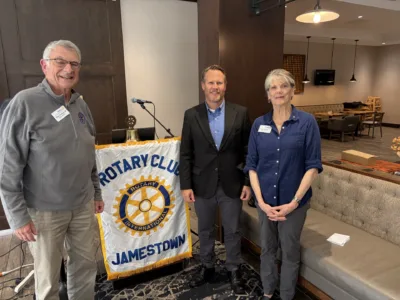
Mark Coolidge Johnson, the 19th president of the Chautauqua Institution, addressed the members of the Rotary Club of Jamestown recently.
Johnson, a senior Foreign Service Officer, attorney and third generation Chautauquan, brings more than three decades of diplomatic service and executive leadership experience to Chautauqua.
Before joining Chautauqua, Johnson served as deputy chief of mission in the U.S. Embassy in Mexico City, the largest American diplomatic mission in the world. In that role, he oversaw more than 3,000 employees, nine consulates and nine consular agencies and managed a $282 million operating budget. He also directed the completion of the embassy's new $943 million facility, which opened in 2025.
A native of Jamestown, Johnson has deep family ties to the Chautauqua Institution. He is the son of the late Joe Johnson, who served as the institution's vice president of finance for 20 years, and the grandson of a Chautauqua grounds engineer. Raised living his summers at Chautauqua, Johnson credits the institution's lectures, arts programming and community life with helping shape his commitment to public service.
Johnson earned a Bachelor of Arts in psychology from Boston College and juris doctor from American University's Washington College of Law.
He and his wife, Sue, reside on the grounds of Chautauqua Institution, and their three adult sons visit frequently.
Johnson began his remarks by asking the group if they were members of the military, first responders, teachers, healthcare providers, coaches, and scout leaders. He indicated he has lived all over the world but his observation is that the United States supports and volunteers more than any other country he is aware of. This is the second Rotary club meeting he has attended; the first one being in Argentina, Johnson said, adding he is amazed at the positivity that groups such as Rotary bring to the region. He feels while much of this is true with the British, Canadians, Irish, Australians and New Zealanders, there is no other country that comes together with such individual excellence in working toward a common good then Americans do.
This is not always so obvious from the outside. In fact, in his opinion, much of what we see in the news about the U.S. is tearing and pulling at strings and starting arguments that are maybe just a difference of opinion. He would like people such as himself and others to realize that the Rotary Clubs in the communities around the country that make up the U.S. are what has and will make the country special. Johnson said the United States is an essential nation. He feels it will take individual effort as we go forward and noted that without left or right orientation.
Johnson is a career diplomat and has worked for Republicans and Democrats, but he believes that regardless of the results of the upcoming election, that sense of community building is incumbent upon the country to take the next step.
He also noted how important it is to be sending exchange students across the globe and welcoming students here so that they can have an experience they will take with them for the rest of their lives.
The new president of Chautauqua spent a lot of time at the institution because of his father's job. He feels the community spirit that instills the desire to want to do something purposeful is so much a part of Chautauqua that it's impossible to separate Chautauqua County and Chautauqua Institution from each other. The values he developed growing up locally and doing community service, such as ringing the bell for the Salvation Army with snow falling, planted the idea of doing community service for something bigger than the 2 hours spent ringing that bell. This is an example of what led him to his career in Foreign Service and kept him there far longer than the five years he originally signed up for. The sense of internal fulfillment was what kept him there for 33 years. He never applied for a job outside the State Department until the Chautauqua opportunity presented itself. He felt it was a perfect fit.
This is also a way to pay it forward with the educational platform, the arts and culture, the religion and recreation.
Johnson said he is still working on his vision for the institution. He wants to hear from the community about their thoughts of where Chautauqua should be? What should the institution look like in the future? What kind of performances and conversations should the institution be having? He wants to hear from Jamestown and Chautauqua County on how the institution can better engage with them and how to make new connections.
Johnson then took questions from the audience.