
City Rotary Club hears presentation on Project Lifesaver
Trending
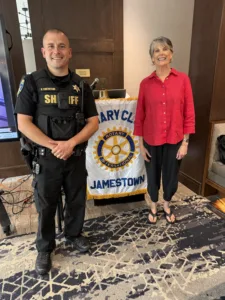
Caitlin O' Reilly, Jamestown Rotary Club president, introduced Chautauqua County Sheriff's Deputy Sgt. Kris Gustafson, who serves as the school resource officer at the Academy at Maple Avenue in Cassadaga and coordinates the county's Project Lifesaver program.
Gustafson has 15 years of law enforcement experience with agencies in Virginia, North Carolina and New York, and is also a major in the United States Army Reserve. He is passionate about serving the community and helping families through programs like Project Lifesaver. Gustafson was accompanied by Officer Phil Lombardo, the Sheriff Office community service sergeant.
The mission of Project Lifesaver is to provide timely responses to save lives for adults and children who wander due to autism, Alzheimer's, traumatic brain injuries or other related cognitive conditions. It is an aid for search and rescue.
Clients are fitted with a bracelet which emits a specific frequency which deputy sheriffs can locate utilizing a special tracking antenna. Chautauqua County Sheriff's office currently has two certified deputy sheriffs who are trained in locating and equipping clients with these special bracelets. The client and family will be interviewed by the program deputy, and the deputy will be permanently assigned to the client and will be responsible for battery installation and technical issues.
The task of searching for wandering or lost individuals can be enormous. Without effective procedures and equipment, searches can involve multiple agencies, hundreds of officers and volunteers, countless man hours and thousands of dollars. Because time is of the essence, every minute lost increases the risk of a tragic outcome. Project Lifesaver is an important tool for these professionals.
The radio transmitter can work as a wristwatch or on the ankle. The transmitter constantly emits a signal (which the wearer doesn't hear). It can be tracked regardless of where the person has wandered - even into a densely wooded area, a marsh, a concrete structure such as a garage, or a building constructed with steel. When a loved one goes missing, caregivers notify locally trained agencies, and they are dispatched to the wanderer's area, and the average rescue time remains around 30 minutes.
The battery must be changed every month and tested every day. The kit comes complete with the correct batteries for one year. A kit that contains the wrist/leg device and all the equipment needed for its operation costs $400. A transmitter costs $1,500 and has a range of approximately one mile depending on topography. The sheriff's department currently has two or three transmitters and has more on order.