Martz Observatory To Host Discussion Wednesday
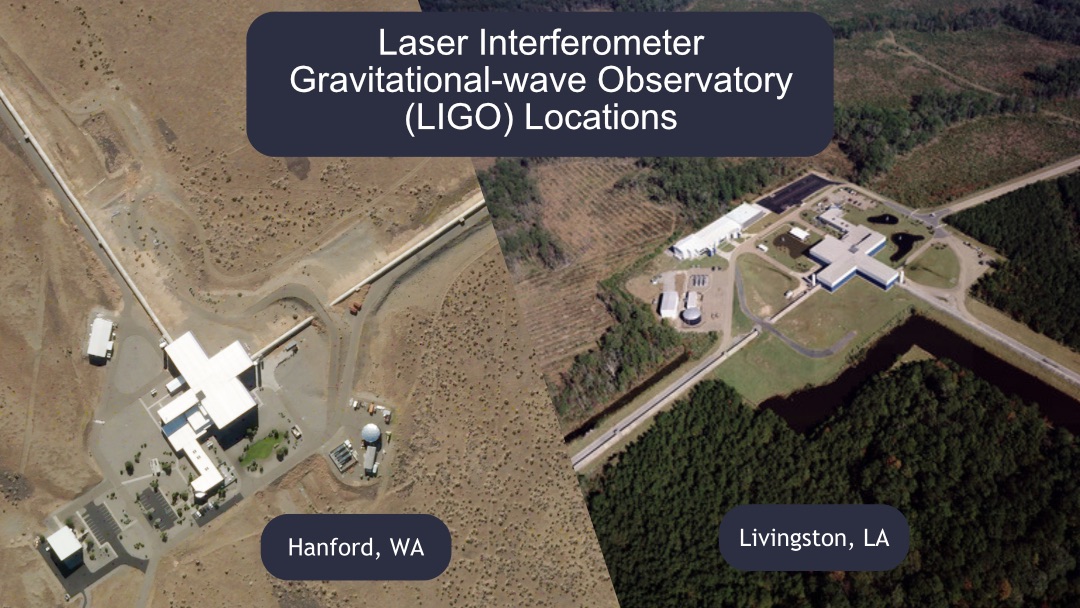
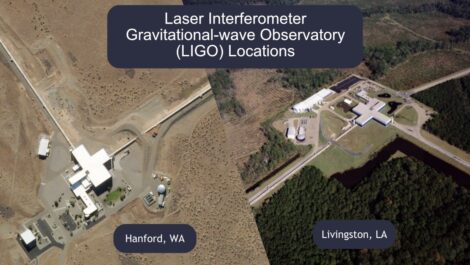
This composite image submitted by the Martz-Kohl Observatory shows the Laser Interferometer Gravitational-Wave Observatory locations in Louisiana and the state of Washington. The 2015 detection by LIGO, a joint venture between Caltech and MIT, provided the first direct evidence for Einstein’s General Theory of Relativity, specifically confirming the existence of gravitational waves.
FREWSBURG – The Martz-Kohl Observatory will host a presentation April 15 by Keith Thorne, who will discuss the collision of black holes and the “shudders” those collisions create.
To capture these faint whispers from the deep cosmos, the NSF Laser Interferometer Gravitational-wave Observatory (LIGO) utilizes colossal laser detectors in Washington and Louisiana. The instruments are so sensitive they can detect movements smaller than the width of an atom. After a decade of refining the technology, LIGO made history in 2015 by detecting a collision from 1.3 billion light-years away, forever changing how man explores the deepest mysteries of the universe.
Thorne will speak at 7:30 p.m. Wednesday, April 15, via Zoom. Thorne is a research physicist who was at the heart of the astronomical breakthroughs. After earning his doctorate at Fermilab, Thorne joined the LIGO collaboration in 2003 and eventually led the real-time controls and computing groups at the Livingston, La., observatory. His technical leadership helped detect gravitational waves and the system upgrades that followed through 2024. Now retired in Wellsboro, Pa., Thorne remains a pillar of the local astronomical community through his work with asteroid occultation observations.
The interactive session will be broadcast on the observatory’s big screen at the Martz-Kohl Observatory and is also available to join online via Zoom. Observatory officials encourage those interested to join in person at the observatory to virtually meet Thorne and participate in the observatory’s question-and-answer session following the talk. If the weather permits, the group will conclude the evening with guided tours and viewing opportunities through the observatory’s telescopes. Those attending should dress for the elements; while the classroom is heated the observatory domes are not.
For more information and the Zoom link, visit: martzobservatory.org
Community
JBGC Honors February Youth Of Month
Jamestown Duo Facing Drugs, Weapons Charges
A pair of Jamestown men are facing federal drugs and weapons charges. On Thursday, U.S. Attorney Michael ...

Senses Come Alive In Spring
Jamestown Police Department’s SWAT Team Receives Federal Grant
The Jamestown Police Department has been awarded $75,000 through the Tactical Team Grant Program to support its ...

Brookdale Chicken, Biscuit Dinner To Benefit Jamestown Kiwanis Club